Calorie restriction, reducing calorie intake without causing malnutrition, has long been studied for its effects on metabolism, aging, and overall health. Scientists have observed that lowering calorie intake can influence many biological pathways, but the underlying molecular mechanisms are still being explored.
In new research led by researchers at the University of Aberdeen, investigators examined how calorie restriction affects a process called alternative splicing.
Alternative splicing is a natural process that allows a single gene to produce multiple versions of RNA and protein. By rearranging how segments of RNA are joined together, cells can create different protein variants from the same gene. This process helps cells adapt to changing conditions and regulate complex biological systems.
The researchers investigated how short term calorie restriction influences alternative splicing across multiple tissues in the body. Rather than affecting a single organ, the results showed that splicing patterns change in a coordinated way across different tissues.
Using RNA sequencing, the team analyzed gene activity and RNA processing patterns in several tissues. The analysis revealed that calorie restriction triggers a cross tissue splicing program, meaning that multiple organs adjust RNA processing in a connected and integrated way.
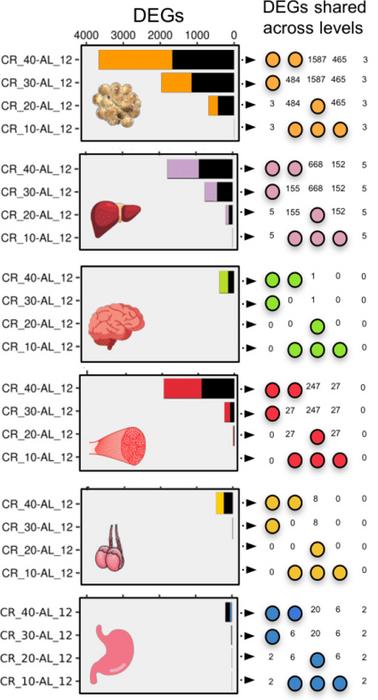
Differential gene expression analysis of male C57BL/6 mice exposed to graded levels (10%−40%) of short-term (3 months) CR compared to mice fed a control diet of AL feeding for 12 h (AL12) each day.
This coordinated response suggests that the body does not regulate calorie restriction effects independently in each tissue. Instead, it appears to use shared regulatory signals that influence gene expression and RNA splicing throughout the organism.
The findings also suggest that alternative splicing may be an important mechanism linking metabolism with systemic physiological changes during dietary restriction. By altering which RNA variants are produced, cells may fine tune protein function to help adapt to reduced energy intake.
Understanding how RNA processing changes during calorie restriction may provide new insight into metabolic regulation, aging, and disease processes. As RNA sequencing technologies continue to improve, researchers will be able to explore these complex regulatory networks in greater detail.


Calorie restriction, reducing calorie intake without causing malnutrition, has long been studied for its effects on metabolism, aging, and overall health. Scientists have observed that lowering calorie intake can influence many biological pathways, but the underlying molecular mechanisms are still being explored.
In new research led by researchers at the University of Aberdeen, investigators examined how calorie restriction affects a process called alternative splicing.
Alternative splicing is a natural process that allows a single gene to produce multiple versions of RNA and protein. By rearranging how segments of RNA are joined together, cells can create different protein variants from the same gene. This process helps cells adapt to changing conditions and regulate complex biological systems.
The researchers investigated how short term calorie restriction influences alternative splicing across multiple tissues in the body. Rather than affecting a single organ, the results showed that splicing patterns change in a coordinated way across different tissues.
Using RNA sequencing, the team analyzed gene activity and RNA processing patterns in several tissues. The analysis revealed that calorie restriction triggers a cross tissue splicing program, meaning that multiple organs adjust RNA processing in a connected and integrated way.
Differential gene expression analysis of male C57BL/6 mice exposed to graded levels (10%−40%) of short-term (3 months) CR compared to mice fed a control diet of AL feeding for 12 h (AL12) each day.
This coordinated response suggests that the body does not regulate calorie restriction effects independently in each tissue. Instead, it appears to use shared regulatory signals that influence gene expression and RNA splicing throughout the organism.
The findings also suggest that alternative splicing may be an important mechanism linking metabolism with systemic physiological changes during dietary restriction. By altering which RNA variants are produced, cells may fine tune protein function to help adapt to reduced energy intake.
Understanding how RNA processing changes during calorie restriction may provide new insight into metabolic regulation, aging, and disease processes. As RNA sequencing technologies continue to improve, researchers will be able to explore these complex regulatory networks in greater detail.
Phillips D P, Mitchell S E, Derous D, Speakman J R. (2026) A functionally integrated cross-tissue alternative splicing program during short-term calorie restriction. Life Metabolism [Epub ahead of print]. [article]
Related Posts
RNAmel simplifies RNA sequencing data analysis with a reproducible, integrated platform
Heart failure reshapes bone marrow to create inflammation-related immune memory
Overlooked DNA regions surrounding ‘microexons’ hold missing pieces of autism’s genetic puzzle
RiboBA improves detection of hidden protein-coding regions using ribosome profiling
An anti-senescence gene may fight spinal disc deterioration
Scientists identify the neuroblastoma cells that signal poor outcomes
Novel biosensor uses DNA ‘barcodes’ to uncover disease signals in cells
CellART extracts single-cell information from high-resolution spatial transcriptomics
Cell2space restores spatial context to single-cell RNA sequencing data
Urine test may improve bladder cancer diagnosis and guide treatment decisions
DeCoRE – a computational method to resolve RNA structural heterogeneity from RNA structure probing data by direct RNA sequencing
Tracing 700 million years of cell evolution
How should biological replicates be handled in long-read RNA sequencing?
RNA-Seq reveals a new way the developing heart controls its growth
The Human RNome Project Consortium seeks to publish first-ever complete sequence of the body’s RNA
scFlowReport brings multiple single-cell RNA sequencing analyses into one workflow
Long-read RNA sequencing reveals how neurons choose alternative RNA endings
DeOPUS improves cell-type estimates from bulk RNA sequencing
ResolVI improves accuracy in spatial transcriptomics analysis
RNA sequencing reveals transcriptional allele differences in prostate cancer stem cells
Stay Connected
Submit a Post to the Blog
Recent Posts
Subscribe to the RNA-Seq Blog
RNA-Seq Products & Services