

Single cell RNA sequencing has become one of the most powerful tools in modern biology. It allows researchers to measure gene activity in individual cells, helping scientists understand cell types, developmental processes, and disease mechanisms. However, current single cell RNA sequencing methods have important limitations.
Most widely used approaches only detect about 10 to 40 percent of all RNA molecules inside a cell. In addition, many high throughput methods focus on the ends of transcripts, usually the untranslated regions. This means researchers often miss information located in the middle of RNA molecules, including regions that may contain mutations, splice variants, or regulatory elements.
Researchers from the University of Zurich carefully examine the sources of bias in single cell RNA sequencing workflows. These biases can arise during cell capture, RNA extraction, reverse transcription, amplification, and library preparation. Each step can influence which transcripts are detected and which are missed.
The researchers then explore targeted sequencing strategies designed to overcome these limitations. Rather than sequencing all RNA molecules equally, targeted approaches focus on specific genes or regions of interest. The review groups these strategies into five categories, based on which step of the protocol they modify or improve.
Main steps in 3′/5′-based scRNA-seq experiments and biases affecting each step
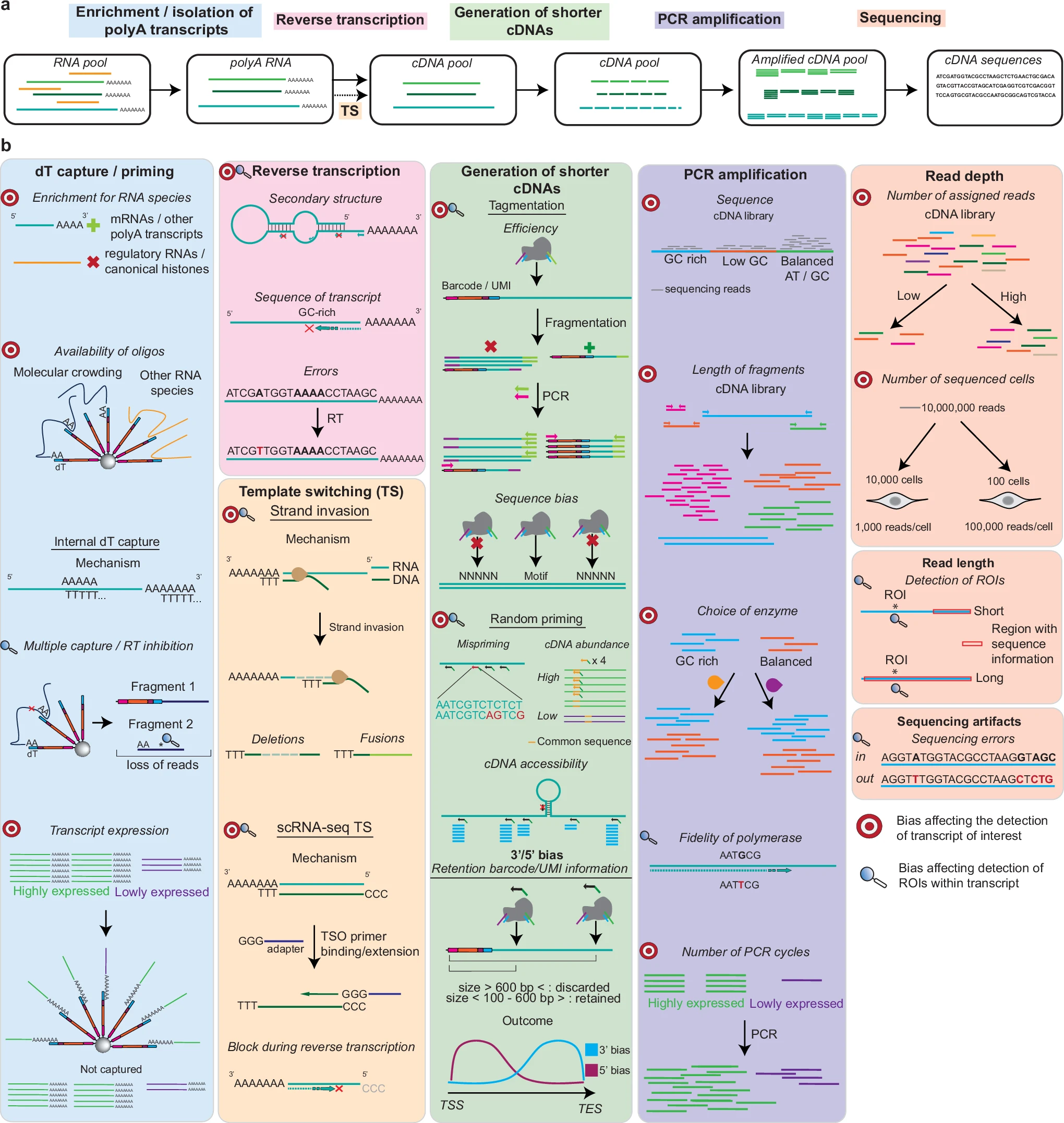
a Most scRNA-seq experiments start with enrichment for polyadenylated transcripts through dT-based capture or priming. RNAs are then converted into cDNAs through reverse transcription, which may include a template switching (TS) reaction. Shorter cDNAs suited for short-read sequencing are then generated, followed by PCR amplification and sequencing. Note: the order of the steps outlined at the top of the figure may vary between scRNA-seq protocols. b Bullseyes indicate biases which affect detection of TOIs, while magnifying glasses indicate issues in detecting ROIs. Biases affecting ROI detection are only considered as such if the detection of TOIs is not affected. scRNA-seq TS refers to the reaction in which the terminal transferase activity adds untemplated Cs at the end of the template, followed by recognition by a TSO primer with a complementary stretch of Gs and subsequent extension to generate a second strand.
Some methods enrich for selected transcripts before sequencing. Others improve amplification efficiency for low abundance genes. Still others are designed to capture internal regions of transcripts that are typically overlooked by standard end focused protocols. Each strategy comes with tradeoffs in cost, complexity, scalability, and resolution.
To help researchers choose the most appropriate method, the authors provide a practical decision tree. This guide considers factors such as the biological question, the number of cells being analyzed, the importance of detecting rare transcripts, and whether internal transcript regions are critical for the study.
By clearly outlining the strengths and weaknesses of available targeted technologies, this review offers a roadmap for improving data quality in single cell RNA sequencing experiments. For researchers studying gene regulation, alternative splicing, mutations, or low abundance transcripts, selecting the right targeted approach can make the difference between missing key signals and uncovering meaningful biological insights.
As single cell technologies continue to evolve, thoughtful experimental design will remain essential. Understanding the biases inherent in RNA sequencing and knowing how to address them allows scientists to extract more complete and accurate information from individual cells.
Moro G, Brunner E, Basler K. (2026) A practical guide to targeted single-cell RNA sequencing technologies. Communications Biology 9(1): 250. [article]
Related Posts


Single cell RNA sequencing has become one of the most powerful tools in modern biology. It allows researchers to measure gene activity in individual cells, helping scientists understand cell types, developmental processes, and disease mechanisms. However, current single cell RNA sequencing methods have important limitations.
Most widely used approaches only detect about 10 to 40 percent of all RNA molecules inside a cell. In addition, many high throughput methods focus on the ends of transcripts, usually the untranslated regions. This means researchers often miss information located in the middle of RNA molecules, including regions that may contain mutations, splice variants, or regulatory elements.
Researchers from the University of Zurich carefully examine the sources of bias in single cell RNA sequencing workflows. These biases can arise during cell capture, RNA extraction, reverse transcription, amplification, and library preparation. Each step can influence which transcripts are detected and which are missed.
The researchers then explore targeted sequencing strategies designed to overcome these limitations. Rather than sequencing all RNA molecules equally, targeted approaches focus on specific genes or regions of interest. The review groups these strategies into five categories, based on which step of the protocol they modify or improve.
Main steps in 3′/5′-based scRNA-seq experiments and biases affecting each step
a Most scRNA-seq experiments start with enrichment for polyadenylated transcripts through dT-based capture or priming. RNAs are then converted into cDNAs through reverse transcription, which may include a template switching (TS) reaction. Shorter cDNAs suited for short-read sequencing are then generated, followed by PCR amplification and sequencing. Note: the order of the steps outlined at the top of the figure may vary between scRNA-seq protocols. b Bullseyes indicate biases which affect detection of TOIs, while magnifying glasses indicate issues in detecting ROIs. Biases affecting ROI detection are only considered as such if the detection of TOIs is not affected. scRNA-seq TS refers to the reaction in which the terminal transferase activity adds untemplated Cs at the end of the template, followed by recognition by a TSO primer with a complementary stretch of Gs and subsequent extension to generate a second strand.
Some methods enrich for selected transcripts before sequencing. Others improve amplification efficiency for low abundance genes. Still others are designed to capture internal regions of transcripts that are typically overlooked by standard end focused protocols. Each strategy comes with tradeoffs in cost, complexity, scalability, and resolution.
To help researchers choose the most appropriate method, the authors provide a practical decision tree. This guide considers factors such as the biological question, the number of cells being analyzed, the importance of detecting rare transcripts, and whether internal transcript regions are critical for the study.
By clearly outlining the strengths and weaknesses of available targeted technologies, this review offers a roadmap for improving data quality in single cell RNA sequencing experiments. For researchers studying gene regulation, alternative splicing, mutations, or low abundance transcripts, selecting the right targeted approach can make the difference between missing key signals and uncovering meaningful biological insights.
As single cell technologies continue to evolve, thoughtful experimental design will remain essential. Understanding the biases inherent in RNA sequencing and knowing how to address them allows scientists to extract more complete and accurate information from individual cells.
Moro G, Brunner E, Basler K. (2026) A practical guide to targeted single-cell RNA sequencing technologies. Communications Biology 9(1): 250. [article]
Related Posts
Recent Posts
 Scientists identify the neuroblastoma cells that signal poor outcomes
 GARAGE improves rare cell detection in single-cell RNA sequencing analysis using AI
 Machine learning reveals how RNA splicing is regulated in individual cell types
 Illumina releases SpliceAI2 to help advance rare disease research
 Postdoctoral Fellow – Long-Read RNA Methods Development for Neurodegeneration
 Novel biosensor uses DNA ‘barcodes’ to uncover disease signals in cells
RNA-Seq Products & Services



Stay Connected