

Planning an RNA sequencing (RNA-Seq) experiment is one of the most crucial steps in any genomics research project. While RNA-Seq has become a standard method for studying gene expression, designing a successful experiment requires thoughtful planning, technical understanding, and clear analysis goals. In a recent commentary researchers from the Morehouse School of Medicine shared practical insights into the major technical and analytical considerations that researchers should keep in mind before beginning an RNA-Seq study.
RNA sequencing enables scientists to capture and measure RNA molecules within a sample, providing a snapshot of which genes are active and to what extent. This technology has advanced our understanding of cellular processes, disease mechanisms, and therapeutic responses. Compared with microarrays, which can only measure known genes, RNA-Seq allows researchers to discover previously uncharacterized transcripts, detect gene fusions, and study complex events such as alternative splicing. These advantages make RNA-Seq an indispensable tool in modern molecular biology and biomedical research.
However, as the researchers pointed out, RNA-Seq is not as simple as pressing “start” on a sequencer. The technique measures relative levels of RNA within a sample, not absolute numbers of transcripts. This means that the data must be carefully normalized and interpreted within context, especially when comparing results across different conditions or tissue types. Understanding this principle helps avoid common pitfalls in data interpretation and ensures that findings reflect true biological differences rather than technical variation.
The researchers highlight several stages of experimental planning that can dramatically impact data quality and interpretation. The first is library preparation, which involves converting RNA molecules into a form compatible with sequencing. Different methods can bias the results toward certain RNA types, so selecting an approach appropriate for the biological question is critical. For example, some protocols enrich for messenger RNA (mRNA), while others retain small RNAs or non-coding transcripts.
RNA-Seq library building methods, using unstranded or stranded approaches
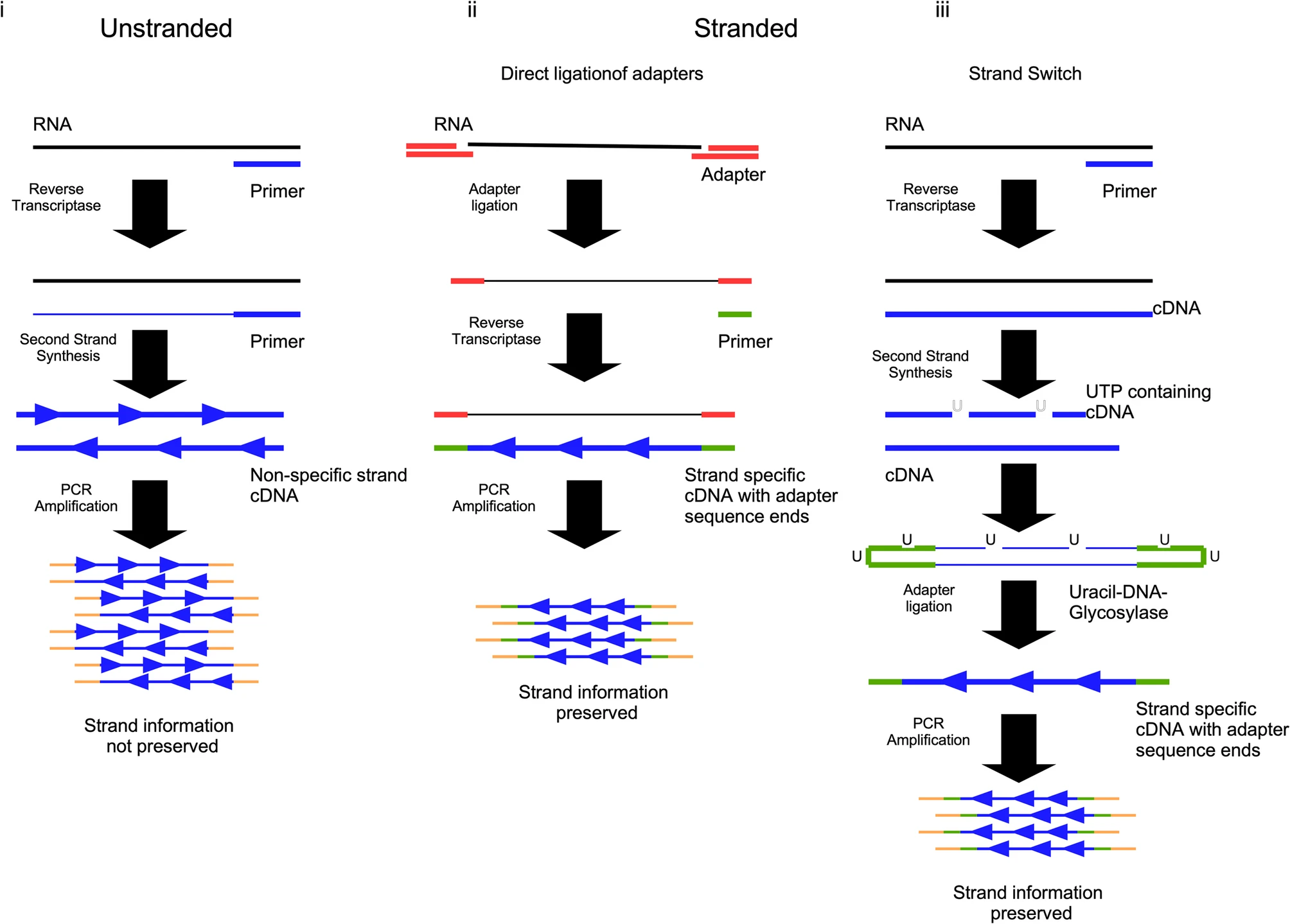
The basic principle of building an RNA seq library is to reverse transcribe fragmented RNA into cDNA, create a second strand, and then amplify using PCR. i) For an unstranded library the PCR reaction is performed following ligation of non-directional adapters containing primer sequences specific for a given platform. ii) Applied Biosystems released a stranded RNA-Seq Library building assay, whereby following fragmentation adapters are Ligated directly to the RNA, and the 3’ adapter was used for priming the RT step. The adapters also include sequences complementary to primers for barcoding and amplification. iii) A second approach utilizes a hexamer RT step of fragmented RNA, followed by a polymerase-mediated second strand synthesis using UTP. The adapters are ligated to the cDNA hybrid, and then the second strand is degraded by a UTP glycosylase, leaving the first strand available for targeted PCR
Another key step is RNA depletion, particularly when studying samples rich in ribosomal RNA (rRNA), which can dominate the sequencing reads if not removed. The authors discuss how depletion techniques such as rRNA subtraction or poly-A selection can improve the efficiency of sequencing and increase the sensitivity for low-abundance transcripts.
Beyond laboratory techniques, data analysis represents another major source of variability. The researchers emphasize that researchers should plan their computational strategy before generating data. Choices such as read alignment tools, normalization methods, and differential expression algorithms can all influence the results. Close collaboration between experimental biologists and bioinformaticians is therefore essential to ensure consistency and reproducibility.
Finally, the researchers discuss cost considerations. RNA sequencing projects can vary widely in expense depending on sequencing depth, sample size, and platform selection. While it may be tempting to minimize costs by reducing read depth or replicates, doing so can compromise statistical power and limit the ability to detect biologically meaningful changes. Balancing budget with scientific objectives is a crucial step in experimental design.
Taken together, the commentary serves as both a technical guide and a conceptual framework for anyone embarking on RNA-Seq research. It reminds scientists that careful planning, from RNA extraction to computational analysis, determines the reliability and interpretability of the final data. By understanding these factors in advance, researchers can design experiments that produce robust, reproducible, and insightful results.
Verma R, Savaria-Butler A, Enguita FJ, Meller R. (2025) Commentary: a review of technical considerations for planning an RNA sequencing experiment. BMC Genomics 26(1):918. [article]
Related Posts


Planning an RNA sequencing (RNA-Seq) experiment is one of the most crucial steps in any genomics research project. While RNA-Seq has become a standard method for studying gene expression, designing a successful experiment requires thoughtful planning, technical understanding, and clear analysis goals. In a recent commentary researchers from the Morehouse School of Medicine shared practical insights into the major technical and analytical considerations that researchers should keep in mind before beginning an RNA-Seq study.
RNA sequencing enables scientists to capture and measure RNA molecules within a sample, providing a snapshot of which genes are active and to what extent. This technology has advanced our understanding of cellular processes, disease mechanisms, and therapeutic responses. Compared with microarrays, which can only measure known genes, RNA-Seq allows researchers to discover previously uncharacterized transcripts, detect gene fusions, and study complex events such as alternative splicing. These advantages make RNA-Seq an indispensable tool in modern molecular biology and biomedical research.
However, as the researchers pointed out, RNA-Seq is not as simple as pressing “start” on a sequencer. The technique measures relative levels of RNA within a sample, not absolute numbers of transcripts. This means that the data must be carefully normalized and interpreted within context, especially when comparing results across different conditions or tissue types. Understanding this principle helps avoid common pitfalls in data interpretation and ensures that findings reflect true biological differences rather than technical variation.
The researchers highlight several stages of experimental planning that can dramatically impact data quality and interpretation. The first is library preparation, which involves converting RNA molecules into a form compatible with sequencing. Different methods can bias the results toward certain RNA types, so selecting an approach appropriate for the biological question is critical. For example, some protocols enrich for messenger RNA (mRNA), while others retain small RNAs or non-coding transcripts.
RNA-Seq library building methods, using unstranded or stranded approaches
The basic principle of building an RNA seq library is to reverse transcribe fragmented RNA into cDNA, create a second strand, and then amplify using PCR. i) For an unstranded library the PCR reaction is performed following ligation of non-directional adapters containing primer sequences specific for a given platform. ii) Applied Biosystems released a stranded RNA-Seq Library building assay, whereby following fragmentation adapters are Ligated directly to the RNA, and the 3’ adapter was used for priming the RT step. The adapters also include sequences complementary to primers for barcoding and amplification. iii) A second approach utilizes a hexamer RT step of fragmented RNA, followed by a polymerase-mediated second strand synthesis using UTP. The adapters are ligated to the cDNA hybrid, and then the second strand is degraded by a UTP glycosylase, leaving the first strand available for targeted PCR
Another key step is RNA depletion, particularly when studying samples rich in ribosomal RNA (rRNA), which can dominate the sequencing reads if not removed. The authors discuss how depletion techniques such as rRNA subtraction or poly-A selection can improve the efficiency of sequencing and increase the sensitivity for low-abundance transcripts.
Beyond laboratory techniques, data analysis represents another major source of variability. The researchers emphasize that researchers should plan their computational strategy before generating data. Choices such as read alignment tools, normalization methods, and differential expression algorithms can all influence the results. Close collaboration between experimental biologists and bioinformaticians is therefore essential to ensure consistency and reproducibility.
Finally, the researchers discuss cost considerations. RNA sequencing projects can vary widely in expense depending on sequencing depth, sample size, and platform selection. While it may be tempting to minimize costs by reducing read depth or replicates, doing so can compromise statistical power and limit the ability to detect biologically meaningful changes. Balancing budget with scientific objectives is a crucial step in experimental design.
Taken together, the commentary serves as both a technical guide and a conceptual framework for anyone embarking on RNA-Seq research. It reminds scientists that careful planning, from RNA extraction to computational analysis, determines the reliability and interpretability of the final data. By understanding these factors in advance, researchers can design experiments that produce robust, reproducible, and insightful results.
Verma R, Savaria-Butler A, Enguita FJ, Meller R. (2025) Commentary: a review of technical considerations for planning an RNA sequencing experiment. BMC Genomics 26(1):918. [article]
Related Posts
Recent Posts
 Scientists identify the neuroblastoma cells that signal poor outcomes
 GARAGE improves rare cell detection in single-cell RNA sequencing analysis using AI
 Machine learning reveals how RNA splicing is regulated in individual cell types
 Illumina releases SpliceAI2 to help advance rare disease research
 Postdoctoral Fellow – Long-Read RNA Methods Development for Neurodegeneration
 Novel biosensor uses DNA ‘barcodes’ to uncover disease signals in cells
RNA-Seq Products & Services


Stay Connected