
When genes are “expressed,” it is like reading an instruction manual to create things the body needs – such as proteins or RNA. It is an incredibly important process in regulating normal cellular functions. Understanding more about gene expression can reveal insights into the biological processes behind different conditions.
One of those conditions we desperately need to learn more about is autism spectrum disorder (ASD), which is a neurodevelopmental condition characterized by difficulties in social communication, alongside restricted or repetitive patterns of behavior and interests. Epidemiological studies have linked advanced paternal age to an increased risk of ASD in offspring. However, the mechanisms underlying this association remain poorly understood.
Theorizing that gene expression may reveal key clues about the link between paternal age and ASD risk, a research team from the Department of Developmental Neuroscience at Tohoku University Graduate School of Medicine investigated gene expression in the brains of mouse embryos conceived from young (3-month-old) or aged (19-month-old) fathers. They found that the effects of paternal aging on gene expression in the embryonic brain may differ between the sexes. Notably, female embryos conceived by aged fathers exhibited a distinct gene expression profile and a tendency toward increased gene expression levels. These findings provide a foundation for investigating how paternal aging may influence early brain development in a sex-dependent manner.
Overview of this study
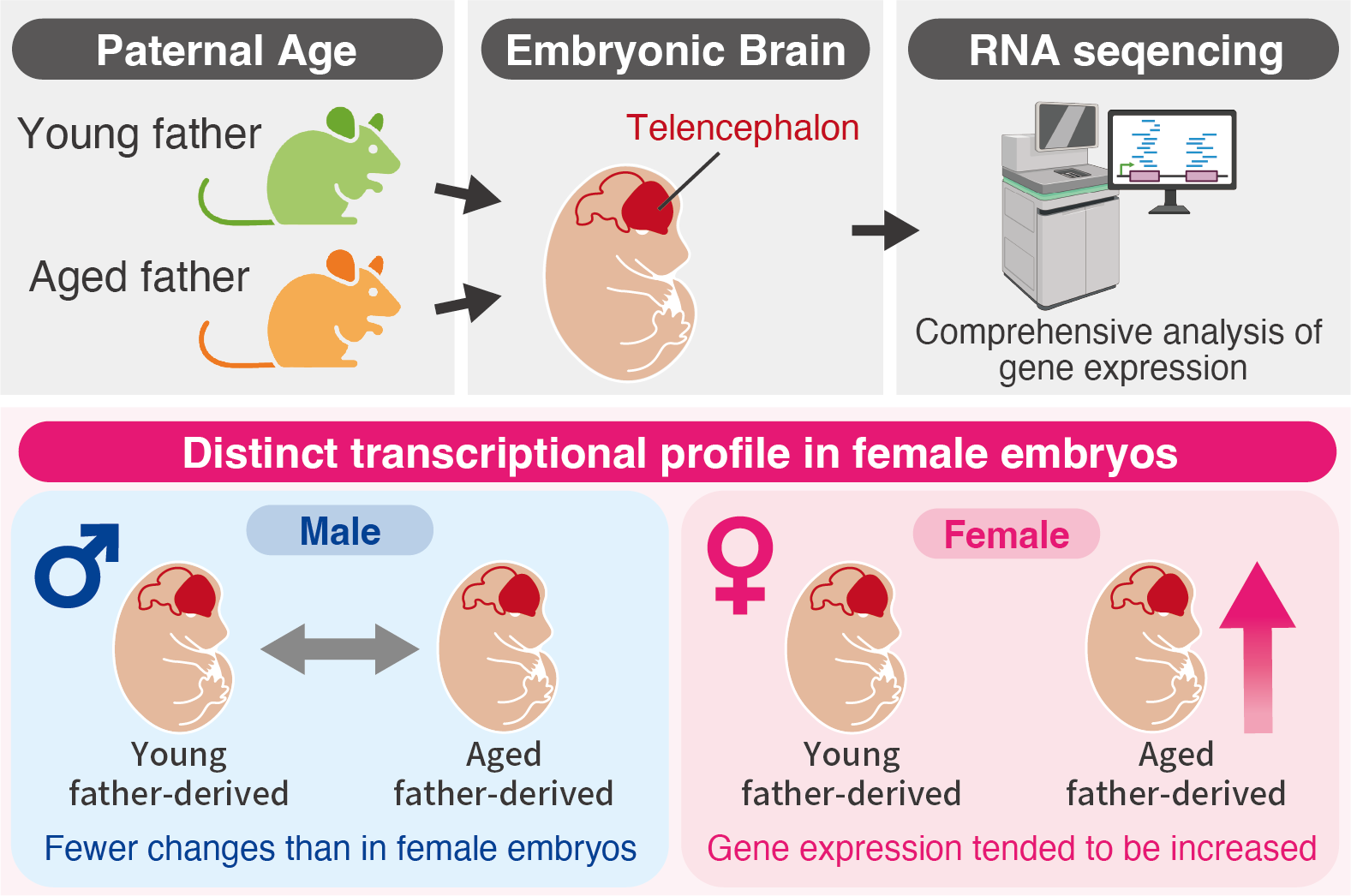
Using RNA sequencing, the team analyzed the telencephalon (the region that gives rise to structures including the cerebral cortex), examining male and female embryos separately. Because the embryonic brain undergoes rapid cell proliferation and differentiation, even small differences in developmental stage can influence gene expression. They selected embryos whose estimated developmental stages, assessed based on limb morphology, fell within a window of approximately 4 hours, reducing this source of variability and enabling a more precise assessment.
The analysis revealed differences in embryonic brain gene expression associated with both paternal age and embryo sex. Notably, female embryos conceived by aged fathers exhibited a distinct gene expression profile, and showed increased gene expression levels.
“Since there are marked gender differences in ASD – with men developing the condition at a much higher rate than women – research on women has been lacking until now,” explains Noriko Osumi (Tohoku University). “This is why studies like these examining sex-dependent biological processes could reveal important pathways and interactions.”
While the results cannot explicitly say whether these sex-dependent differences directly increase the risk of ASD or not, the dataset provides a resource for investigating how paternal aging may influence early brain development in males and females. In future studies, the team plans to investigate how the genes and gene sets showing altered expression in this study may be linked to ASD and other conditions, and how these transcriptional changes may relate to health, development, and behavior after birth. Integrating these data with other ASD-related datasets may help clarify the molecular pathways linking paternal age, brain development, and sex differences in ASD.
Source – Tohoku University


When genes are “expressed,” it is like reading an instruction manual to create things the body needs – such as proteins or RNA. It is an incredibly important process in regulating normal cellular functions. Understanding more about gene expression can reveal insights into the biological processes behind different conditions.
One of those conditions we desperately need to learn more about is autism spectrum disorder (ASD), which is a neurodevelopmental condition characterized by difficulties in social communication, alongside restricted or repetitive patterns of behavior and interests. Epidemiological studies have linked advanced paternal age to an increased risk of ASD in offspring. However, the mechanisms underlying this association remain poorly understood.
Theorizing that gene expression may reveal key clues about the link between paternal age and ASD risk, a research team from the Department of Developmental Neuroscience at Tohoku University Graduate School of Medicine investigated gene expression in the brains of mouse embryos conceived from young (3-month-old) or aged (19-month-old) fathers. They found that the effects of paternal aging on gene expression in the embryonic brain may differ between the sexes. Notably, female embryos conceived by aged fathers exhibited a distinct gene expression profile and a tendency toward increased gene expression levels. These findings provide a foundation for investigating how paternal aging may influence early brain development in a sex-dependent manner.
Overview of this study
Using RNA sequencing, the team analyzed the telencephalon (the region that gives rise to structures including the cerebral cortex), examining male and female embryos separately. Because the embryonic brain undergoes rapid cell proliferation and differentiation, even small differences in developmental stage can influence gene expression. They selected embryos whose estimated developmental stages, assessed based on limb morphology, fell within a window of approximately 4 hours, reducing this source of variability and enabling a more precise assessment.
The analysis revealed differences in embryonic brain gene expression associated with both paternal age and embryo sex. Notably, female embryos conceived by aged fathers exhibited a distinct gene expression profile, and showed increased gene expression levels.
While the results cannot explicitly say whether these sex-dependent differences directly increase the risk of ASD or not, the dataset provides a resource for investigating how paternal aging may influence early brain development in males and females. In future studies, the team plans to investigate how the genes and gene sets showing altered expression in this study may be linked to ASD and other conditions, and how these transcriptional changes may relate to health, development, and behavior after birth. Integrating these data with other ASD-related datasets may help clarify the molecular pathways linking paternal age, brain development, and sex differences in ASD.
Source – Tohoku University
Endo H, Kikkawa T, Osumi N. (2026) A transcriptomic dataset of embryonic mouse telencephalon revealing sex-dependent effects of advanced paternal age. Scientific Data [Epub ahead of print]. [article]
Related Posts
UMIche – a UMI-centric analysis platform for enhancing molecular quantification accuracy in bulk and single-cell sequencing
New RNA sequencing tool reveals how stem cells develop into heart cells
Estimating the completeness of large-scale single-cell sequencing projects
New RNA sequencing tool improves transcriptome reconstruction using machine learning
DeMixNB: deconvolution of sparse-count RNA sequencing data for tumor cells
New RNA sequencing method improves tRNA analysis using deep learning
Researchers create first whole-body single-cell atlas of an adult vertebrate
UAlbany Joins $10 Million Effort to Map RNA Modifications in the Human Body
SpliceCOV improves RNA sequencing analysis by filtering transcriptional noise
Overlooked ‘off switch’ in lung tumors may explain why immunotherapy doesn’t work for everyone
Squids Edit RNA for Novel Protein Functions
New marker panel and web tool help define early human cell fates
RNA sequencing reveals molecular changes driving right ventricular heart failure
Researchers Develop AI Tool to Map MicroRNA Binding Sites on Circular RNAs
Single-cell RNA sequencing reveals the diversity of human neutrophils across health and disease
Yale researchers improve RNA extraction from precision-cut lung slices
RNA sequencing reveals how genes combine to regulate inflammation and immune responses
RNAffinityDB – a curated database of experimental RNA–protein binding affinities
“Raman Genome” for SARS-CoV-2: new Raman technology distinguishes viral variants by their molecular RNA architecture
Exercise is good for us—but why?
Stay Connected
Submit a Post to the Blog
Recent Posts
Subscribe to the RNA-Seq Blog
RNA-Seq Products & Services