

The testis is one of the most transcriptionally active tissues in the human body, meaning it expresses more genes than any other organ. Because of this, it provides a valuable way to study how aging impacts gene regulation. Thanks to single-cell RNA sequencing, scientists can now look at how individual cells in the testis change as organisms age, and they can compare these changes across species.
Researchers from Nantong University have developed a new online tool called Aging-TCA. This platform contains testicular single-cell and spatial transcriptome data from humans, cynomolgus monkeys, mice, and zebrafish, covering 89 samples and over 460,000 cells, nuclei, or tissue spots.
Overview of Aging-TCA datasets and online tools
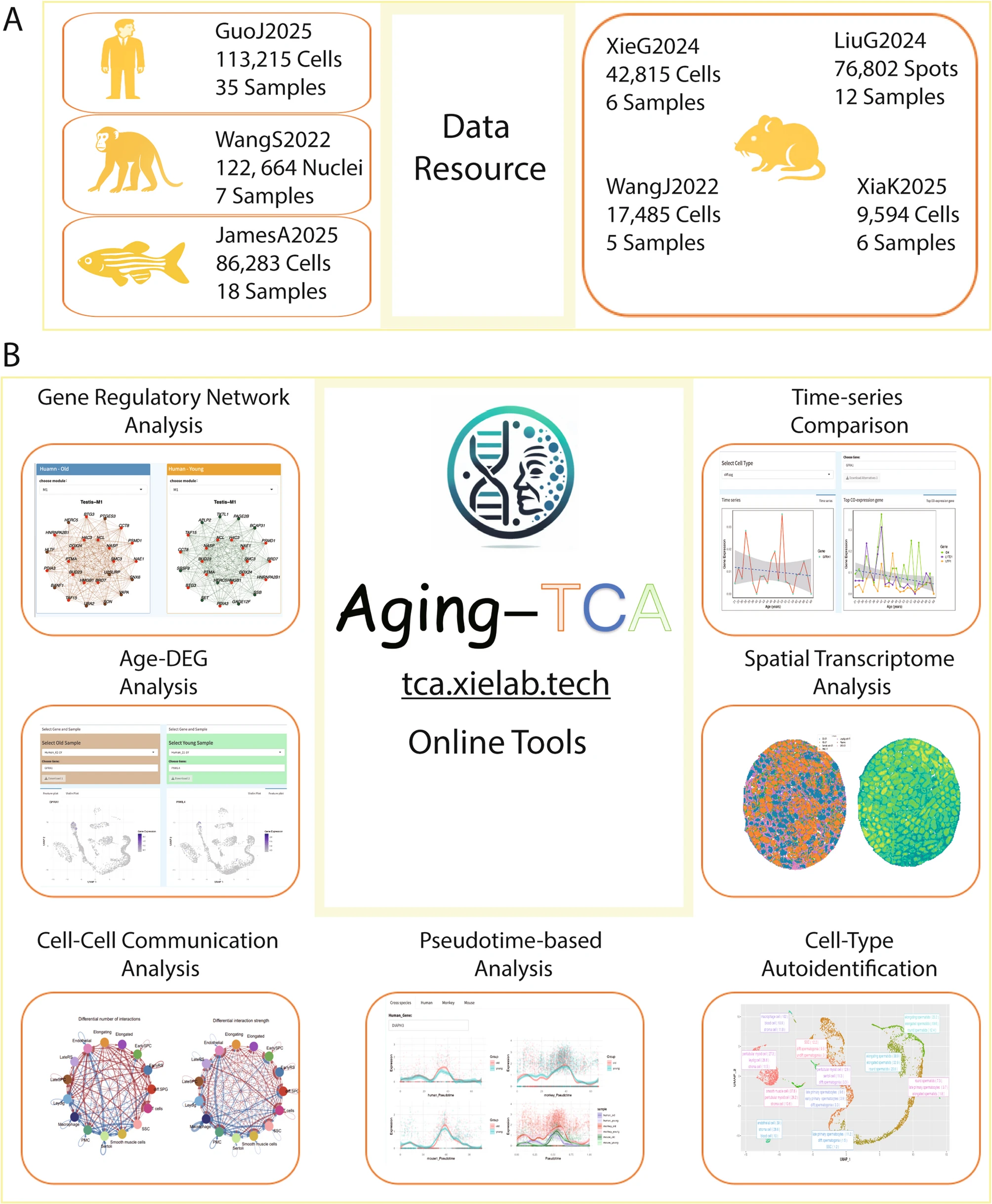
A Data resource of Aging-TCA. B Online tools of Aging-TCA
Aging-TCA gives scientists many ways to study testicular aging. It allows them to visualize gene expression patterns, explore how cells communicate with each other, trace how cells develop over time, and even compare spatial organization of cells across species. The platform also includes tools for identifying different testicular cell types and analyzing gene regulatory networks, offering researchers a comprehensive resource for studying the biology of aging.
By combining single-cell and spatial transcriptomic data across multiple species, Aging-TCA opens the door to new insights into how aging shapes reproductive biology, while also providing a critical foundation for future cross-species studies of gene regulation.
Availability – Aging-TCA (Aging-related Testicular Cell Atlas is available at http://tca.xielab.tech/
Lu Z, Zhang Z, Cao L, Xie G. (2025) Aging-TCA, a cross-species single-cell transcriptomic atlas for studying testicular aging. BMC Genomics 26(1): 857. [article]
Related Posts




The testis is one of the most transcriptionally active tissues in the human body, meaning it expresses more genes than any other organ. Because of this, it provides a valuable way to study how aging impacts gene regulation. Thanks to single-cell RNA sequencing, scientists can now look at how individual cells in the testis change as organisms age, and they can compare these changes across species.
Researchers from Nantong University have developed a new online tool called Aging-TCA. This platform contains testicular single-cell and spatial transcriptome data from humans, cynomolgus monkeys, mice, and zebrafish, covering 89 samples and over 460,000 cells, nuclei, or tissue spots.
Overview of Aging-TCA datasets and online tools
A Data resource of Aging-TCA. B Online tools of Aging-TCA
Aging-TCA gives scientists many ways to study testicular aging. It allows them to visualize gene expression patterns, explore how cells communicate with each other, trace how cells develop over time, and even compare spatial organization of cells across species. The platform also includes tools for identifying different testicular cell types and analyzing gene regulatory networks, offering researchers a comprehensive resource for studying the biology of aging.
By combining single-cell and spatial transcriptomic data across multiple species, Aging-TCA opens the door to new insights into how aging shapes reproductive biology, while also providing a critical foundation for future cross-species studies of gene regulation.
Availability – Aging-TCA (Aging-related Testicular Cell Atlas is available at http://tca.xielab.tech/
Lu Z, Zhang Z, Cao L, Xie G. (2025) Aging-TCA, a cross-species single-cell transcriptomic atlas for studying testicular aging. BMC Genomics 26(1): 857. [article]
Related Posts
Recent Posts
 Scientists identify the neuroblastoma cells that signal poor outcomes
 GARAGE improves rare cell detection in single-cell RNA sequencing analysis using AI
 Machine learning reveals how RNA splicing is regulated in individual cell types
 Illumina releases SpliceAI2 to help advance rare disease research
 Postdoctoral Fellow – Long-Read RNA Methods Development for Neurodegeneration
 Novel biosensor uses DNA ‘barcodes’ to uncover disease signals in cells
RNA-Seq Products & Services


Stay Connected