Identification of sub-categories of the disease linked to gene expression also sheds light on why current treatments may fail.
A new major finding in how genes are linked to psoriasis could help offer tailored treatments for the common inflammatory condition, helping to treat the most stubborn and severe cases.
Psoriasis is a common inflammatory skin disease, with 1 in 50 people in the UK affected in some form. Despite its links to several long-term health conditions, such as heart disease and Type 2 diabetes, and the substantial impact severe psoriasis has on sufferers’ quality of life, little is known about the causes of inflammatory and autoimmune diseases like it. This includes ailments like rheumatoid arthritis, lupus and Crohn’s disease.
Because of this lack of understanding, current, high-cost treatment options such as biologics can fail for no visible reason – impacting patients and placing severe cost on the NHS.
By using advanced Machine Learning, researchers from King’s, Newcastle University, and Queen Mary University of London, have identified several sub-types of the disease based on how someone’s genes impact psoriasis severity. This classification will give clinicians a better idea of why current treatments may fail and open the door to more personalised ones.
Summary of study design, including patient recruitment, sample collection and analysis methodology
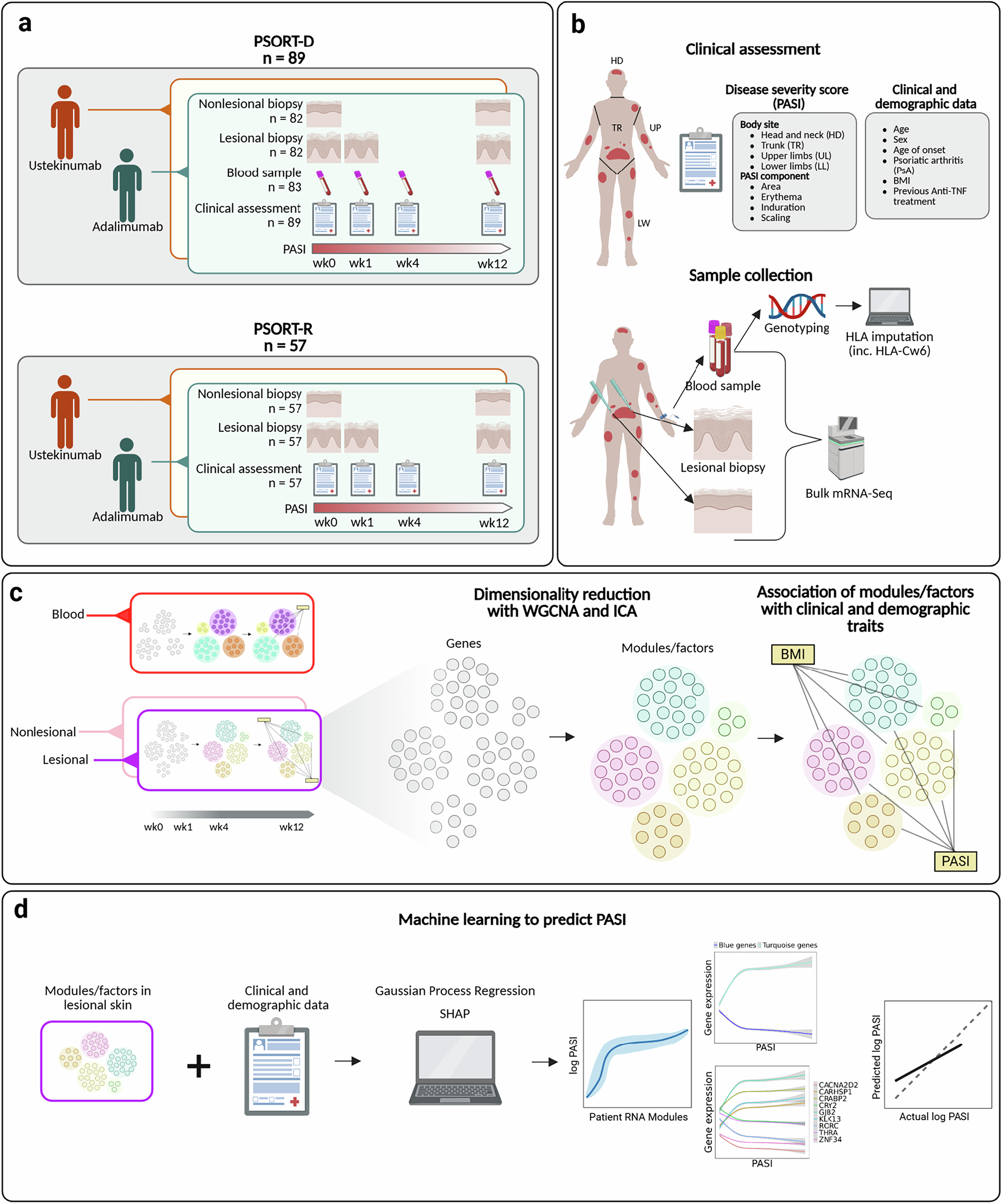
a, b Participants with moderate-to-severe psoriasis eligible for biologic therapy were enroled into discovery (PSORT-D, n = 89) and replication (PSORT-R, n = 57) cohorts and treated with either adalimumab or ustekinumab. At baseline and follow-up visits (weeks 0, 1, 4 and 12), lesional kin, nonlesional-skin and peripheral blood samples were collected, and PASI scores obtained. c To discover disease endotypes, we applied two complementary dimension-reduction methods separately to skin and blood RNA-seq data. Weighted Gene Co-expression Network Analysis (WGCNA) groups transcripts with similar expression into modules and represents each module by its first principal component (the module eigengene). Independent Component Analysis (ICA) decomposes the dataset into statistically independent latent factors that capture underlying biological signals. Eigengenes and latent factors were correlated with clinical traits (e.g. BMI, HLA-C*06:02 genotype) and with PASI across time-points to reveal both baseline (disease) and disease-severity signatures. d Finally, we trained a Gaussian Process Regression (GPR) model—a flexible non-linear machine learning approach—using eigengenes and latent factors to predict log-transformed PASI. Model interpretability was provided by SHAP (SHapley Additive exPlanations), which quantifies the contribution of each module or factor for example to the prediction, allowing derivation of a concise gene signature of disease severity. PASI Psoriasis Area and Severity Index, BMI body-mass index, LS lesional skin, NLS non-lesional skin, WGCNA weighted gene co-expression network analysis, ICA independent component analysis, GPR Gaussian Process Regression, SHAP SHapley Additive exPlanations.
Dr David Watson, Lecturer in Artificial Intelligence and joint first author of the study said, “Diseases that present the same are often completely different. Breast cancer for example is not one, but a thousand different diseases all under the same label. To be able to develop targeted treatments you need to understand how all these different diseases work, or risk ‘fat-fingered’ interventions like chemotherapy which can have large side effects.
“Until now, we didn’t have that with psoriasis. But by using RNA sequencing and AI modelling, we can now categorise how genes affect the trajectory of psoriasis and group the disease into several sub-types as a prerequisite for better treatment – helping better deal with the most severe cases.”
Analysing 700 plus blood samples from over 140 patients with moderate to severe psoriasis over an extended period, the team mapped how genes interfaced both individually and in evolving networks with other biological factors, like BMI, to impact disease severity against common biologic treatments.
They identified a nine-gene biomarker linked to psoriasis severity, along with specific genetic variants associated with more severe baseline disease. They also found a 14-gene signature connected to BMI in unaffected skin and to disease severity in affected skin displaying lesions.
In the future, the researchers hope to take they have learned from the gene expression involved in this inflammatory disease and apply it to others.
Dr Watson said “There are many immune mediated inflammatory diseases, like rheumatoid arthritis and Crohn’s. And while they present differently, we know they are genetically linked – having one increases the risk of passing another to your kids.
“This is a complex world and by figuring out how genes influence the path of one inflammatory disease, we hope to take this learning and apply it to a host of different diseases and see how they materialise in patients. If we can categorise the gene expression there too, we could potentially design personalised treatments for all these ailments which plague patients and cost our healthcare system millions.”
Source – King’s College London


Identification of sub-categories of the disease linked to gene expression also sheds light on why current treatments may fail.
A new major finding in how genes are linked to psoriasis could help offer tailored treatments for the common inflammatory condition, helping to treat the most stubborn and severe cases.
Psoriasis is a common inflammatory skin disease, with 1 in 50 people in the UK affected in some form. Despite its links to several long-term health conditions, such as heart disease and Type 2 diabetes, and the substantial impact severe psoriasis has on sufferers’ quality of life, little is known about the causes of inflammatory and autoimmune diseases like it. This includes ailments like rheumatoid arthritis, lupus and Crohn’s disease.
Because of this lack of understanding, current, high-cost treatment options such as biologics can fail for no visible reason – impacting patients and placing severe cost on the NHS.
By using advanced Machine Learning, researchers from King’s, Newcastle University, and Queen Mary University of London, have identified several sub-types of the disease based on how someone’s genes impact psoriasis severity. This classification will give clinicians a better idea of why current treatments may fail and open the door to more personalised ones.
Summary of study design, including patient recruitment, sample collection and analysis methodology
a, b Participants with moderate-to-severe psoriasis eligible for biologic therapy were enroled into discovery (PSORT-D, n = 89) and replication (PSORT-R, n = 57) cohorts and treated with either adalimumab or ustekinumab. At baseline and follow-up visits (weeks 0, 1, 4 and 12), lesional kin, nonlesional-skin and peripheral blood samples were collected, and PASI scores obtained. c To discover disease endotypes, we applied two complementary dimension-reduction methods separately to skin and blood RNA-seq data. Weighted Gene Co-expression Network Analysis (WGCNA) groups transcripts with similar expression into modules and represents each module by its first principal component (the module eigengene). Independent Component Analysis (ICA) decomposes the dataset into statistically independent latent factors that capture underlying biological signals. Eigengenes and latent factors were correlated with clinical traits (e.g. BMI, HLA-C*06:02 genotype) and with PASI across time-points to reveal both baseline (disease) and disease-severity signatures. d Finally, we trained a Gaussian Process Regression (GPR) model—a flexible non-linear machine learning approach—using eigengenes and latent factors to predict log-transformed PASI. Model interpretability was provided by SHAP (SHapley Additive exPlanations), which quantifies the contribution of each module or factor for example to the prediction, allowing derivation of a concise gene signature of disease severity. PASI Psoriasis Area and Severity Index, BMI body-mass index, LS lesional skin, NLS non-lesional skin, WGCNA weighted gene co-expression network analysis, ICA independent component analysis, GPR Gaussian Process Regression, SHAP SHapley Additive exPlanations.
Dr David Watson, Lecturer in Artificial Intelligence and joint first author of the study said, “Diseases that present the same are often completely different. Breast cancer for example is not one, but a thousand different diseases all under the same label. To be able to develop targeted treatments you need to understand how all these different diseases work, or risk ‘fat-fingered’ interventions like chemotherapy which can have large side effects.
Analysing 700 plus blood samples from over 140 patients with moderate to severe psoriasis over an extended period, the team mapped how genes interfaced both individually and in evolving networks with other biological factors, like BMI, to impact disease severity against common biologic treatments.
They identified a nine-gene biomarker linked to psoriasis severity, along with specific genetic variants associated with more severe baseline disease. They also found a 14-gene signature connected to BMI in unaffected skin and to disease severity in affected skin displaying lesions.
In the future, the researchers hope to take they have learned from the gene expression involved in this inflammatory disease and apply it to others.
Source – King’s College London
Rider A, Grantham HJ, Smith GR, Watson DS, Casement J, Cockell SJ, Gisby J, Foulkes AC, Henkin R, Iqbal WA, Ewen T, Amarnath S, Ng S, Zuliani P, Dand N, Stocken D, Traini C, Thomas E, Kalyana-Sundaram S, Rajpal DK, Smith KM, Barker JN, Griffiths CEM, Di Meglio P, Smith CH, Warren RB, Barnes MR, Reynolds NJ; PSORT consortium. (2026) Transcriptomic profiling and machine learning uncover gene signatures of psoriasis endotypes and disease severity. Communications Medicine 6(1): 65. [article]
Related Posts
Scientists identify the neuroblastoma cells that signal poor outcomes
Novel biosensor uses DNA ‘barcodes’ to uncover disease signals in cells
CellART extracts single-cell information from high-resolution spatial transcriptomics
Cell2space restores spatial context to single-cell RNA sequencing data
Urine test may improve bladder cancer diagnosis and guide treatment decisions
DeCoRE – a computational method to resolve RNA structural heterogeneity from RNA structure probing data by direct RNA sequencing
Tracing 700 million years of cell evolution
How should biological replicates be handled in long-read RNA sequencing?
RNA-Seq reveals a new way the developing heart controls its growth
The Human RNome Project Consortium seeks to publish first-ever complete sequence of the body’s RNA
scFlowReport brings multiple single-cell RNA sequencing analyses into one workflow
Long-read RNA sequencing reveals how neurons choose alternative RNA endings
DeOPUS improves cell-type estimates from bulk RNA sequencing
ResolVI improves accuracy in spatial transcriptomics analysis
RNA sequencing reveals transcriptional allele differences in prostate cancer stem cells
Unmasking “zombie cells” in aging tissue with an AI-powered barcode
RNA variant imaging for cancer diagnosis
Autism-risk mutations reveal two opposing patterns of brain gene activity
A real-data approach to evaluating RNA transcript analysis methods
Detection and sequencing of Ap2N-capped RNAs in human cells
Stay Connected
Submit a Post to the Blog
Recent Posts
Subscribe to the RNA-Seq Blog
RNA-Seq Products & Services