

Understanding how genes interact and regulate each other at the cellular level is essential for uncovering the mechanisms behind development, disease, and treatment responses. Researchers from the Wenzhou University of Technology have developed AnomalGRN, a novel artificial intelligence (AI)-based tool designed to improve the accuracy of single-cell gene regulatory network (GRN) analysis.
Single-cell RNA sequencing (scRNA-seq) allows scientists to study how genes are expressed in individual cells, revealing complex gene regulatory interactions. However, analyzing these networks is challenging due to noisy data and imbalanced relationships—some gene interactions are well-documented (positive links), while others remain poorly understood (negative links). Traditional deep learning approaches struggle with these issues, making it difficult to uncover hidden gene relationships accurately.
To tackle these challenges, the researchers developed AnomalGRN, an innovative model that applies graph anomaly detection (GAD)—a technique used to identify unusual patterns in large datasets. Instead of treating gene regulation as a simple link prediction problem, AnomalGRN reframes it as a node prediction task by representing gene pairs as network nodes. This approach enhances the model’s ability to distinguish between true regulatory interactions and random noise.
The proposed AnomalGRN architecture includes four main modules
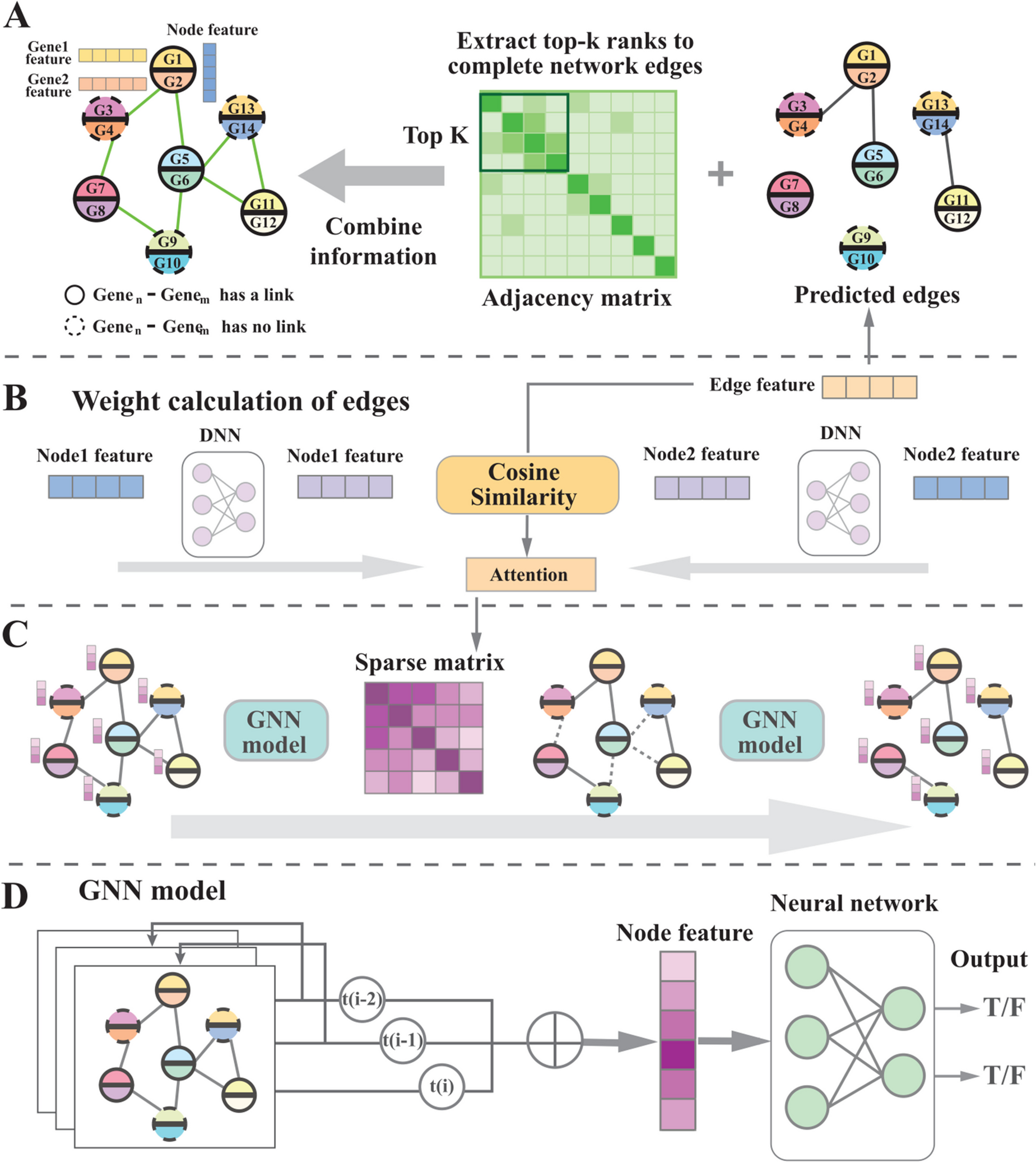
A task transformation to construct a reconstructed GRN, B weight reconstruction, C an overview of the entire process, and D integration of outputs from multi-layer GNNs to extract node features and make predictions
A key feature of AnomalGRN is its use of graph structure sparsification, which filters out irrelevant data to refine gene interaction networks. Additionally, the model applies a cosine metric rule, allowing it to differentiate between similar (homogeneous) and distinct (heterogeneous) gene interactions, improving prediction accuracy.
By leveraging AI and anomaly detection techniques, AnomalGRN provides a more precise and scalable method for mapping gene regulatory networks. This breakthrough could accelerate discoveries in fields such as cancer research, regenerative medicine, and personalized therapies by offering a clearer picture of how genes function within individual cells.
With AnomalGRN, these researchers have introduced a powerful computational tool that advances single-cell RNA sequencing analysis. As AI continues to revolutionize genomics, approaches like this could unlock new insights into gene regulation, helping researchers develop targeted treatments and novel therapies.
Availability – code is publicly available in the GitHub repository: https://github.com/ZZCrazy00/AnomalGRN,
Zhou Z, Wei J, Liu M, et al. (2025) AnomalGRN: deciphering single-cell gene regulation network with graph anomaly detection. BMC Biol [Epub ahead of print]. [article]
Related Posts






Understanding how genes interact and regulate each other at the cellular level is essential for uncovering the mechanisms behind development, disease, and treatment responses. Researchers from the Wenzhou University of Technology have developed AnomalGRN, a novel artificial intelligence (AI)-based tool designed to improve the accuracy of single-cell gene regulatory network (GRN) analysis.
Single-cell RNA sequencing (scRNA-seq) allows scientists to study how genes are expressed in individual cells, revealing complex gene regulatory interactions. However, analyzing these networks is challenging due to noisy data and imbalanced relationships—some gene interactions are well-documented (positive links), while others remain poorly understood (negative links). Traditional deep learning approaches struggle with these issues, making it difficult to uncover hidden gene relationships accurately.
To tackle these challenges, the researchers developed AnomalGRN, an innovative model that applies graph anomaly detection (GAD)—a technique used to identify unusual patterns in large datasets. Instead of treating gene regulation as a simple link prediction problem, AnomalGRN reframes it as a node prediction task by representing gene pairs as network nodes. This approach enhances the model’s ability to distinguish between true regulatory interactions and random noise.
The proposed AnomalGRN architecture includes four main modules
A task transformation to construct a reconstructed GRN, B weight reconstruction, C an overview of the entire process, and D integration of outputs from multi-layer GNNs to extract node features and make predictions
A key feature of AnomalGRN is its use of graph structure sparsification, which filters out irrelevant data to refine gene interaction networks. Additionally, the model applies a cosine metric rule, allowing it to differentiate between similar (homogeneous) and distinct (heterogeneous) gene interactions, improving prediction accuracy.
By leveraging AI and anomaly detection techniques, AnomalGRN provides a more precise and scalable method for mapping gene regulatory networks. This breakthrough could accelerate discoveries in fields such as cancer research, regenerative medicine, and personalized therapies by offering a clearer picture of how genes function within individual cells.
With AnomalGRN, these researchers have introduced a powerful computational tool that advances single-cell RNA sequencing analysis. As AI continues to revolutionize genomics, approaches like this could unlock new insights into gene regulation, helping researchers develop targeted treatments and novel therapies.
Availability – code is publicly available in the GitHub repository: https://github.com/ZZCrazy00/AnomalGRN,
Zhou Z, Wei J, Liu M, et al. (2025) AnomalGRN: deciphering single-cell gene regulation network with graph anomaly detection. BMC Biol [Epub ahead of print]. [article]
Related Posts
Recent Posts
 Machine learning reveals how RNA splicing is regulated in individual cell types
 Illumina releases SpliceAI2 to help advance rare disease research
 Postdoctoral Fellow – Long-Read RNA Methods Development for Neurodegeneration
 Novel biosensor uses DNA ‘barcodes’ to uncover disease signals in cells
 GP-DHT uses single-cell RNA sequencing to map gene regulatory networks
 Boehringer taps Envisagenics’ AI to mine RNA splicing for cancer targets
RNA-Seq Products & Services


Stay Connected