Analysis of more than 1,000 mouse brain transcriptomes identifies shared molecular patterns that vary with sex and respond differently to experimental drug exposure
Autism spectrum disorder (ASD) is associated with more than 1,200 risk genes, raising a fundamental question: Do these diverse genetic changes affect the brain in entirely different ways, or do they converge on shared biological mechanisms?
A research team led by Professor KIM Eunjoon of the Center for Synaptic Brain Dysfunctions within the Institute for Basic Science (IBS) has identified two opposing patterns of brain gene activity across mice carrying different autism-risk mutations. By analyzing more than 1,000 mouse brain transcriptomes, the researchers found that genetically distinct models could be grouped according to shared molecular changes, offering a new framework for investigating autism-related mechanisms and responses to experimental drugs.
The two groups showed opposite changes in genes involved in communication between nerve cells and the regulation of gene activity. Their molecular responses to fluoxetine and lithium also differed, suggesting that these patterns could help researchers compare drug effects across genetically diverse mouse models.
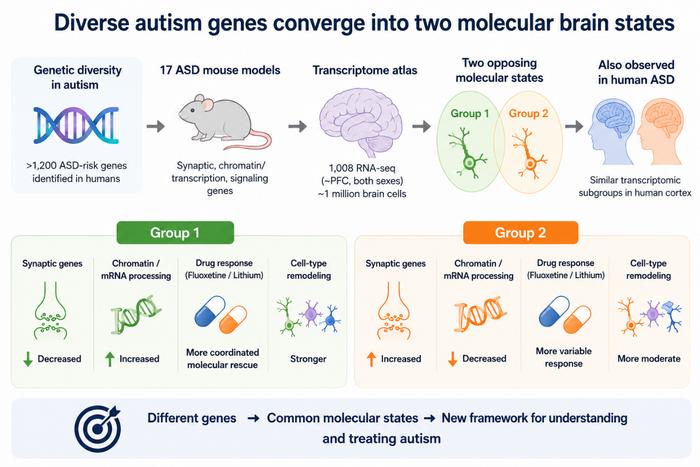
Transcriptomic profiling of 17 ASD mouse models representing over 1,200 human autism-risk genes, combined with single-cell RNA sequencing of approximately one million brain cells, identified two opposing molecular brain states despite diverse genetic etiologies. Group 1 showed reduced synaptic gene expression, increased chromatin and mRNA-processing programs, more consistent molecular responses to fluoxetine and lithium, and stronger cell-type remodeling, whereas Group 2 displayed the opposite molecular profile, more variable drug responses, and more moderate cellular remodeling. Comparable transcriptomic subgroups were also observed in the human ASD cortex, supporting a new framework for molecular classification and precision treatment of autism.
Finding common patterns across different mutations
Previous studies of autism-risk genes have revealed numerous changes in brain development and function. However, many experiments have focused on individual mutations or small sets of mouse models, making it difficult to determine which biological changes are shared across different genetic causes.
To address this challenge, the researchers analyzed RNA-sequencing data from the prefrontal cortex of 17 genetically engineered mouse lines. The mutations affected genes involved in synaptic communication, regulation of gene expression, and cell signaling. Both male and female mice were included, along with groups exposed to fluoxetine or lithium during early postnatal development.
The analysis revealed two broad molecular groups. In Group 1, genes involved in synaptic communication generally showed reduced expression, while genes associated with chromatin regulation and RNA processing showed increased expression. Group 2 displayed the opposite pattern.
The distinction emerged across several complementary analyses of gene expression, RNA splicing, and networks of genes that tend to be active together. This suggests that the two groups reflect recurring patterns of molecular change rather than an outcome of a single analytical method.
“Genetic discoveries have revealed extraordinary diversity in autism, but diversity alone does not explain the biology,” said co-corresponding author Dr. BAE Mihyun. “Our study suggests that many different genetic mutations converge into a limited number of molecular brain states, providing a framework for understanding autism at the level of shared biology rather than individual genes.”
The same mutation can produce different molecular patterns
The researchers found that the grouping was not determined by genetic mutation alone. In seven of the 17 mouse lines, males and females carrying the same mutation fell into different molecular groups.
The patterns also changed with development. When the team examined four representative mouse lines at a later developmental stage, some retained their original group assignments while others switched. The two-group distinction was much less pronounced in the hippocampus than in the prefrontal cortex.
These findings indicate that the molecular effects of an autism-risk mutation can depend on sex, developmental stage, and brain region. The groups therefore represent context-dependent patterns of brain gene activity, rather than fixed categories assigned to individual genes.
To investigate the cellular basis of these patterns, the researchers also analyzed gene expression in approximately one million individual cell nuclei from 205 mice. The two groups showed differences across multiple brain-cell populations. Group 1 exhibited broader changes in the relative proportions of certain neuronal and glial cell populations, while both groups showed distinct patterns of gene activity across several cell types.
The findings suggest that the opposing molecular patterns arise from coordinated changes across different types of brain cells, rather than from a single neuronal population.
Different responses to experimental drugs
The team next examined how the two molecular groups responded to fluoxetine (popularly known as Prozac) and lithium. Both drugs have previously been investigated in selected mouse models for their effects on autism-related behaviors, but neither is an established treatment for the core features of autism.
In Group 1, the drugs shifted certain sets of genes more consistently toward the expression patterns observed in control mice. Group 2 showed more variable responses, and the effects differed depending on the gene set and cell type examined.
The drugs did not reverse the observed differences in the relative proportions of brain-cell populations. Their effects were instead concentrated in particular gene-expression programs, including those in selected neuronal populations.
These results suggest that molecular grouping could help researchers investigate why different mouse models respond differently to experimental drugs. However, changes in gene expression do not necessarily translate into improvements in behavior, and the study did not establish the clinical effectiveness of either drug.
Examining whether the patterns extend to humans
To test the broader relevance of the findings, the researchers examined three additional mouse lines and previously collected prefrontal-cortex transcriptomic data from 40 autistic individuals and 17 neurotypical controls. The additional mouse lines could be provisionally assigned to the two molecular groups. In the human data, the researchers also identified two subgroups with opposing patterns of synaptic gene activity.
However, the human patterns were not identical to those found in mice. Changes involving immune-related pathways were more prominent in the human samples, while some other molecular differences were less pronounced. The available human data also did not allow the researchers to link subgroup membership to specific autism-risk mutations.
The researchers emphasize that these findings are preliminary. The study does not establish two clinical types of autism or provide a way to predict an individual’s symptoms, support needs, or response to medication.
“Instead of asking which gene is mutated, we asked whether different mutations produce common molecular patterns in the brain,” said Director Kim. “That perspective revealed a surprising level of convergence across genetically distinct forms of autism.”
The study provides a foundation for investigating shared molecular mechanisms across genetically diverse mouse models. Future research combining transcriptomic analysis with behavioral measurements, brain-circuit studies, and additional experimental treatments will be needed to determine whether these molecular patterns can help guide the development and evaluation of therapies.
Source – Eurekalert


Analysis of more than 1,000 mouse brain transcriptomes identifies shared molecular patterns that vary with sex and respond differently to experimental drug exposure
Autism spectrum disorder (ASD) is associated with more than 1,200 risk genes, raising a fundamental question: Do these diverse genetic changes affect the brain in entirely different ways, or do they converge on shared biological mechanisms?
A research team led by Professor KIM Eunjoon of the Center for Synaptic Brain Dysfunctions within the Institute for Basic Science (IBS) has identified two opposing patterns of brain gene activity across mice carrying different autism-risk mutations. By analyzing more than 1,000 mouse brain transcriptomes, the researchers found that genetically distinct models could be grouped according to shared molecular changes, offering a new framework for investigating autism-related mechanisms and responses to experimental drugs.
The two groups showed opposite changes in genes involved in communication between nerve cells and the regulation of gene activity. Their molecular responses to fluoxetine and lithium also differed, suggesting that these patterns could help researchers compare drug effects across genetically diverse mouse models.
Transcriptomic profiling of 17 ASD mouse models representing over 1,200 human autism-risk genes, combined with single-cell RNA sequencing of approximately one million brain cells, identified two opposing molecular brain states despite diverse genetic etiologies. Group 1 showed reduced synaptic gene expression, increased chromatin and mRNA-processing programs, more consistent molecular responses to fluoxetine and lithium, and stronger cell-type remodeling, whereas Group 2 displayed the opposite molecular profile, more variable drug responses, and more moderate cellular remodeling. Comparable transcriptomic subgroups were also observed in the human ASD cortex, supporting a new framework for molecular classification and precision treatment of autism.
Finding common patterns across different mutations
Previous studies of autism-risk genes have revealed numerous changes in brain development and function. However, many experiments have focused on individual mutations or small sets of mouse models, making it difficult to determine which biological changes are shared across different genetic causes.
To address this challenge, the researchers analyzed RNA-sequencing data from the prefrontal cortex of 17 genetically engineered mouse lines. The mutations affected genes involved in synaptic communication, regulation of gene expression, and cell signaling. Both male and female mice were included, along with groups exposed to fluoxetine or lithium during early postnatal development.
The analysis revealed two broad molecular groups. In Group 1, genes involved in synaptic communication generally showed reduced expression, while genes associated with chromatin regulation and RNA processing showed increased expression. Group 2 displayed the opposite pattern.
The distinction emerged across several complementary analyses of gene expression, RNA splicing, and networks of genes that tend to be active together. This suggests that the two groups reflect recurring patterns of molecular change rather than an outcome of a single analytical method.
The same mutation can produce different molecular patterns
The researchers found that the grouping was not determined by genetic mutation alone. In seven of the 17 mouse lines, males and females carrying the same mutation fell into different molecular groups.
The patterns also changed with development. When the team examined four representative mouse lines at a later developmental stage, some retained their original group assignments while others switched. The two-group distinction was much less pronounced in the hippocampus than in the prefrontal cortex.
These findings indicate that the molecular effects of an autism-risk mutation can depend on sex, developmental stage, and brain region. The groups therefore represent context-dependent patterns of brain gene activity, rather than fixed categories assigned to individual genes.
To investigate the cellular basis of these patterns, the researchers also analyzed gene expression in approximately one million individual cell nuclei from 205 mice. The two groups showed differences across multiple brain-cell populations. Group 1 exhibited broader changes in the relative proportions of certain neuronal and glial cell populations, while both groups showed distinct patterns of gene activity across several cell types.
The findings suggest that the opposing molecular patterns arise from coordinated changes across different types of brain cells, rather than from a single neuronal population.
Different responses to experimental drugs
The team next examined how the two molecular groups responded to fluoxetine (popularly known as Prozac) and lithium. Both drugs have previously been investigated in selected mouse models for their effects on autism-related behaviors, but neither is an established treatment for the core features of autism.
In Group 1, the drugs shifted certain sets of genes more consistently toward the expression patterns observed in control mice. Group 2 showed more variable responses, and the effects differed depending on the gene set and cell type examined.
The drugs did not reverse the observed differences in the relative proportions of brain-cell populations. Their effects were instead concentrated in particular gene-expression programs, including those in selected neuronal populations.
These results suggest that molecular grouping could help researchers investigate why different mouse models respond differently to experimental drugs. However, changes in gene expression do not necessarily translate into improvements in behavior, and the study did not establish the clinical effectiveness of either drug.
Examining whether the patterns extend to humans
To test the broader relevance of the findings, the researchers examined three additional mouse lines and previously collected prefrontal-cortex transcriptomic data from 40 autistic individuals and 17 neurotypical controls. The additional mouse lines could be provisionally assigned to the two molecular groups. In the human data, the researchers also identified two subgroups with opposing patterns of synaptic gene activity.
However, the human patterns were not identical to those found in mice. Changes involving immune-related pathways were more prominent in the human samples, while some other molecular differences were less pronounced. The available human data also did not allow the researchers to link subgroup membership to specific autism-risk mutations.
The researchers emphasize that these findings are preliminary. The study does not establish two clinical types of autism or provide a way to predict an individual’s symptoms, support needs, or response to medication.
The study provides a foundation for investigating shared molecular mechanisms across genetically diverse mouse models. Future research combining transcriptomic analysis with behavioral measurements, brain-circuit studies, and additional experimental treatments will be needed to determine whether these molecular patterns can help guide the development and evaluation of therapies.
Source – Eurekalert
Roh JD, Jun Y, Jeon H, Kim J, Yi Y, Kim M, Cho H, Oh Y, Moon H, Kim J, Kim S, Ryu J, Kang M, Kim J, Kim Y, Jung Y, Yoo T, Oh H, Kim H, Jin C, Yang Y, Choi G, Ahn S, Kim JY, Kang H, Bae M, Kim E. (2026) Transcriptome-based classification in mice with ASD-risk mutations. Science 393(6817): 1250-1257. [article]
Related Posts
Scientists identify the neuroblastoma cells that signal poor outcomes
Novel biosensor uses DNA ‘barcodes’ to uncover disease signals in cells
CellART extracts single-cell information from high-resolution spatial transcriptomics
Cell2space restores spatial context to single-cell RNA sequencing data
Urine test may improve bladder cancer diagnosis and guide treatment decisions
DeCoRE – a computational method to resolve RNA structural heterogeneity from RNA structure probing data by direct RNA sequencing
Tracing 700 million years of cell evolution
How should biological replicates be handled in long-read RNA sequencing?
RNA-Seq reveals a new way the developing heart controls its growth
The Human RNome Project Consortium seeks to publish first-ever complete sequence of the body’s RNA
scFlowReport brings multiple single-cell RNA sequencing analyses into one workflow
Long-read RNA sequencing reveals how neurons choose alternative RNA endings
DeOPUS improves cell-type estimates from bulk RNA sequencing
ResolVI improves accuracy in spatial transcriptomics analysis
RNA sequencing reveals transcriptional allele differences in prostate cancer stem cells
Unmasking “zombie cells” in aging tissue with an AI-powered barcode
RNA variant imaging for cancer diagnosis
A real-data approach to evaluating RNA transcript analysis methods
Detection and sequencing of Ap2N-capped RNAs in human cells
Single-cell RNA sequencing provides a closer look at the Aedes aegypti midgut
Stay Connected
Submit a Post to the Blog
Recent Posts
Subscribe to the RNA-Seq Blog
RNA-Seq Products & Services