Analysing the gene activity of every single bacterial cell in a colony? A new technique of single-cell transcriptomics developed in Würzburg can do this much more efficiently than other methods: It reliably detects 300 to 600 genes per bacterial cell with a high success rate of 95%, thereby surpassing the efficiency of established procedures.
Not all individuals in a population of bacteria are identical. Some may be on the verge of cell division, others are differentiating, others are in the process of adapting to changing environmental conditions. Particularly with regard to pathogens, it is important for researchers to understand this diversity within a bacterial population as well as possible. This knowledge can help to develop improved therapies.
One technology that helps to analyse bacterial diversity is single-cell transcriptomics. It uses small messenger molecules (mRNA) to determine which genes are active in the individual bacterial cells of a population at a specific point in time. Even in complex bacterial groups, mRNA analysis shows how the individual bacterial cells react to antibiotics or other environmental changes.
Publication in the Journal “Nature Protocols”
Researchers at Julius-Maximilians-Universität (JMU) Würzburg and the Helmholtz Institute for RNA-based Infection Research (HIRI) in Würzburg developed an innovative variant of bacterial single-cell transcriptomics in 2020. The method is called bacterial MATQ-seq and has several advantages.
The Würzburg researchers have since further refined their method. In the journal Nature Protocols, they now present a step-by-step protocol, i.e. precise instructions for creating single bacterial transcriptomes with MATQ-seq. The protocol also includes the experimental and computer-aided analysis of the data.
Overview of the MATQ-seq workflow
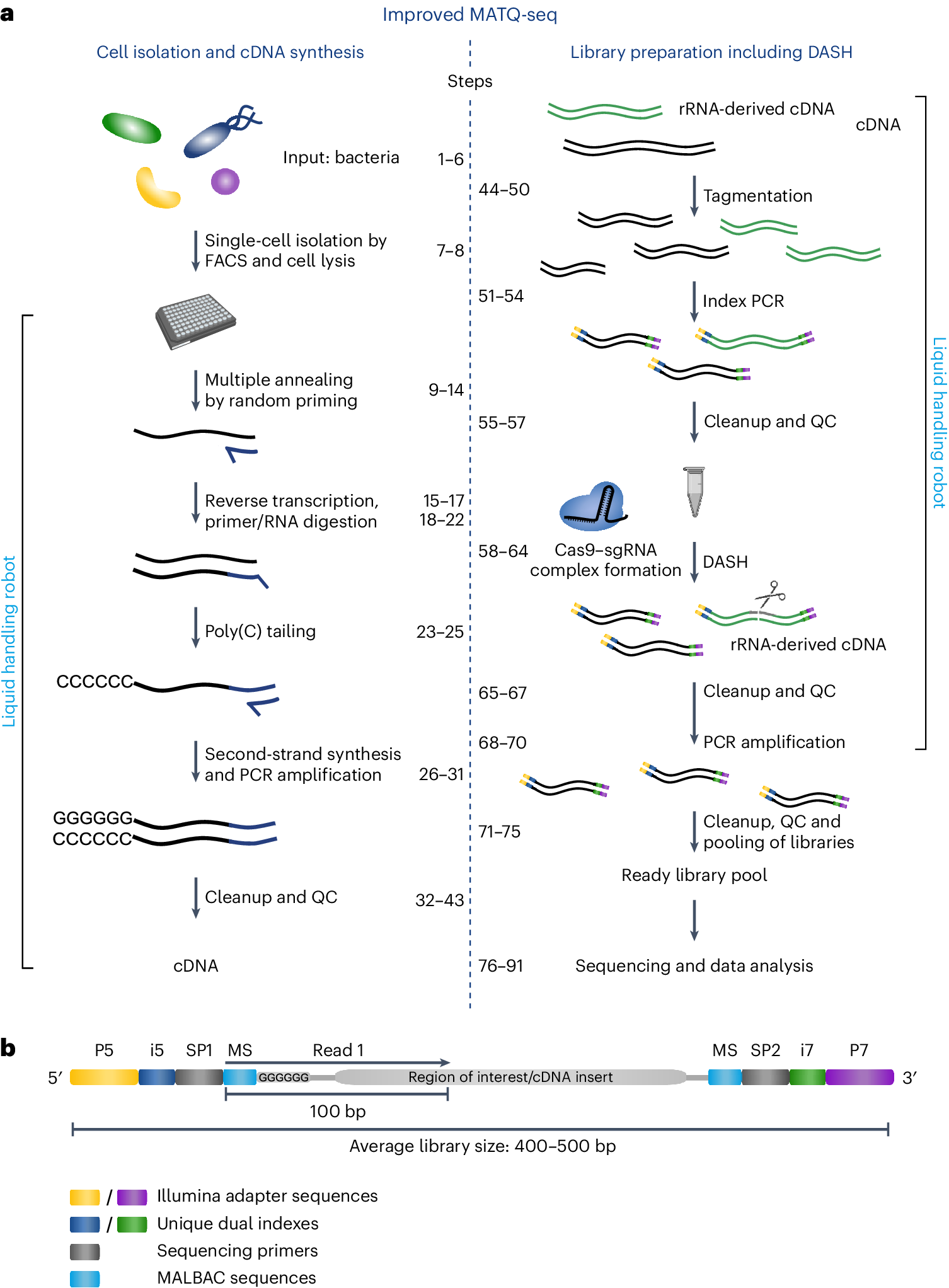
a, The workflow is structured into two main steps: cell isolation and cDNA synthesis (left) and library preparation including DASH for rRNA depletion (right). All pipetting steps can be automated using a liquid handling robot, except for all cleanup and QC steps. b, Illustration of the final MATQ-seq library using the Illumina Nextera XT library preparation kit. In addition to the region of interest containing the RNA-derived cDNA, the library includes Illumina and MATQ-seq specific sequences derived from dual indices, sequencing adapters and MALBAC primers. Sample indexing and demultiplexing is based on unique dual indexes implemented during the index PCR. The scheme illustrates sequencing in single-end mode for read 1, using 100 cycles.
Protocol Covers 95 Percent of the Bacteria Used
“We have developed a robust bacterial scRNA-seq protocol based on quantitative single-cell RNA sequencing,” says Dr. Christina Homberger from the JMU Institute of Molecular Infection Biology, who is now a researcher at the Biozentrum of the University of Basel.
The scientist and her JMU colleague Dr. Fabian Imdahl are the first authors of the study.
“Using model organisms such as Salmonella enterica, we show that the method is very efficient,” explains Christina Homberger.
It achieves a very high cell retention rate of 95 percent – this means that at the end of the process, individual gene libraries are actually created from 95 percent of the cells used at the beginning. This is considerably higher than other protocols, which have loss rates of up to 70 percent.
Activity of 300 to 600 Genes is Analysed
“Our method reliably detects the activity of 300 to 600 genes per bacterial cell. On average, this is also significantly more than other methods currently achieve,” says Fabian Imdahl.
Based on the recorded gene activity, it is very easy to recognize what an individual bacterium is currently doing or to which environmental conditions it is currently adapting.
The entire procedure – from single cell isolation to raw data generation – takes around five days with MATQ-seq. It is ideal for smaller samples from hundreds of cells; in this range it works very efficiently and with high resolution. For a high cell throughput in the range of hundreds of thousands to millions of cells, other protocols are more suitable, whereby a high loss of cells and the detection of less than 100 genes per cell must be accepted.
Globally Unique Platform for Collaborations
“Our protocol enables the robust analysis of various bacterial species, thereby laying the foundation for the development of a globally unique microbial single-cell RNA sequencing platform here in Würzburg,” explains Professor Jörg Vogel, director of HIRI and IMIB.
The platform aims to consolidate protocols and expertise, making the technology accessible to other researchers and laboratories.
The new platform is called the Center for Microbial Single-Cell RNA-seq (MICROSEQ):
“It is based on the technology we have developed and other established high-throughput methods for the transcriptome analysis of individual bacteria.”
In future, research groups from all over the world will be able to access technologies for single-cell transcriptomics of bacterial cells.
MICROSEQ is being established as part of the Würzburg Single-Cell Center, which already offers single-cell transcriptomics for eukaryotic cells: www.single-cell-center.de
Source – Julius-Maximilians-Universität Würzburg


Analysing the gene activity of every single bacterial cell in a colony? A new technique of single-cell transcriptomics developed in Würzburg can do this much more efficiently than other methods: It reliably detects 300 to 600 genes per bacterial cell with a high success rate of 95%, thereby surpassing the efficiency of established procedures.
Not all individuals in a population of bacteria are identical. Some may be on the verge of cell division, others are differentiating, others are in the process of adapting to changing environmental conditions. Particularly with regard to pathogens, it is important for researchers to understand this diversity within a bacterial population as well as possible. This knowledge can help to develop improved therapies.
One technology that helps to analyse bacterial diversity is single-cell transcriptomics. It uses small messenger molecules (mRNA) to determine which genes are active in the individual bacterial cells of a population at a specific point in time. Even in complex bacterial groups, mRNA analysis shows how the individual bacterial cells react to antibiotics or other environmental changes.
Publication in the Journal “Nature Protocols”
Researchers at Julius-Maximilians-Universität (JMU) Würzburg and the Helmholtz Institute for RNA-based Infection Research (HIRI) in Würzburg developed an innovative variant of bacterial single-cell transcriptomics in 2020. The method is called bacterial MATQ-seq and has several advantages.
The Würzburg researchers have since further refined their method. In the journal Nature Protocols, they now present a step-by-step protocol, i.e. precise instructions for creating single bacterial transcriptomes with MATQ-seq. The protocol also includes the experimental and computer-aided analysis of the data.
Overview of the MATQ-seq workflow
a, The workflow is structured into two main steps: cell isolation and cDNA synthesis (left) and library preparation including DASH for rRNA depletion (right). All pipetting steps can be automated using a liquid handling robot, except for all cleanup and QC steps. b, Illustration of the final MATQ-seq library using the Illumina Nextera XT library preparation kit. In addition to the region of interest containing the RNA-derived cDNA, the library includes Illumina and MATQ-seq specific sequences derived from dual indices, sequencing adapters and MALBAC primers. Sample indexing and demultiplexing is based on unique dual indexes implemented during the index PCR. The scheme illustrates sequencing in single-end mode for read 1, using 100 cycles.
Protocol Covers 95 Percent of the Bacteria Used
The scientist and her JMU colleague Dr. Fabian Imdahl are the first authors of the study.
It achieves a very high cell retention rate of 95 percent – this means that at the end of the process, individual gene libraries are actually created from 95 percent of the cells used at the beginning. This is considerably higher than other protocols, which have loss rates of up to 70 percent.
Activity of 300 to 600 Genes is Analysed
Based on the recorded gene activity, it is very easy to recognize what an individual bacterium is currently doing or to which environmental conditions it is currently adapting.
The entire procedure – from single cell isolation to raw data generation – takes around five days with MATQ-seq. It is ideal for smaller samples from hundreds of cells; in this range it works very efficiently and with high resolution. For a high cell throughput in the range of hundreds of thousands to millions of cells, other protocols are more suitable, whereby a high loss of cells and the detection of less than 100 genes per cell must be accepted.
Globally Unique Platform for Collaborations
The platform aims to consolidate protocols and expertise, making the technology accessible to other researchers and laboratories.
The new platform is called the Center for Microbial Single-Cell RNA-seq (MICROSEQ):
In future, research groups from all over the world will be able to access technologies for single-cell transcriptomics of bacterial cells.
MICROSEQ is being established as part of the Würzburg Single-Cell Center, which already offers single-cell transcriptomics for eukaryotic cells: www.single-cell-center.de
Source – Julius-Maximilians-Universität Würzburg
Homberger C, Imdahl F, Hayward RJ, Barquist L, Saliba AE, Vogel J. (2025) Transcriptomic profiling of individual bacteria by MATQ-seq. Nature Protocols 20(4): 678–690. [article]
Related Posts
Scientists identify the neuroblastoma cells that signal poor outcomes
Novel biosensor uses DNA ‘barcodes’ to uncover disease signals in cells
CellART extracts single-cell information from high-resolution spatial transcriptomics
Cell2space restores spatial context to single-cell RNA sequencing data
Urine test may improve bladder cancer diagnosis and guide treatment decisions
DeCoRE – a computational method to resolve RNA structural heterogeneity from RNA structure probing data by direct RNA sequencing
Tracing 700 million years of cell evolution
How should biological replicates be handled in long-read RNA sequencing?
RNA-Seq reveals a new way the developing heart controls its growth
The Human RNome Project Consortium seeks to publish first-ever complete sequence of the body’s RNA
scFlowReport brings multiple single-cell RNA sequencing analyses into one workflow
Long-read RNA sequencing reveals how neurons choose alternative RNA endings
DeOPUS improves cell-type estimates from bulk RNA sequencing
ResolVI improves accuracy in spatial transcriptomics analysis
RNA sequencing reveals transcriptional allele differences in prostate cancer stem cells
Unmasking “zombie cells” in aging tissue with an AI-powered barcode
Single-cell TimeLapse-seq reveals MTA is an essential retrotransposon
RNA variant imaging for cancer diagnosis
Autism-risk mutations reveal two opposing patterns of brain gene activity
A real-data approach to evaluating RNA transcript analysis methods
Stay Connected
Submit a Post to the Blog
Recent Posts
Subscribe to the RNA-Seq Blog
RNA-Seq Products & Services