

Circular RNAs, often called circRNAs, are a special type of RNA molecule that form a closed loop instead of the usual linear shape. Because they do not have loose ends, they are more stable than many other RNA types and can persist in cells longer. Scientists are increasingly interested in circRNAs because they can vary between tissues and may serve as useful biomarkers for diseases.
However, studying circRNAs is not straightforward. Their circular structure and wide range of sizes make them difficult to detect using traditional sequencing methods, which typically break RNA into smaller fragments. This is where long read sequencing, such as that provided by Oxford Nanopore Technologies, becomes valuable. It allows researchers to read entire RNA molecules in one piece, making it easier to identify circular structures.
Researchers at the University of Rennes compared three specialized computational tools designed to detect circRNAs from long read sequencing data. These tools, CIRI-long, IsoCIRC, and circNICK-Irs, each use different algorithms to identify circular RNA molecules from sequencing reads.
To fairly evaluate these tools, the team created a new simulation pipeline that generates realistic synthetic sequencing data. This pipeline mimics real biological features of circRNAs while also incorporating the technical characteristics of Nanopore sequencing. By doing this, the researchers could test how well each tool performs under controlled conditions.
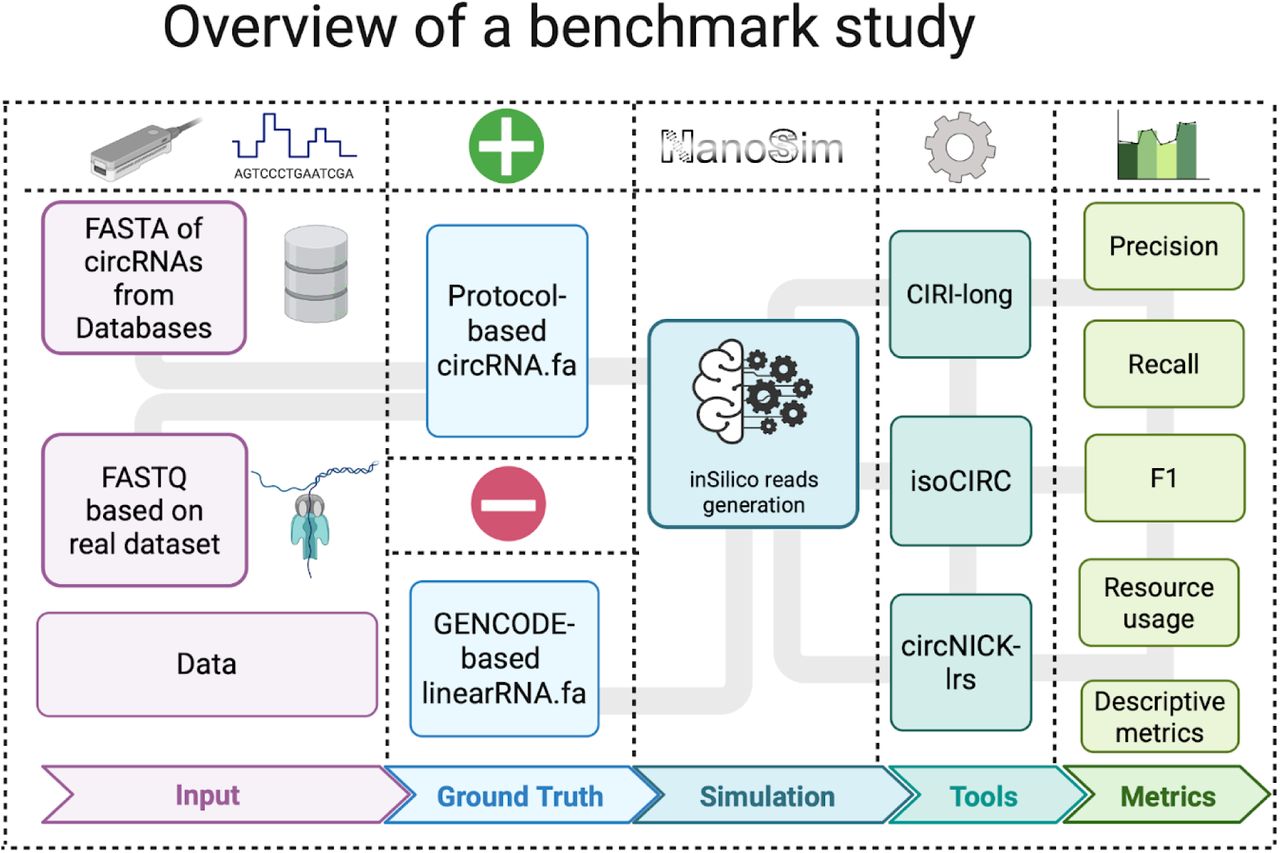
The results showed that while all three tools were good at avoiding false positives, meaning they rarely identified something as a circRNA when it was not, they differed in how many real circRNAs they could detect. Some tools were better at identifying certain types of circRNAs, while others missed them. Interestingly, the overlap between the circRNAs detected by each tool was relatively low, suggesting that each method captures a different subset of molecules.
Another important finding was that computational efficiency varied significantly. Some tools required more time and resources than others, which can be an important factor for large-scale studies.
Overall, the findings suggest that relying on a single tool may not provide a complete picture of circRNA populations. Instead, combining multiple tools or improving existing algorithms may lead to more accurate and comprehensive detection. The simulation framework developed in this work also provides a valuable resource for researchers to test and refine new methods for circRNA analysis.
This work highlights both the promise of long read sequencing technologies and the ongoing need for better bioinformatics tools to fully understand the complexity of RNA biology.
Rusakovich A, Corre S, Cadieu E, Fraboulet R M, Le Bars V, Galibert M D, Derrien T, Blum Y. (2026) Benchmarking circRNA Detection Tools from Long-Read Sequencing Using Data-Driven and Flexible Simulation Framework Name of Journal 6(article no. e27): Pages. [https://gitlab.com/bingo-igdr/nano-circ]
Availability – The customizable simulation framework, offering a resource to optimize detection approaches and advance bioinformatic tool development for circRNA research is freely available at: https://gitlab.com/bingo-igdr/nano-circ
Rusakovich A, Corre S, Cadieu E, Fraboulet R M, Le Bars V, Galibert M D, Derrien T, Blum Y. (2026) Benchmarking circRNA Detection Tools from Long-Read Sequencing Using Data-Driven and Flexible Simulation Framework. Peer Community Journal 6(e27): e27. [article]
Related Posts






Circular RNAs, often called circRNAs, are a special type of RNA molecule that form a closed loop instead of the usual linear shape. Because they do not have loose ends, they are more stable than many other RNA types and can persist in cells longer. Scientists are increasingly interested in circRNAs because they can vary between tissues and may serve as useful biomarkers for diseases.
However, studying circRNAs is not straightforward. Their circular structure and wide range of sizes make them difficult to detect using traditional sequencing methods, which typically break RNA into smaller fragments. This is where long read sequencing, such as that provided by Oxford Nanopore Technologies, becomes valuable. It allows researchers to read entire RNA molecules in one piece, making it easier to identify circular structures.
Researchers at the University of Rennes compared three specialized computational tools designed to detect circRNAs from long read sequencing data. These tools, CIRI-long, IsoCIRC, and circNICK-Irs, each use different algorithms to identify circular RNA molecules from sequencing reads.
To fairly evaluate these tools, the team created a new simulation pipeline that generates realistic synthetic sequencing data. This pipeline mimics real biological features of circRNAs while also incorporating the technical characteristics of Nanopore sequencing. By doing this, the researchers could test how well each tool performs under controlled conditions.
The results showed that while all three tools were good at avoiding false positives, meaning they rarely identified something as a circRNA when it was not, they differed in how many real circRNAs they could detect. Some tools were better at identifying certain types of circRNAs, while others missed them. Interestingly, the overlap between the circRNAs detected by each tool was relatively low, suggesting that each method captures a different subset of molecules.
Another important finding was that computational efficiency varied significantly. Some tools required more time and resources than others, which can be an important factor for large-scale studies.
Overall, the findings suggest that relying on a single tool may not provide a complete picture of circRNA populations. Instead, combining multiple tools or improving existing algorithms may lead to more accurate and comprehensive detection. The simulation framework developed in this work also provides a valuable resource for researchers to test and refine new methods for circRNA analysis.
This work highlights both the promise of long read sequencing technologies and the ongoing need for better bioinformatics tools to fully understand the complexity of RNA biology.
Rusakovich A, Corre S, Cadieu E, Fraboulet R M, Le Bars V, Galibert M D, Derrien T, Blum Y. (2026) Benchmarking circRNA Detection Tools from Long-Read Sequencing Using Data-Driven and Flexible Simulation Framework Name of Journal 6(article no. e27): Pages. [https://gitlab.com/bingo-igdr/nano-circ]
Availability – The customizable simulation framework, offering a resource to optimize detection approaches and advance bioinformatic tool development for circRNA research is freely available at: https://gitlab.com/bingo-igdr/nano-circ
Rusakovich A, Corre S, Cadieu E, Fraboulet R M, Le Bars V, Galibert M D, Derrien T, Blum Y. (2026) Benchmarking circRNA Detection Tools from Long-Read Sequencing Using Data-Driven and Flexible Simulation Framework. Peer Community Journal 6(e27): e27. [article]
Related Posts
Recent Posts
 Machine learning reveals how RNA splicing is regulated in individual cell types
 Illumina releases SpliceAI2 to help advance rare disease research
 Postdoctoral Fellow – Long-Read RNA Methods Development for Neurodegeneration
 Novel biosensor uses DNA ‘barcodes’ to uncover disease signals in cells
 GP-DHT uses single-cell RNA sequencing to map gene regulatory networks
 Boehringer taps Envisagenics’ AI to mine RNA splicing for cancer targets
RNA-Seq Products & Services



Stay Connected