

Researchers at Sun Yat-sen University set out to solve a growing challenge in single-cell biology. As single-cell RNA sequencing generates data from millions of cells, scientists often need to combine information from different labs, instruments or techniques. However, technical differences between datasets, known as batch effects, can hide the real biological patterns that researchers care about.
Multi-level loss regularization designs for single-cell integration
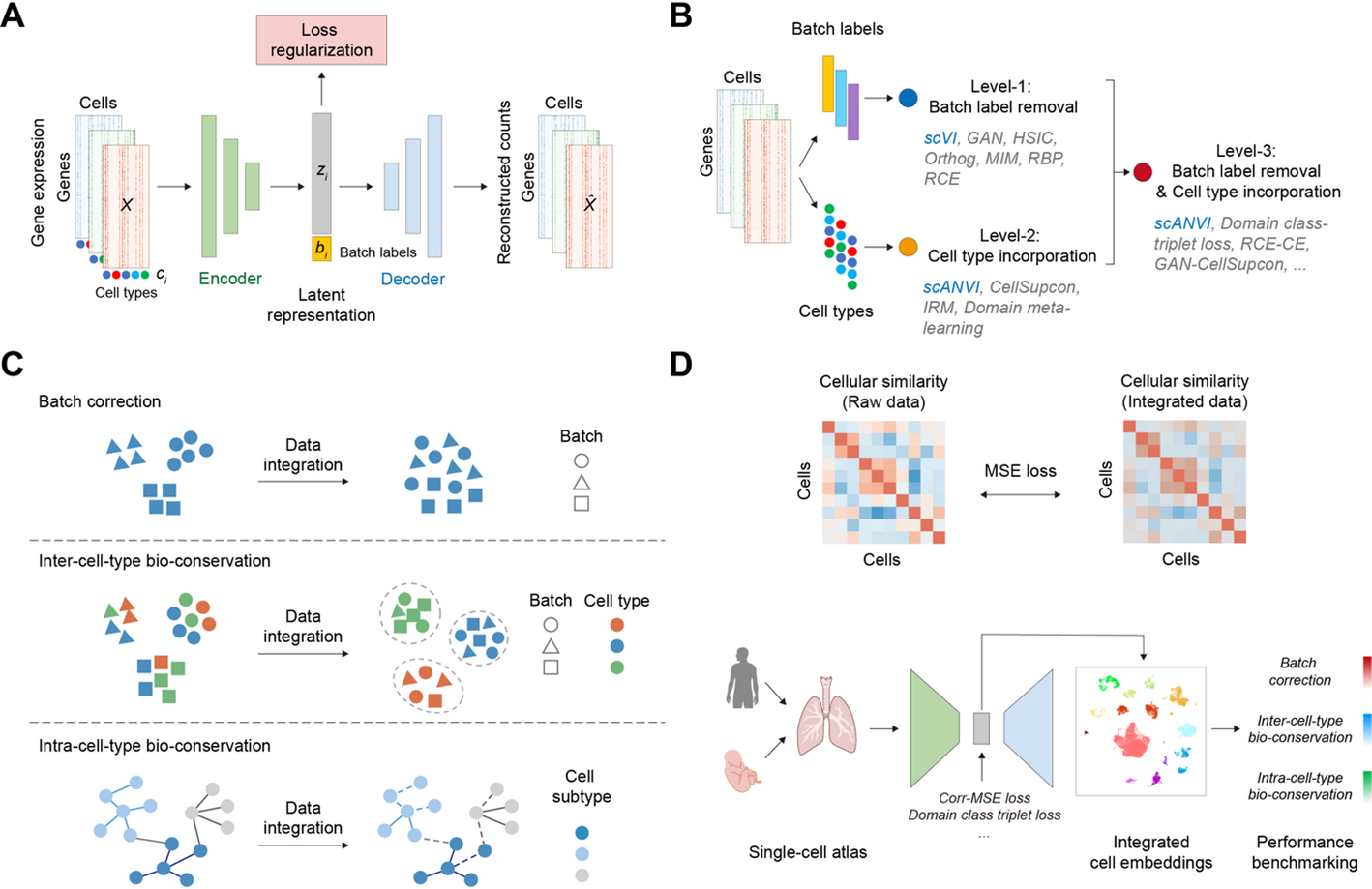
A Diagram illustrating the unified variational autoencoder framework used in this project. B Schematic representation of the three-level loss designs implemented in this study. C Illustration of the effects of batch correction (top), inter-cell-type biological conservation (middle), and intra-cell-type biological conservation (bottom) following single-cell data integration. D Schematic representation of the Corr-MSE loss design (top) and the process of biologically conserved single-cell integration (bottom)
The team analyzed 16 deep-learning-based integration methods within one unified variational autoencoder framework. When they compared the results, they found that a widely used benchmarking tool called scIB struggled to preserve fine-scale biological differences among cells belonging to the same cell type. This kind of subtle variation is important because it can reveal how cells respond differently to disease, development or their surrounding environment.
To improve integration quality, the researchers introduced a correlation-based loss function that helps maintain biologically meaningful relationships within each cell type. They also created expanded benchmarking metrics, called scIB-E, which evaluate how well an integration method balances batch correction, differences between cell types, and variation within each cell type. Using large lung and breast cell atlases, their improved approach better preserved authentic biological signals across all these layers.
Overall, this work highlights how deep learning can be strengthened with biologically informed metrics to integrate increasingly complex single-cell datasets more accurately. For anyone merging data across experiments, the message is that preserving fine-grained cell behavior is just as critical as removing unwanted technical noise.
Yi C, Cheng J, Chen J, Liu W, Liu J, Li Y. (2025) Benchmarking deep learning methods for biologically conserved single-cell integration. Genome Biol 26(1):398. [article]
Related Posts




Researchers at Sun Yat-sen University set out to solve a growing challenge in single-cell biology. As single-cell RNA sequencing generates data from millions of cells, scientists often need to combine information from different labs, instruments or techniques. However, technical differences between datasets, known as batch effects, can hide the real biological patterns that researchers care about.
Multi-level loss regularization designs for single-cell integration
A Diagram illustrating the unified variational autoencoder framework used in this project. B Schematic representation of the three-level loss designs implemented in this study. C Illustration of the effects of batch correction (top), inter-cell-type biological conservation (middle), and intra-cell-type biological conservation (bottom) following single-cell data integration. D Schematic representation of the Corr-MSE loss design (top) and the process of biologically conserved single-cell integration (bottom)
The team analyzed 16 deep-learning-based integration methods within one unified variational autoencoder framework. When they compared the results, they found that a widely used benchmarking tool called scIB struggled to preserve fine-scale biological differences among cells belonging to the same cell type. This kind of subtle variation is important because it can reveal how cells respond differently to disease, development or their surrounding environment.
To improve integration quality, the researchers introduced a correlation-based loss function that helps maintain biologically meaningful relationships within each cell type. They also created expanded benchmarking metrics, called scIB-E, which evaluate how well an integration method balances batch correction, differences between cell types, and variation within each cell type. Using large lung and breast cell atlases, their improved approach better preserved authentic biological signals across all these layers.
Overall, this work highlights how deep learning can be strengthened with biologically informed metrics to integrate increasingly complex single-cell datasets more accurately. For anyone merging data across experiments, the message is that preserving fine-grained cell behavior is just as critical as removing unwanted technical noise.
Yi C, Cheng J, Chen J, Liu W, Liu J, Li Y. (2025) Benchmarking deep learning methods for biologically conserved single-cell integration. Genome Biol 26(1):398. [article]
Related Posts
Recent Posts
 Machine learning reveals how RNA splicing is regulated in individual cell types
 Illumina releases SpliceAI2 to help advance rare disease research
 Postdoctoral Fellow – Long-Read RNA Methods Development for Neurodegeneration
 Novel biosensor uses DNA ‘barcodes’ to uncover disease signals in cells
 GP-DHT uses single-cell RNA sequencing to map gene regulatory networks
 Boehringer taps Envisagenics’ AI to mine RNA splicing for cancer targets
RNA-Seq Products & Services



Stay Connected