

Long-read RNA sequencing is giving researchers a much clearer view of how genes produce different RNA molecules through alternative splicing. Unlike traditional short-read sequencing, long-read technologies can capture entire RNA transcripts, making it possible to identify complete RNA isoforms. When combined with single-cell RNA sequencing and spatial transcriptomics, these technologies allow scientists to study not only which genes are active in individual cells, but also which full-length transcript variants those cells produce.
Researchers from the GenomiqueENS, Institut de Biologie de l’ENS (IBENS), France developed a comprehensive benchmarking resource to evaluate bioinformatics tools designed for analyzing long-read single-cell and spatial RNA sequencing data. Their goal was to help researchers select the most appropriate computational methods as these rapidly evolving technologies become more widely adopted.
One of the biggest challenges in long-read RNA sequencing is accurately assigning each sequencing read to its original cell while correctly identifying unique RNA molecules. Errors during barcode detection, unique molecular identifier (UMI) assignment, or transcript reconstruction can reduce the accuracy of downstream analyses.
Overview of the benchmark
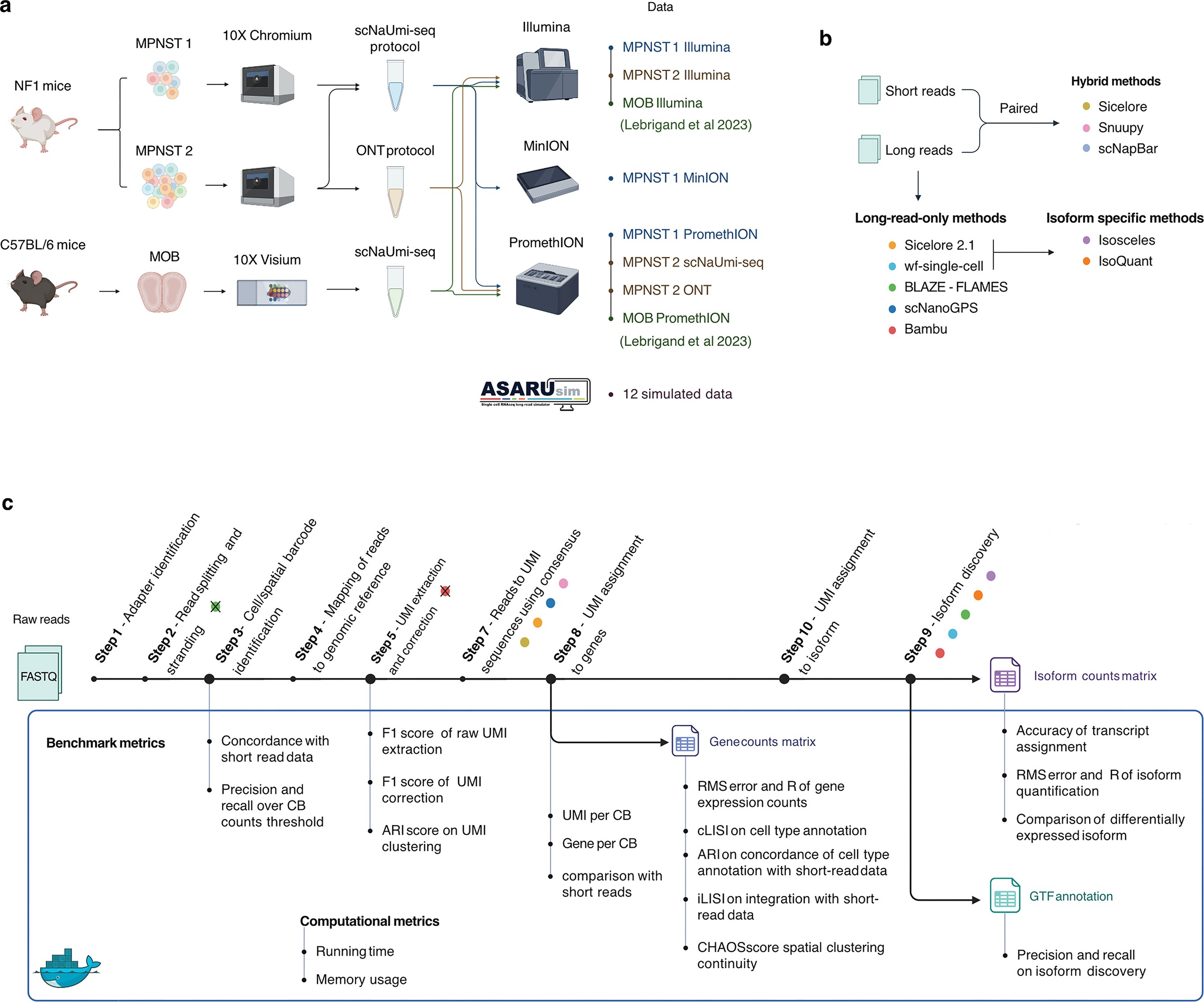
(A) This study was performed with a total of 20 datasets on various cell types and sample sizes. Six were newly-generated [malignant peripheral nerve sheath tumor (MPNST) 10X Genomics] covering two library preparation protocols and three sequencing platforms. Two were from a public dataset [mouse olfactory bulb (MOB), Visium], and 12 were simulated with the dedicated tool AsaruSim. (B) A total of 10 single-cell and spatial long-read RNA-seq methods were evaluated, organised into three categories: hybrid methods, long-read-only methods, and isoform-specific methods. (C) Data processing steps evaluated in this benchmark along with associated metrics. The preprocessing steps are organized chronologically, from raw FASTQ files to the generation of gene- and isoform-level count matrices. The step is supported by all methods, unless specified differently as follows: dots indicate the few methods supporting a particular step; crossed dots indicate the few methods that do not support a given step, with colors corresponding to the tools presented in panel (B). The entire benchmark is implemented as a reusable workflow in Nextflow and executed within Docker containers.
To compare existing software, the researchers generated paired datasets using both traditional short-read sequencing and Oxford Nanopore long-read sequencing from the same single-cell samples. These datasets provided a reliable reference for evaluating how well different computational tools performed under realistic experimental conditions.
The team examined ten state-of-the-art bioinformatics methods across four major analytical tasks. These included barcode and UMI detection, cell demultiplexing and UMI clustering, gene expression profiling, and full-length RNA isoform detection and quantification. They also evaluated each method using both experimental and simulated datasets generated under different sequencing depths, library preparation protocols, and sequencing chemistries.
The results showed that no single software package consistently outperformed the others in every category. Some methods excelled at identifying cell barcodes, while others were better at reconstructing full-length RNA isoforms or measuring gene expression. The researchers also found that sequencing quality and accurate correction of UMI errors had a major influence on overall performance.
An important outcome of the project is the reusable benchmarking workflow. As new computational methods continue to be developed, software developers can compare their own tools against the same standardized reference datasets, making it easier to measure improvements and identify remaining challenges.
As long-read RNA sequencing becomes increasingly common, selecting appropriate analysis software will become just as important as generating high-quality sequencing data. Resources like this benchmark help researchers understand the strengths and limitations of existing tools, improving the accuracy of RNA isoform detection, gene expression analysis, and spatial transcriptomics across a wide range of biological applications.
Hamraoui A, Onfroy A, Sénamaud-Beaufort C, Coulpier F, Lemoine S, Jourdren L, Thomas-Chollier M. (2026) A systematic benchmark of bioinformatics methods for single-cell and spatial RNA-seq nanopore long reads data. NAR Genomics and Bioinformatics 8(3): lqag070. [article]
Related Posts


Long-read RNA sequencing is giving researchers a much clearer view of how genes produce different RNA molecules through alternative splicing. Unlike traditional short-read sequencing, long-read technologies can capture entire RNA transcripts, making it possible to identify complete RNA isoforms. When combined with single-cell RNA sequencing and spatial transcriptomics, these technologies allow scientists to study not only which genes are active in individual cells, but also which full-length transcript variants those cells produce.
Researchers from the GenomiqueENS, Institut de Biologie de l’ENS (IBENS), France developed a comprehensive benchmarking resource to evaluate bioinformatics tools designed for analyzing long-read single-cell and spatial RNA sequencing data. Their goal was to help researchers select the most appropriate computational methods as these rapidly evolving technologies become more widely adopted.
One of the biggest challenges in long-read RNA sequencing is accurately assigning each sequencing read to its original cell while correctly identifying unique RNA molecules. Errors during barcode detection, unique molecular identifier (UMI) assignment, or transcript reconstruction can reduce the accuracy of downstream analyses.
Overview of the benchmark
(A) This study was performed with a total of 20 datasets on various cell types and sample sizes. Six were newly-generated [malignant peripheral nerve sheath tumor (MPNST) 10X Genomics] covering two library preparation protocols and three sequencing platforms. Two were from a public dataset [mouse olfactory bulb (MOB), Visium], and 12 were simulated with the dedicated tool AsaruSim. (B) A total of 10 single-cell and spatial long-read RNA-seq methods were evaluated, organised into three categories: hybrid methods, long-read-only methods, and isoform-specific methods. (C) Data processing steps evaluated in this benchmark along with associated metrics. The preprocessing steps are organized chronologically, from raw FASTQ files to the generation of gene- and isoform-level count matrices. The step is supported by all methods, unless specified differently as follows: dots indicate the few methods supporting a particular step; crossed dots indicate the few methods that do not support a given step, with colors corresponding to the tools presented in panel (B). The entire benchmark is implemented as a reusable workflow in Nextflow and executed within Docker containers.
To compare existing software, the researchers generated paired datasets using both traditional short-read sequencing and Oxford Nanopore long-read sequencing from the same single-cell samples. These datasets provided a reliable reference for evaluating how well different computational tools performed under realistic experimental conditions.
The team examined ten state-of-the-art bioinformatics methods across four major analytical tasks. These included barcode and UMI detection, cell demultiplexing and UMI clustering, gene expression profiling, and full-length RNA isoform detection and quantification. They also evaluated each method using both experimental and simulated datasets generated under different sequencing depths, library preparation protocols, and sequencing chemistries.
The results showed that no single software package consistently outperformed the others in every category. Some methods excelled at identifying cell barcodes, while others were better at reconstructing full-length RNA isoforms or measuring gene expression. The researchers also found that sequencing quality and accurate correction of UMI errors had a major influence on overall performance.
An important outcome of the project is the reusable benchmarking workflow. As new computational methods continue to be developed, software developers can compare their own tools against the same standardized reference datasets, making it easier to measure improvements and identify remaining challenges.
As long-read RNA sequencing becomes increasingly common, selecting appropriate analysis software will become just as important as generating high-quality sequencing data. Resources like this benchmark help researchers understand the strengths and limitations of existing tools, improving the accuracy of RNA isoform detection, gene expression analysis, and spatial transcriptomics across a wide range of biological applications.
Hamraoui A, Onfroy A, Sénamaud-Beaufort C, Coulpier F, Lemoine S, Jourdren L, Thomas-Chollier M. (2026) A systematic benchmark of bioinformatics methods for single-cell and spatial RNA-seq nanopore long reads data. NAR Genomics and Bioinformatics 8(3): lqag070. [article]
Related Posts
Recent Posts
 DeMixNB: deconvolution of sparse-count RNA sequencing data for tumor cells
 New RNA sequencing method improves tRNA analysis using deep learning
 mobileRNA – an integrative, automated tool for accurate identification of mobile RNA molecules based on multiple genome mapping
 The Festival of Genomics & Biodata
 Researchers create first whole-body single-cell atlas of an adult vertebrate
 RNA sequencing reveals functional gene similarities across species
RNA-Seq Products & Services



Stay Connected