

Alternative splicing allows a single gene to produce multiple RNA transcripts by combining different portions of the original RNA message. This process greatly expands the diversity of proteins that cells can make, and abnormal splicing has been linked to many diseases.
Short-read RNA sequencing is widely used to study alternative splicing, but researchers have not always agreed on which experimental and computational approaches produce the most accurate results. Differences in sequencing depth, data quality, software, and analysis strategy can all affect which splice junctions and transcript isoforms are detected.
A large benchmarking effort by researchers at the Key Laboratory of Geriatrics of NHC, Chinese Academy of Medical Sciences has now compared these approaches using standardized reference materials.
Comparing hundreds of RNA sequencing workflows
The researchers evaluated short-read RNA sequencing data generated across 42 laboratories and analyzed the results using 207 different pipelines. They used two established reference systems, the Quartet and MAQC reference materials, which provide standardized samples for evaluating sequencing performance.
The goal was to determine how experimental choices and bioinformatics workflows influence the accuracy of alternative splicing analysis.
The team examined several important tasks, including detecting splice junctions, measuring individual transcript isoforms, identifying alternative splicing events, and detecting differences in splicing between samples.
Overview of study design
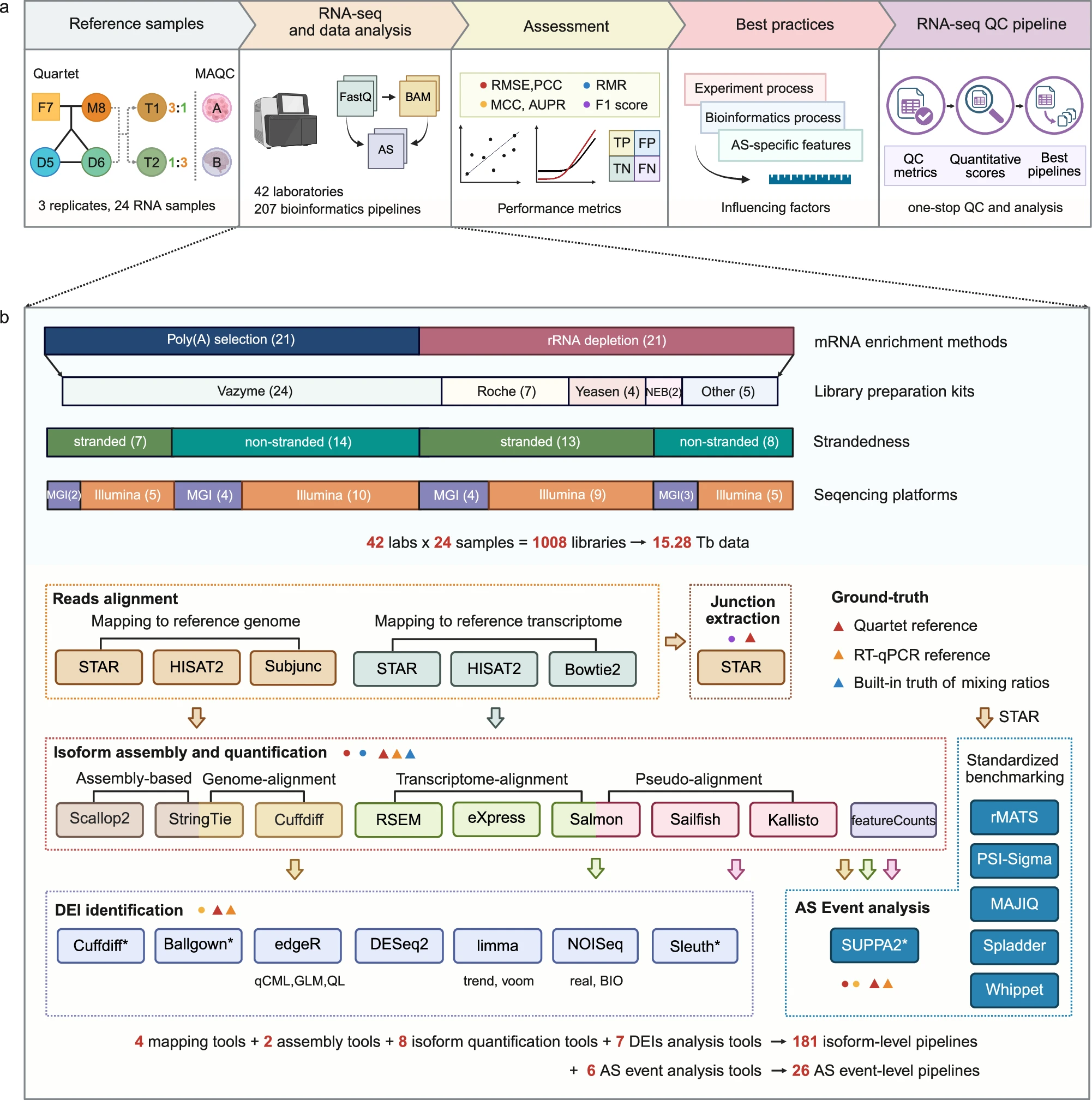
a Certified Quartet RNA reference materials derived from immortalized cell lines of a Chinese Quartet, including the father (F7), mother (M8), and monozygotic twin daughters (D5 and D6), as well as the MAQC reference materials derived from 10 cancer cell lines (MAQC A) and brain tissues from 23 donors (MAQC B), were used in this study. Samples M8 and D6 were mixed at 3:1 and 1:3 ratios to create samples T1 and T2, respectively. Each sample was prepared with three replicates. The reference samples were tested in 42 laboratories with distinct protocols and analyzed with 207 combined bioinformatics pipelines. We systematically evaluated srRNA-seq accuracy in isoform quantification, AS event quantification, and differential expression and splicing analyses. Factors from experimental and computational processes, as well as intrinsic isoform and event features, were assessed to identify best practices. A QC pipeline was also developed for metric assessment, performance scoring, and pipeline selection. b Overview of the sequencing platforms, library preparation methods, and bioinformatics pipelines. *Differential analysis tools were applied only to compatible inputs: Cuffdiff to Cuffdiff outputs, Ballgown to StringTie outputs, and Sleuth to Salmon-, Kallisto-, and Sailfish-derived outputs. Circles and triangles indicate different performance metrics and ground-truth types, respectively. RMSE root mean square error, PCC Pearson correlation coefficient, RMR recovery of mixing ratios, MCC Matthews correlation coefficient; AUPR area under the precision–recall curve. Created in BioRender. Zhang, R. (2026)
Data quality and sequencing depth matter
One of the clearest findings was that higher-quality data and greater sequencing depth improved performance.
More sequencing reads increased the ability to detect splice junctions and quantify transcript isoforms accurately. These improvements also carried over into differential analyses, where researchers compare samples to identify changes in transcript usage or splicing patterns.
However, simply generating more reads did not solve every problem. Lowly expressed transcripts and regions with limited read coverage remained difficult to measure accurately.
Bioinformatics choices can strongly affect results
The analysis showed substantial differences between the best and worst-performing pipelines.
For isoform-level measurements, optimized workflows produced considerably better agreement with the reference values than poorly performing pipelines. Similar differences were observed when identifying alternative splicing events.
This means that researchers studying the same biological samples could potentially reach different conclusions depending on how their RNA sequencing data are processed.
By comparing a large number of workflows under standardized conditions, the researchers were able to identify combinations of experimental and computational choices that produced more reliable results.
Some transcripts remain difficult to analyze
Alternative splicing analysis is challenging because many genes produce several closely related RNA isoforms that share much of the same sequence.
Short sequencing reads may therefore align equally well to multiple transcripts, making it difficult to determine which isoform produced a particular read.
The benchmarking analysis found that low expression, insufficient coverage, and high transcript complexity all limited accuracy, even when strong analysis pipelines were used.
These limitations are particularly important as researchers compare short-read methods with newer long-read sequencing technologies, which can sometimes sequence complete RNA molecules.
Establishing best practices for splicing research
The results provide practical guidance for researchers designing RNA sequencing experiments focused on alternative splicing.
Careful attention to sequencing depth, data quality, and bioinformatics workflow selection can substantially improve the accuracy of splice junction detection, isoform quantification, and differential splicing analysis.
The benchmarking also shows the value of standardized reference materials such as Quartet and MAQC. By providing known samples that laboratories can analyze independently, these materials make it possible to identify sources of variability and compare performance across different workflows.
As alternative splicing becomes increasingly important in disease research and therapeutic development, standardized benchmarking can help researchers obtain more reproducible and reliable results from short-read RNA sequencing.
Wang D, Zhao J, Chen Q, Han Y, Liu Y, Zhang Y, Liu C, Hou W, Yu Y, Shi L, Zheng Y, Li J, Zhang R. (2026) Benchmarking RNA-seq with the Quartet and MAQC reference materials to establish best practices for accurate alternative splicing analysis. Nature Communications 17(1): 9535. [article]
Related Posts






Alternative splicing allows a single gene to produce multiple RNA transcripts by combining different portions of the original RNA message. This process greatly expands the diversity of proteins that cells can make, and abnormal splicing has been linked to many diseases.
Short-read RNA sequencing is widely used to study alternative splicing, but researchers have not always agreed on which experimental and computational approaches produce the most accurate results. Differences in sequencing depth, data quality, software, and analysis strategy can all affect which splice junctions and transcript isoforms are detected.
A large benchmarking effort by researchers at the Key Laboratory of Geriatrics of NHC, Chinese Academy of Medical Sciences has now compared these approaches using standardized reference materials.
Comparing hundreds of RNA sequencing workflows
The researchers evaluated short-read RNA sequencing data generated across 42 laboratories and analyzed the results using 207 different pipelines. They used two established reference systems, the Quartet and MAQC reference materials, which provide standardized samples for evaluating sequencing performance.
The goal was to determine how experimental choices and bioinformatics workflows influence the accuracy of alternative splicing analysis.
The team examined several important tasks, including detecting splice junctions, measuring individual transcript isoforms, identifying alternative splicing events, and detecting differences in splicing between samples.
Overview of study design
a Certified Quartet RNA reference materials derived from immortalized cell lines of a Chinese Quartet, including the father (F7), mother (M8), and monozygotic twin daughters (D5 and D6), as well as the MAQC reference materials derived from 10 cancer cell lines (MAQC A) and brain tissues from 23 donors (MAQC B), were used in this study. Samples M8 and D6 were mixed at 3:1 and 1:3 ratios to create samples T1 and T2, respectively. Each sample was prepared with three replicates. The reference samples were tested in 42 laboratories with distinct protocols and analyzed with 207 combined bioinformatics pipelines. We systematically evaluated srRNA-seq accuracy in isoform quantification, AS event quantification, and differential expression and splicing analyses. Factors from experimental and computational processes, as well as intrinsic isoform and event features, were assessed to identify best practices. A QC pipeline was also developed for metric assessment, performance scoring, and pipeline selection. b Overview of the sequencing platforms, library preparation methods, and bioinformatics pipelines. *Differential analysis tools were applied only to compatible inputs: Cuffdiff to Cuffdiff outputs, Ballgown to StringTie outputs, and Sleuth to Salmon-, Kallisto-, and Sailfish-derived outputs. Circles and triangles indicate different performance metrics and ground-truth types, respectively. RMSE root mean square error, PCC Pearson correlation coefficient, RMR recovery of mixing ratios, MCC Matthews correlation coefficient; AUPR area under the precision–recall curve. Created in BioRender. Zhang, R. (2026)
Data quality and sequencing depth matter
One of the clearest findings was that higher-quality data and greater sequencing depth improved performance.
More sequencing reads increased the ability to detect splice junctions and quantify transcript isoforms accurately. These improvements also carried over into differential analyses, where researchers compare samples to identify changes in transcript usage or splicing patterns.
However, simply generating more reads did not solve every problem. Lowly expressed transcripts and regions with limited read coverage remained difficult to measure accurately.
Bioinformatics choices can strongly affect results
The analysis showed substantial differences between the best and worst-performing pipelines.
For isoform-level measurements, optimized workflows produced considerably better agreement with the reference values than poorly performing pipelines. Similar differences were observed when identifying alternative splicing events.
This means that researchers studying the same biological samples could potentially reach different conclusions depending on how their RNA sequencing data are processed.
By comparing a large number of workflows under standardized conditions, the researchers were able to identify combinations of experimental and computational choices that produced more reliable results.
Some transcripts remain difficult to analyze
Alternative splicing analysis is challenging because many genes produce several closely related RNA isoforms that share much of the same sequence.
Short sequencing reads may therefore align equally well to multiple transcripts, making it difficult to determine which isoform produced a particular read.
The benchmarking analysis found that low expression, insufficient coverage, and high transcript complexity all limited accuracy, even when strong analysis pipelines were used.
These limitations are particularly important as researchers compare short-read methods with newer long-read sequencing technologies, which can sometimes sequence complete RNA molecules.
Establishing best practices for splicing research
The results provide practical guidance for researchers designing RNA sequencing experiments focused on alternative splicing.
Careful attention to sequencing depth, data quality, and bioinformatics workflow selection can substantially improve the accuracy of splice junction detection, isoform quantification, and differential splicing analysis.
The benchmarking also shows the value of standardized reference materials such as Quartet and MAQC. By providing known samples that laboratories can analyze independently, these materials make it possible to identify sources of variability and compare performance across different workflows.
As alternative splicing becomes increasingly important in disease research and therapeutic development, standardized benchmarking can help researchers obtain more reproducible and reliable results from short-read RNA sequencing.
Wang D, Zhao J, Chen Q, Han Y, Liu Y, Zhang Y, Liu C, Hou W, Yu Y, Shi L, Zheng Y, Li J, Zhang R. (2026) Benchmarking RNA-seq with the Quartet and MAQC reference materials to establish best practices for accurate alternative splicing analysis. Nature Communications 17(1): 9535. [article]
Related Posts
Recent Posts
 Scientists identify the neuroblastoma cells that signal poor outcomes
 GARAGE improves rare cell detection in single-cell RNA sequencing analysis using AI
 Machine learning reveals how RNA splicing is regulated in individual cell types
 Illumina releases SpliceAI2 to help advance rare disease research
 Postdoctoral Fellow – Long-Read RNA Methods Development for Neurodegeneration
 Novel biosensor uses DNA ‘barcodes’ to uncover disease signals in cells
RNA-Seq Products & Services


Stay Connected