

Researchers at LMU Munich have conducted a comprehensive evaluation of computational tools used to detect copy number variations (CNVs) from single-cell RNA sequencing (scRNA-seq) data. CNVs, which are gains or losses of sections of DNA, play a significant role in diseases such as cancer, where they can drive tumor growth and influence how a patient responds to treatment.
Single-cell RNA sequencing offers scientists a powerful way to look at genetic differences between individual cells within the same sample, helping identify distinct cell populations or “subclones” that may behave differently during disease progression. However, accurately identifying CNVs from this type of data is challenging, and various tools have been developed to do so. Schmid and her team evaluated six widely used computational methods to see how well they could identify true CNVs, normal (euploid) cells, and subclonal structures across 21 different datasets.
Overview of the benchmarking workflow
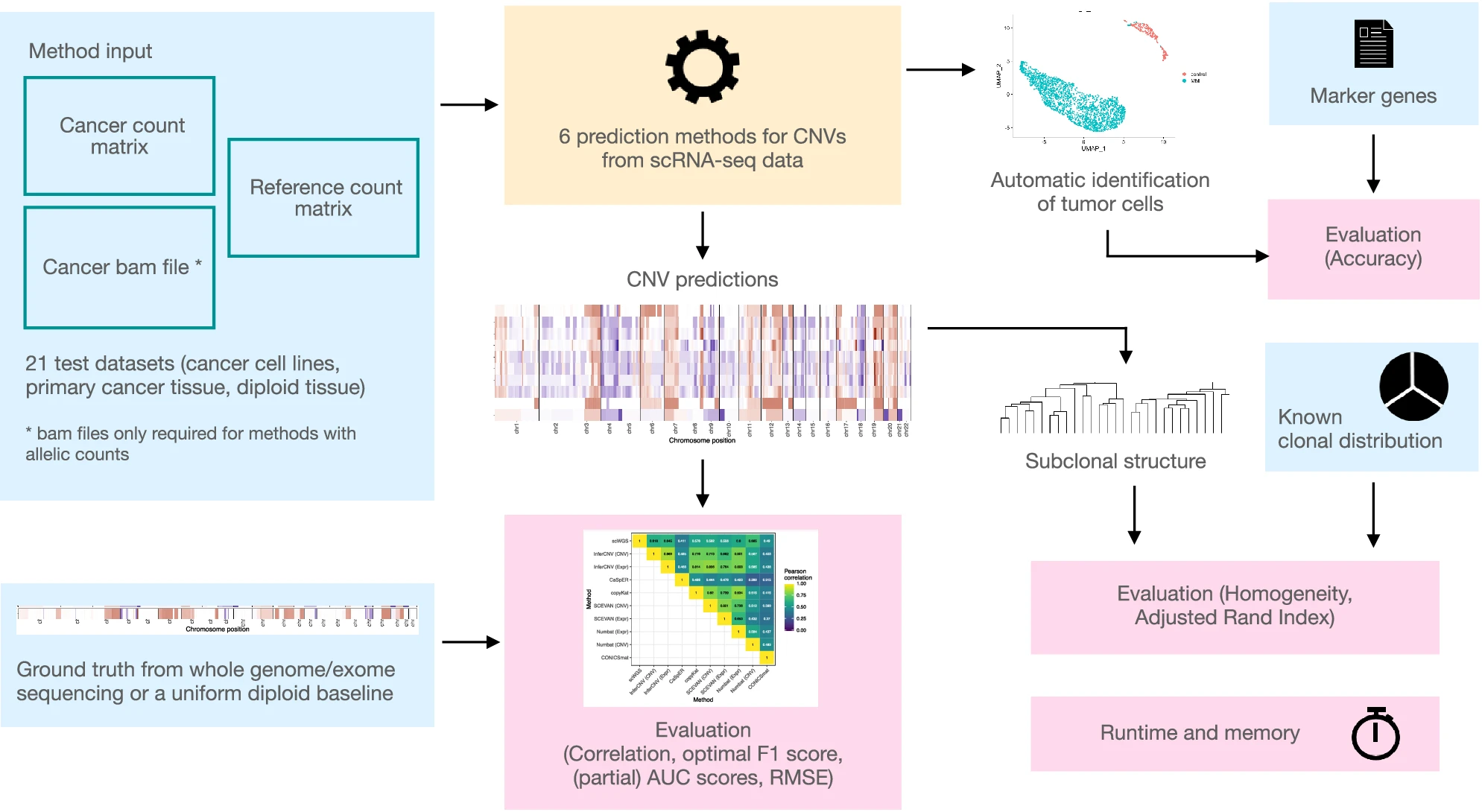
Input data in blue, evaluation results in pink.
Their findings revealed that the performance of these methods depends heavily on the dataset itself, including its size, the types and numbers of CNVs present, and which reference data are used for comparison. Some tools that use allelic information performed more accurately for large datasets but required longer processing times. Additionally, each method offered different capabilities, emphasizing the importance of choosing the right tool for each specific dataset.
To help researchers make informed choices, the team developed a benchmarking pipeline that allows scientists to test and select the most suitable method for their data. This work is an important step toward improving CNV detection and understanding genetic diversity within tumors, ultimately aiding the development of more precise diagnostic and therapeutic strategies.
Schmid K T, Symeonidi A, Hlushchenko D, Richter M L, Tijhuis A E, Foijer F, Colomé-Tatché M. (2025) Benchmarking scRNA-seq copy number variation callers. Nature Communications 16(1): 8777. [article]
Related Posts






Researchers at LMU Munich have conducted a comprehensive evaluation of computational tools used to detect copy number variations (CNVs) from single-cell RNA sequencing (scRNA-seq) data. CNVs, which are gains or losses of sections of DNA, play a significant role in diseases such as cancer, where they can drive tumor growth and influence how a patient responds to treatment.
Single-cell RNA sequencing offers scientists a powerful way to look at genetic differences between individual cells within the same sample, helping identify distinct cell populations or “subclones” that may behave differently during disease progression. However, accurately identifying CNVs from this type of data is challenging, and various tools have been developed to do so. Schmid and her team evaluated six widely used computational methods to see how well they could identify true CNVs, normal (euploid) cells, and subclonal structures across 21 different datasets.
Overview of the benchmarking workflow
Input data in blue, evaluation results in pink.
Their findings revealed that the performance of these methods depends heavily on the dataset itself, including its size, the types and numbers of CNVs present, and which reference data are used for comparison. Some tools that use allelic information performed more accurately for large datasets but required longer processing times. Additionally, each method offered different capabilities, emphasizing the importance of choosing the right tool for each specific dataset.
To help researchers make informed choices, the team developed a benchmarking pipeline that allows scientists to test and select the most suitable method for their data. This work is an important step toward improving CNV detection and understanding genetic diversity within tumors, ultimately aiding the development of more precise diagnostic and therapeutic strategies.
Schmid K T, Symeonidi A, Hlushchenko D, Richter M L, Tijhuis A E, Foijer F, Colomé-Tatché M. (2025) Benchmarking scRNA-seq copy number variation callers. Nature Communications 16(1): 8777. [article]
Related Posts
Recent Posts
 Scientists identify the neuroblastoma cells that signal poor outcomes
 GARAGE improves rare cell detection in single-cell RNA sequencing analysis using AI
 Machine learning reveals how RNA splicing is regulated in individual cell types
 Illumina releases SpliceAI2 to help advance rare disease research
 Postdoctoral Fellow – Long-Read RNA Methods Development for Neurodegeneration
 Novel biosensor uses DNA ‘barcodes’ to uncover disease signals in cells
RNA-Seq Products & Services



Stay Connected