

Understanding the makeup of tissues is one of the toughest challenges in biology, especially when studying diseases like Alzheimer’s. Traditional methods use bulk RNA data to estimate what types of cells are present, but these methods often miss key details because they treat all samples the same and struggle to integrate data from different sources.
Researchers from the University of Pittsburgh have developed a new computational method called BLEND. BLEND uses a hierarchical Bayesian model to combine information from multiple single-cell reference datasets, which allows it to select the best reference for each sample. This tailored approach improves accuracy when estimating cell fractions and helps reveal subtle differences that may be linked to disease progression.
Overview of BLEND
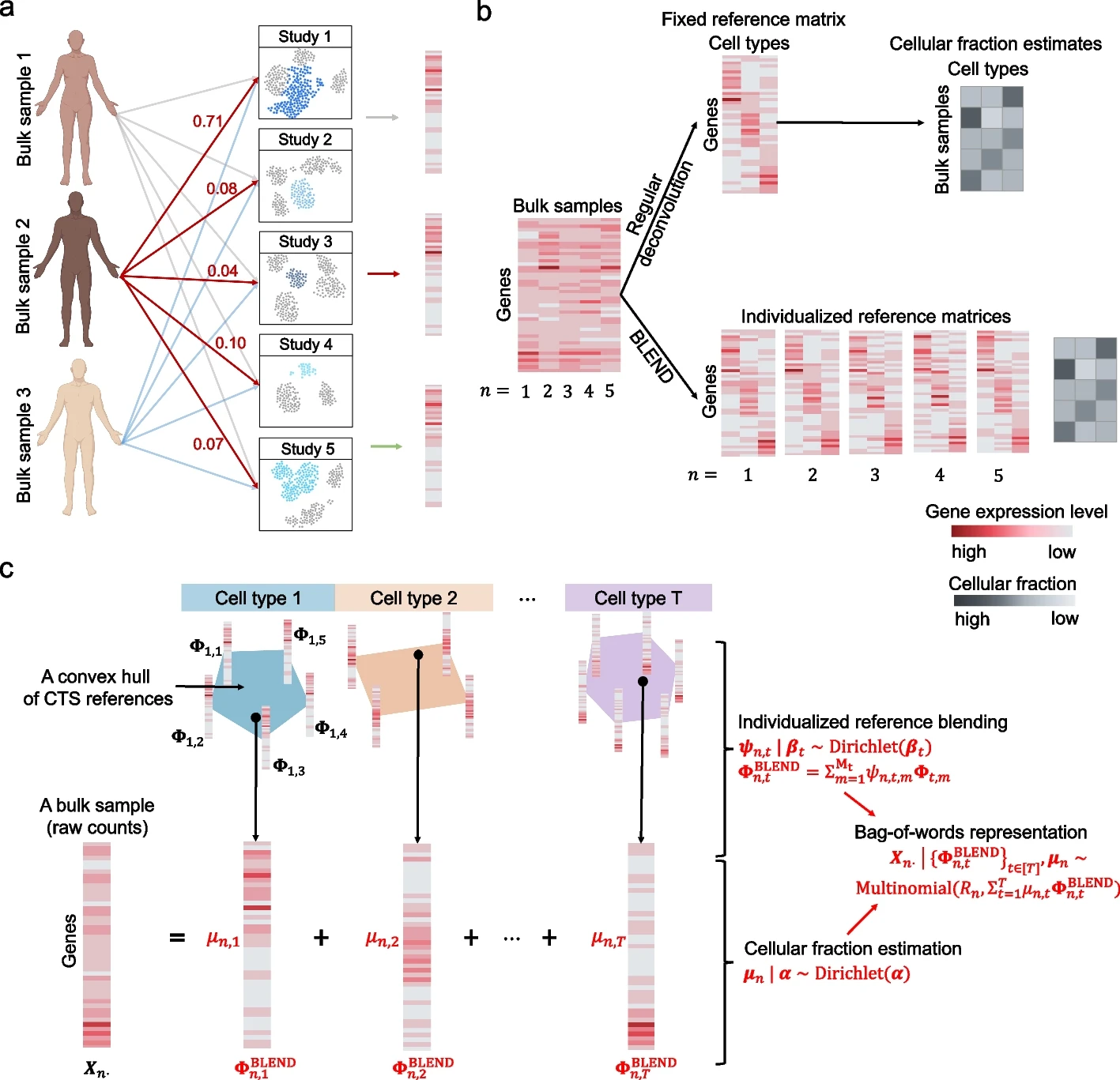
a BLEND integrates multiple cell type-specific (CTS) expression references from single-cell or sorted-cell studies to individualize references for heterogeneous bulk RNA-seq samples. By exploring the convex hull of available references, BLEND automatically selects the most suitable reference for each sample through reference blending. b BLEND estimates each bulk sample’s cellular fractions using its individualized reference matrix. By contrast, regular deconvolution methods use a fixed reference for all bulk samples. c For each bulk sample, BLEND models gene expression as a weighted average of CTS expression, where the weights correspond to cell type fractions. By employing a “bag-of-words” representation, BLEND jointly models individualized references, cellular fractions, and bulk samples in a probabilistic framework
When tested on human brain cortex data, BLEND outperformed other leading methods. Importantly, it provided clearer insights into how cell populations change during Alzheimer’s disease, which could support the search for new treatments. By bridging gaps between bulk and single-cell RNA sequencing data, BLEND offers researchers a more reliable way to decode the cellular makeup of complex tissues.
Availability – The accompanied R package is available at https://github.com/Penghuihuang2000/BLEND
Huang P, Cai M, McKennan C, Wang J. (2025) BLEND: probabilistic cellular deconvolution with individualized single-cell reference integration. Genome Biol 26(1): 328. [article]
Related Posts




Understanding the makeup of tissues is one of the toughest challenges in biology, especially when studying diseases like Alzheimer’s. Traditional methods use bulk RNA data to estimate what types of cells are present, but these methods often miss key details because they treat all samples the same and struggle to integrate data from different sources.
Researchers from the University of Pittsburgh have developed a new computational method called BLEND. BLEND uses a hierarchical Bayesian model to combine information from multiple single-cell reference datasets, which allows it to select the best reference for each sample. This tailored approach improves accuracy when estimating cell fractions and helps reveal subtle differences that may be linked to disease progression.
Overview of BLEND
a BLEND integrates multiple cell type-specific (CTS) expression references from single-cell or sorted-cell studies to individualize references for heterogeneous bulk RNA-seq samples. By exploring the convex hull of available references, BLEND automatically selects the most suitable reference for each sample through reference blending. b BLEND estimates each bulk sample’s cellular fractions using its individualized reference matrix. By contrast, regular deconvolution methods use a fixed reference for all bulk samples. c For each bulk sample, BLEND models gene expression as a weighted average of CTS expression, where the weights correspond to cell type fractions. By employing a “bag-of-words” representation, BLEND jointly models individualized references, cellular fractions, and bulk samples in a probabilistic framework
When tested on human brain cortex data, BLEND outperformed other leading methods. Importantly, it provided clearer insights into how cell populations change during Alzheimer’s disease, which could support the search for new treatments. By bridging gaps between bulk and single-cell RNA sequencing data, BLEND offers researchers a more reliable way to decode the cellular makeup of complex tissues.
Availability – The accompanied R package is available at https://github.com/Penghuihuang2000/BLEND
Huang P, Cai M, McKennan C, Wang J. (2025) BLEND: probabilistic cellular deconvolution with individualized single-cell reference integration. Genome Biol 26(1): 328. [article]
Related Posts
Recent Posts
 RNAmel simplifies RNA sequencing data analysis with a reproducible, integrated platform
 Heart failure reshapes bone marrow to create inflammation-related immune memory
 Overlooked DNA regions surrounding ‘microexons’ hold missing pieces of autism’s genetic puzzle
 RiboBA improves detection of hidden protein-coding regions using ribosome profiling
 An anti-senescence gene may fight spinal disc deterioration
 Bulk RNA-seq Analysis: A Complete Beginner’s Guide
RNA-Seq Products & Services


Stay Connected