

In recent years, machine learning has become an essential tool in understanding the complexities of genetics, particularly in interpreting the impact of genetic variants. One exciting development in this field is the introduction of Borzoi, a new machine-learning model developed at Calico Life Sciences designed to predict RNA expression profiles from DNA sequences, a task that has been challenging for previous models.
To put it simply, our DNA contains instructions for producing proteins, but not all of these instructions are straightforward. Some genetic variations influence how genes are regulated, which includes how much of a gene is expressed, how the RNA is processed, and how it is ultimately used to produce proteins. This regulation happens at several levels, including transcription (how genes are copied into RNA), splicing (how RNA is modified), and polyadenylation (how RNA is stabilized).
Borzoi is designed to solve the challenge of predicting these regulatory processes. It does this by learning from large amounts of genomic data, particularly RNA sequencing (RNA-seq) data, which shows how much RNA is produced from different parts of the genome. What makes Borzoi stand out is that it doesn’t just predict basic RNA expression levels; it also predicts how genetic variants, like mutations, might impact the regulation of RNA in specific tissues or cell types.
Borzoi: a neural network for predicting RNA-seq coverage from sequence
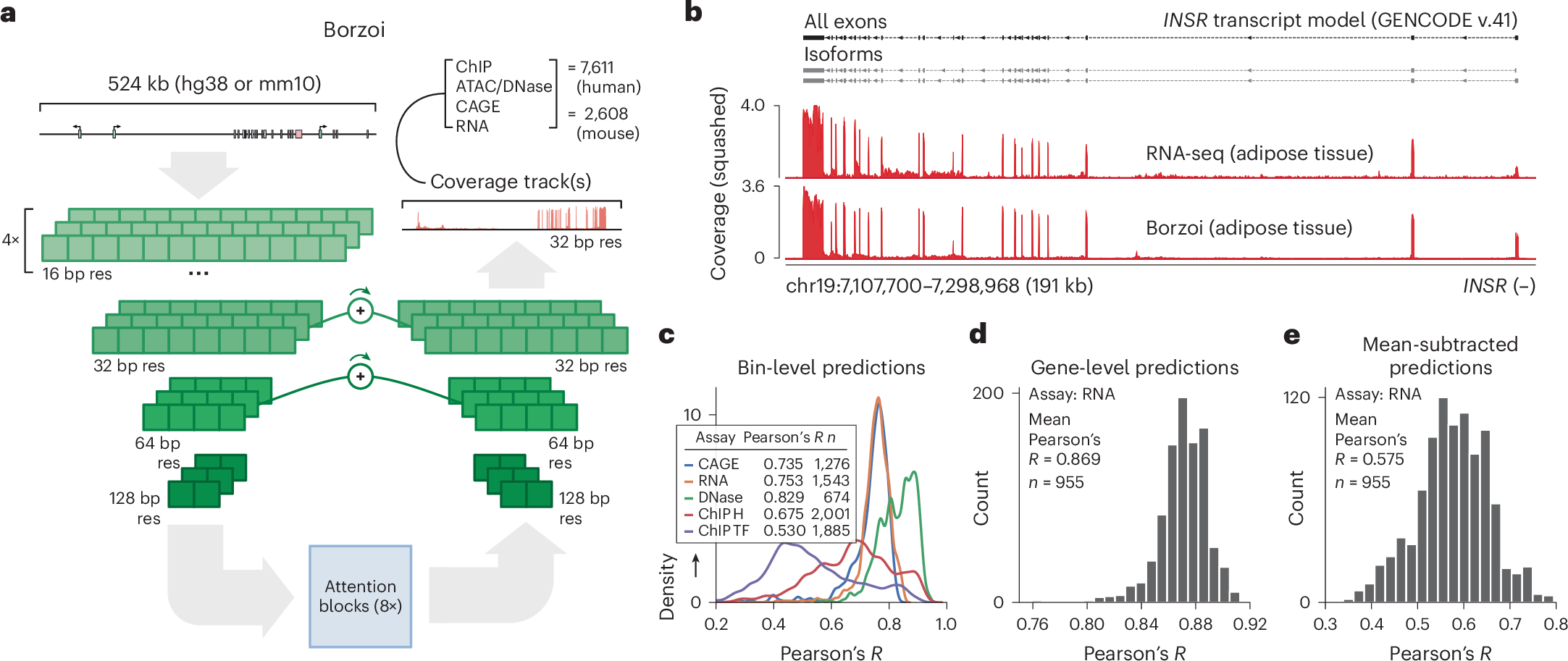
a, The Borzoi neural network architecture consists of a number of convolution and downsampling layers followed by a stack of self-attention layers with relative positional encodings operating at 128 bp resolution, similar to the Enformer architecture. The output is then repeatedly upsampled and put through additional convolution layers with matched U-net connections to predict at 32 bp resolution. Connections with ‘+’ symbols represent a combination of the outputs of a previous layer with the inputs of a new layer through residual convolution. b, RNA-seq coverage prediction for the held-out test gene INSR (GTEx ‘adipose tissue’), obtained by averaging the predictions of four model replicates. The ‘squashed’ scale refers to the transformed scale applied to the training data. c, Bin-level Pearson correlation on held-out test data across coverage tracks when predicting CAGE, RNA-seq, DNase-seq or ChIP–seq (n = number of coverage tracks). Predictions were averaged across four model replicates. d, Gene-level Pearson correlation when comparing the predicted to measured sum of RNA coverage across exons (n = number of sequencing experiments). e, Gene-level Pearson correlation after quantile-normalizing the RNA coverage tracks and subtracting the average gene expression across tracks (n = number of sequencing experiments).
For example, Borzoi can predict how certain DNA variations might affect transcription, splicing, or polyadenylation—important steps in gene expression. By using statistical data from Borzoi’s predictions, researchers can better understand the effects of DNA variants on these regulatory processes, which is important for studying diseases caused by genetic mutations.
In tests, Borzoi has proven to be very accurate, often outperforming other models that only focus on one regulatory function, like transcription alone. Additionally, Borzoi can help scientists pinpoint specific regulatory motifs—patterns in DNA sequences that influence RNA expression. These motifs can be crucial for understanding how genes are regulated in different tissues or under different conditions, such as during disease or in response to treatment.
With RNA-seq data now available for a wide variety of species and conditions, this model could be a powerful tool in decoding the complex relationship between DNA sequences and gene regulation. This can help researchers uncover how genetic variations contribute to diseases and lead to more effective treatments tailored to individuals’ unique genetic makeup.
In summary, Borzoi represents a significant advancement in genomics, allowing us to better predict and understand how genetic variants affect gene regulation across various biological contexts. Its ability to integrate multiple layers of regulation makes it an exciting tool for future research in genetics and medicine.
Availability – The code repository for training RNA-seq deep learning models, including example code to use the model as well as scripts for variant scoring, is available under the Apache 2.0 open source license at https://github.com/calico/borzoi
Linder J, Srivastava D, Yuan H, Agarwal V, Kelley DR. (2025) Predicting RNA-seq coverage from DNA sequence as a unifying model of gene regulation. Nat Genet [Epub ahead of print]. [article]
Related Posts




In recent years, machine learning has become an essential tool in understanding the complexities of genetics, particularly in interpreting the impact of genetic variants. One exciting development in this field is the introduction of Borzoi, a new machine-learning model developed at Calico Life Sciences designed to predict RNA expression profiles from DNA sequences, a task that has been challenging for previous models.
To put it simply, our DNA contains instructions for producing proteins, but not all of these instructions are straightforward. Some genetic variations influence how genes are regulated, which includes how much of a gene is expressed, how the RNA is processed, and how it is ultimately used to produce proteins. This regulation happens at several levels, including transcription (how genes are copied into RNA), splicing (how RNA is modified), and polyadenylation (how RNA is stabilized).
Borzoi is designed to solve the challenge of predicting these regulatory processes. It does this by learning from large amounts of genomic data, particularly RNA sequencing (RNA-seq) data, which shows how much RNA is produced from different parts of the genome. What makes Borzoi stand out is that it doesn’t just predict basic RNA expression levels; it also predicts how genetic variants, like mutations, might impact the regulation of RNA in specific tissues or cell types.
Borzoi: a neural network for predicting RNA-seq coverage from sequence
a, The Borzoi neural network architecture consists of a number of convolution and downsampling layers followed by a stack of self-attention layers with relative positional encodings operating at 128 bp resolution, similar to the Enformer architecture. The output is then repeatedly upsampled and put through additional convolution layers with matched U-net connections to predict at 32 bp resolution. Connections with ‘+’ symbols represent a combination of the outputs of a previous layer with the inputs of a new layer through residual convolution. b, RNA-seq coverage prediction for the held-out test gene INSR (GTEx ‘adipose tissue’), obtained by averaging the predictions of four model replicates. The ‘squashed’ scale refers to the transformed scale applied to the training data. c, Bin-level Pearson correlation on held-out test data across coverage tracks when predicting CAGE, RNA-seq, DNase-seq or ChIP–seq (n = number of coverage tracks). Predictions were averaged across four model replicates. d, Gene-level Pearson correlation when comparing the predicted to measured sum of RNA coverage across exons (n = number of sequencing experiments). e, Gene-level Pearson correlation after quantile-normalizing the RNA coverage tracks and subtracting the average gene expression across tracks (n = number of sequencing experiments).
For example, Borzoi can predict how certain DNA variations might affect transcription, splicing, or polyadenylation—important steps in gene expression. By using statistical data from Borzoi’s predictions, researchers can better understand the effects of DNA variants on these regulatory processes, which is important for studying diseases caused by genetic mutations.
In tests, Borzoi has proven to be very accurate, often outperforming other models that only focus on one regulatory function, like transcription alone. Additionally, Borzoi can help scientists pinpoint specific regulatory motifs—patterns in DNA sequences that influence RNA expression. These motifs can be crucial for understanding how genes are regulated in different tissues or under different conditions, such as during disease or in response to treatment.
With RNA-seq data now available for a wide variety of species and conditions, this model could be a powerful tool in decoding the complex relationship between DNA sequences and gene regulation. This can help researchers uncover how genetic variations contribute to diseases and lead to more effective treatments tailored to individuals’ unique genetic makeup.
In summary, Borzoi represents a significant advancement in genomics, allowing us to better predict and understand how genetic variants affect gene regulation across various biological contexts. Its ability to integrate multiple layers of regulation makes it an exciting tool for future research in genetics and medicine.
Availability – The code repository for training RNA-seq deep learning models, including example code to use the model as well as scripts for variant scoring, is available under the Apache 2.0 open source license at https://github.com/calico/borzoi
Linder J, Srivastava D, Yuan H, Agarwal V, Kelley DR. (2025) Predicting RNA-seq coverage from DNA sequence as a unifying model of gene regulation. Nat Genet [Epub ahead of print]. [article]
Related Posts
Recent Posts
 RNAmel simplifies RNA sequencing data analysis with a reproducible, integrated platform
 Heart failure reshapes bone marrow to create inflammation-related immune memory
 Overlooked DNA regions surrounding ‘microexons’ hold missing pieces of autism’s genetic puzzle
 RiboBA improves detection of hidden protein-coding regions using ribosome profiling
 An anti-senescence gene may fight spinal disc deterioration
 Bulk RNA-seq Analysis: A Complete Beginner’s Guide
RNA-Seq Products & Services


Stay Connected