Breakthrough research from the University of Cincinnati College of Medicine is revealing how immune cells in the adult brain can regulate the generation of new neurons.
The study is leading to a new understanding of how immune cells can influence adult neurogenesis, the process of creating new neurons in the brain. Neurons are the brain’s fundamental information messengers, and the immune cells conduct surveillance and send messages to new neurons.
The study’s corresponding author is Yu (Agnes) Luo, PhD, professor and vice chair for research in the Department of Molecular and Cellular Biosciences.
“Adult neurogenesis is vital for learning, memory and mood regulation, and we hope to discover novel ways to enhance this process,” said Luo. Factors such as exercise, sleep and learning can stimulate neurogenesis, while stress and aging can decrease it — offering one possible explanation for cognitive decline.
UC study breakthroughs
Luo said it has long been debated whether adults even have the capacity for neurogenesis. Does the human brain make new neurons in adulthood?
Then research published in the journal Science in the summer of 2025 concluded, yes, neurogenesis happens in the adult human hippocampus, the part of the brain that handles learning and memory.
So Luo and the graduate assistants working in her research lab on UC’s campus turned their attention to the mechanisms that regulate adult neurogenesis, and their research in Nature Communications reveals two breakthroughs.
The first is that immune cells in the brain, known as microglia, have the capacity to regulate neurogenesis in the hippocampal region of the adult brain.
“The status of microglia in the hippocampus is critical in the process,” said Luo.
The second breakthrough concerns activated microglia, which lack TGF-beta signaling, and, in turn, stimulate adult neurogenesis through microglia-neural stem cell signaling crosstalk — the complex interplay in which cellular pathways communicate.
ScRNAseq analysis of the dissected hippocampus from control, MG-Alk5 or Tgfb1 iKO mice show microglia-neuroblasts crosstalk and identifies IGF-1, TNF-α, PTEN/mTOR pathways as mediators for the increased neurogenesis in the iKO mice
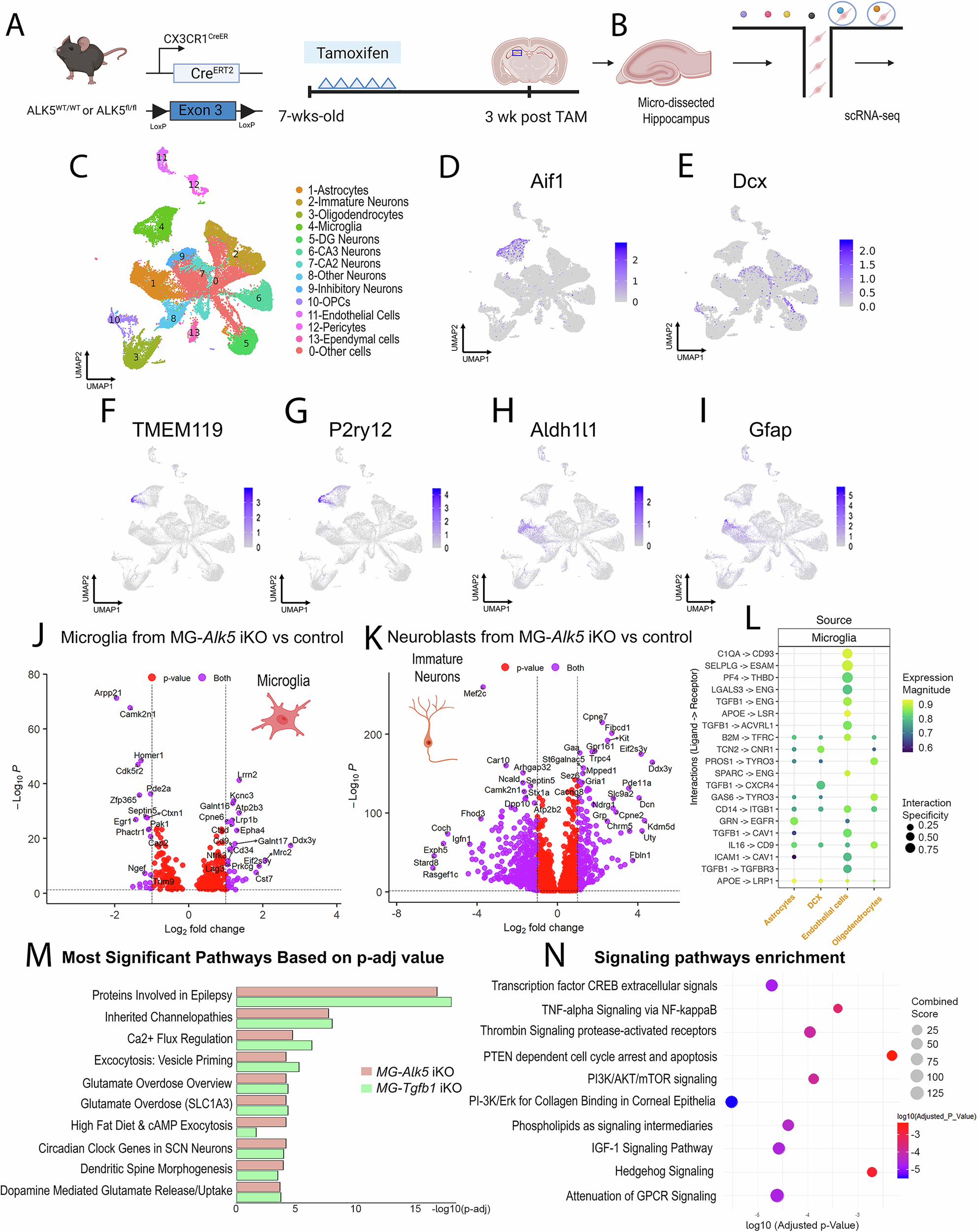
A mouse model used to B micro-dissect the hippocampus and process for single cell 10x Genomic Flex sequencing. C UMAP clustering of cells with annotation for immature neurons and microglia. D Feature plot of Aif1 (coding IBA1 protein) marker to denote microglia cluster. E Feature plot of Dcx to denote DCX+ immature neuroblasts/neuron cluster. F–I Feature plots of Tmem119, P2ry12, Aldh1l1 and Gfap to denote enrichment of microglial signature genes but not astrocytic signature genes in the microglia cluster. J DEGs in MG-Alk5 iKO derived microglia compared to control microglia presented as a volcano plot. K DEGs in MG-Alk5 iKO derived neuroblasts compared to control neuroblasts presented as a volcano plot. L LIANA was used to identify cell-cell interactions and show strong interaction between microglia-endothelial cells and microglia-neuroblasts with identified potential ligand-receptor pairs. M, N EnrichR pathway analysis of DEGs from neuroblasts in MG-Alk5 or Tgfb1 iKO mice with tables denoting top altered disease/cellular processes and molecular pathways. (DEGs) p values were calculated using the Wald test with adjustments for multiple comparisons corrected using the Benjamini-Hochberg method, and (GO Process) p values were calculated using Fisher’s Exact test with adjustments for multiple comparisons were made using Benjamini-Hochberg method.
Future implications
For now, research on adult neurogenesis has been in animal models, but microglia-integrated human organoids are in development for future testing. For the human organoids, Luo is working with Ziyuan Guo, PhD, assistant professor in the College of Medicine’s Department of Pediatrics. Guo’s lab at Cincinnati Children’s focuses on developing next-generation human central nervous system (CNS) models to study neurodevelopmental and neurodegenerative disorders using advanced stem cell and engineering technology.
Krishna Roskin, PhD, an informaticist and immunobiologist at Cincinnati Children’s, also helped decipher the immune-neural stem cell crosstalk by single-cell RNA sequencing analysis.
A long-term goal of Luo and her lab is to use adult neurogenesis as rejuvenation in the brains of aging adults, helping to sustain their cognition and allowing for healthier aging.
“We will be testing the future implications of adult neurogenesis in the understanding and treatment of Alzheimer’s disease,” said Joshua Peter, one of the paper’s lead authors and a graduate assistant in the Luo lab.
Peter was a PhD candidate who recently defended his dissertation and is beginning work at Medpace Inc., managing clinical trials.
“I want to help patients and help drive new treatments in many areas of medicine. Taking research developments to the next level in clinical trials is exciting,” said Peter.
Another graduate student in Luo’s lab, Kierra Ware, is credited with laying the groundwork for the study before she earned her PhD. Ware is now completing a postdoctoral fellowship at Seattle Children’s Hospital.
Both Peter and Ware made novel findings during their time in the Luo lab. “We were able to take part in strong and rigorous research,” said Peter.
Now both have extensive training on cutting-edge technology and are staying in the biomedical research field.
“We are training the next generation of scientists here at the UC College of Medicine,” said Luo.
Source – University of Cincinnati College of Medicine


Breakthrough research from the University of Cincinnati College of Medicine is revealing how immune cells in the adult brain can regulate the generation of new neurons.
The study is leading to a new understanding of how immune cells can influence adult neurogenesis, the process of creating new neurons in the brain. Neurons are the brain’s fundamental information messengers, and the immune cells conduct surveillance and send messages to new neurons.
The study’s corresponding author is Yu (Agnes) Luo, PhD, professor and vice chair for research in the Department of Molecular and Cellular Biosciences.
UC study breakthroughs
Luo said it has long been debated whether adults even have the capacity for neurogenesis. Does the human brain make new neurons in adulthood?
Then research published in the journal Science in the summer of 2025 concluded, yes, neurogenesis happens in the adult human hippocampus, the part of the brain that handles learning and memory.
So Luo and the graduate assistants working in her research lab on UC’s campus turned their attention to the mechanisms that regulate adult neurogenesis, and their research in Nature Communications reveals two breakthroughs.
The first is that immune cells in the brain, known as microglia, have the capacity to regulate neurogenesis in the hippocampal region of the adult brain.
The second breakthrough concerns activated microglia, which lack TGF-beta signaling, and, in turn, stimulate adult neurogenesis through microglia-neural stem cell signaling crosstalk — the complex interplay in which cellular pathways communicate.
ScRNAseq analysis of the dissected hippocampus from control, MG-Alk5 or Tgfb1 iKO mice show microglia-neuroblasts crosstalk and identifies IGF-1, TNF-α, PTEN/mTOR pathways as mediators for the increased neurogenesis in the iKO mice
A mouse model used to B micro-dissect the hippocampus and process for single cell 10x Genomic Flex sequencing. C UMAP clustering of cells with annotation for immature neurons and microglia. D Feature plot of Aif1 (coding IBA1 protein) marker to denote microglia cluster. E Feature plot of Dcx to denote DCX+ immature neuroblasts/neuron cluster. F–I Feature plots of Tmem119, P2ry12, Aldh1l1 and Gfap to denote enrichment of microglial signature genes but not astrocytic signature genes in the microglia cluster. J DEGs in MG-Alk5 iKO derived microglia compared to control microglia presented as a volcano plot. K DEGs in MG-Alk5 iKO derived neuroblasts compared to control neuroblasts presented as a volcano plot. L LIANA was used to identify cell-cell interactions and show strong interaction between microglia-endothelial cells and microglia-neuroblasts with identified potential ligand-receptor pairs. M, N EnrichR pathway analysis of DEGs from neuroblasts in MG-Alk5 or Tgfb1 iKO mice with tables denoting top altered disease/cellular processes and molecular pathways. (DEGs) p values were calculated using the Wald test with adjustments for multiple comparisons corrected using the Benjamini-Hochberg method, and (GO Process) p values were calculated using Fisher’s Exact test with adjustments for multiple comparisons were made using Benjamini-Hochberg method.
Future implications
For now, research on adult neurogenesis has been in animal models, but microglia-integrated human organoids are in development for future testing. For the human organoids, Luo is working with Ziyuan Guo, PhD, assistant professor in the College of Medicine’s Department of Pediatrics. Guo’s lab at Cincinnati Children’s focuses on developing next-generation human central nervous system (CNS) models to study neurodevelopmental and neurodegenerative disorders using advanced stem cell and engineering technology.
Krishna Roskin, PhD, an informaticist and immunobiologist at Cincinnati Children’s, also helped decipher the immune-neural stem cell crosstalk by single-cell RNA sequencing analysis.
A long-term goal of Luo and her lab is to use adult neurogenesis as rejuvenation in the brains of aging adults, helping to sustain their cognition and allowing for healthier aging.
Peter was a PhD candidate who recently defended his dissertation and is beginning work at Medpace Inc., managing clinical trials.
Another graduate student in Luo’s lab, Kierra Ware, is credited with laying the groundwork for the study before she earned her PhD. Ware is now completing a postdoctoral fellowship at Seattle Children’s Hospital.
Now both have extensive training on cutting-edge technology and are staying in the biomedical research field.
Source – University of Cincinnati College of Medicine
Ware K, Peter J, Yazell J, Thapa C, Taranov A, Bedolla A, Distel C, Lammich S, Feederle R, Sülzen A, Liddelow S, Roskin K, Luo Y. (2026) Inhibition of TGF-β signaling in microglia stimulates hippocampal adult neurogenesis and reduces anxiety-like behavior in adult mice. Nature Communications 17(1): 1440. [article]
Related Posts
Novel biosensor uses DNA ‘barcodes’ to uncover disease signals in cells
CellART extracts single-cell information from high-resolution spatial transcriptomics
Cell2space restores spatial context to single-cell RNA sequencing data
Urine test may improve bladder cancer diagnosis and guide treatment decisions
DeCoRE – a computational method to resolve RNA structural heterogeneity from RNA structure probing data by direct RNA sequencing
Tracing 700 million years of cell evolution
How should biological replicates be handled in long-read RNA sequencing?
RNA-Seq reveals a new way the developing heart controls its growth
The Human RNome Project Consortium seeks to publish first-ever complete sequence of the body’s RNA
scFlowReport brings multiple single-cell RNA sequencing analyses into one workflow
Long-read RNA sequencing reveals how neurons choose alternative RNA endings
DeOPUS improves cell-type estimates from bulk RNA sequencing
ResolVI improves accuracy in spatial transcriptomics analysis
RNA sequencing reveals transcriptional allele differences in prostate cancer stem cells
Unmasking “zombie cells” in aging tissue with an AI-powered barcode
RNA variant imaging for cancer diagnosis
Autism-risk mutations reveal two opposing patterns of brain gene activity
A real-data approach to evaluating RNA transcript analysis methods
Detection and sequencing of Ap2N-capped RNAs in human cells
Single-cell RNA sequencing provides a closer look at the Aedes aegypti midgut
Stay Connected
Submit a Post to the Blog
Recent Posts
Subscribe to the RNA-Seq Blog
RNA-Seq Products & Services