

How researchers move from RNA sequencing data to meaningful questions about genes, disease and treatment response.
Source – Vaxonyx
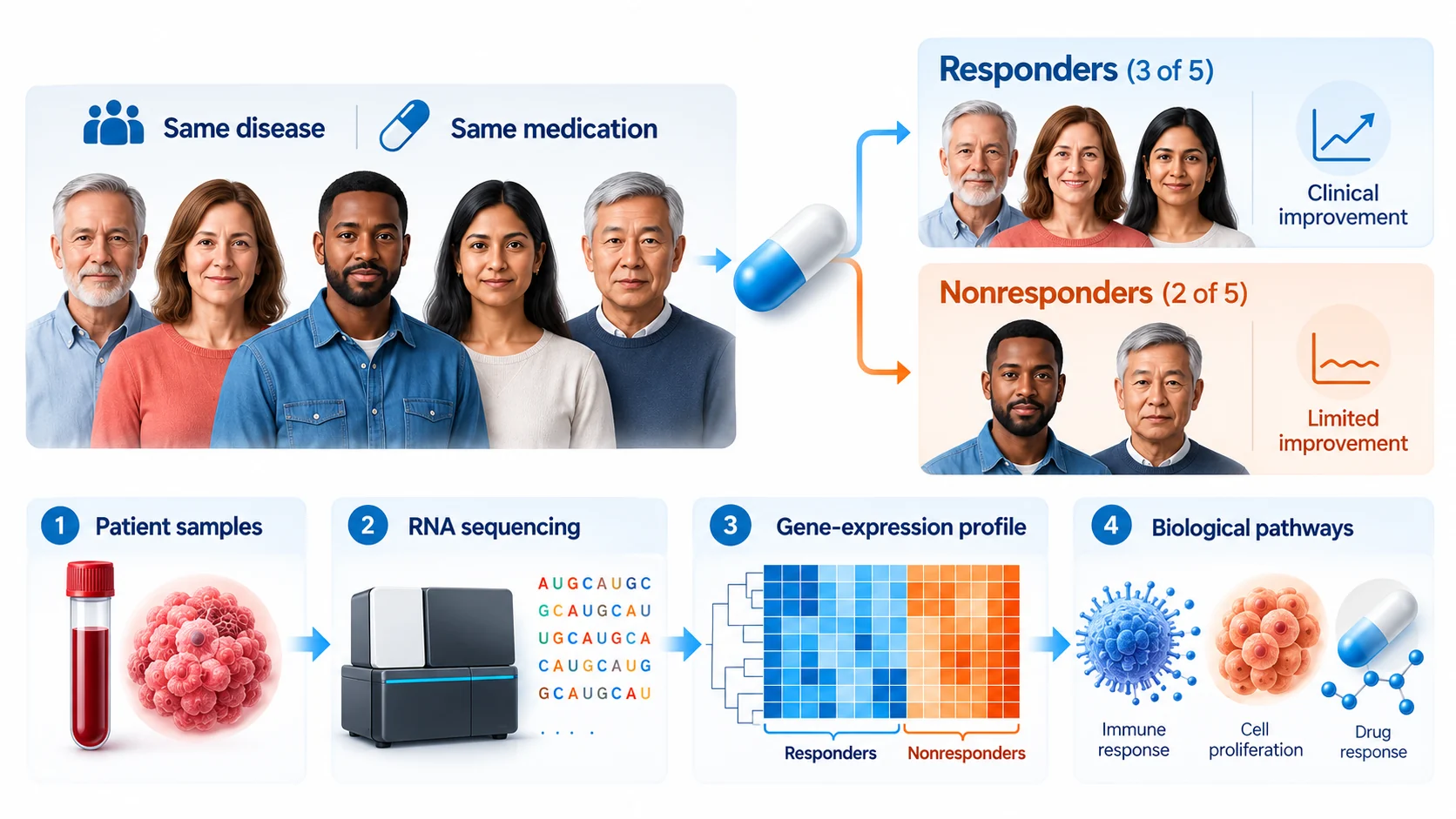
Two patients may receive the same medication for the same diagnosis and have very different experiences. One improves noticeably. Another experiences little change. A third develops side effects that make continued treatment difficult. As illustrated in Figure 01, these differences raise a question that is both simple and challenging: can we identify biological features associated with the way patients respond?
There are many possible influences. Patients may differ in disease subtype, age, immune activity, other medications, genetic background and the amount of drug their bodies are exposed to. Researchers might investigate RNA from blood or relevant tissue to look for patterns linked to clinical response. Those patterns can narrow the next set of questions, but they are not a complete explanation of an individual patient’s outcome.
Imagine that RNA associated with immune signaling is more abundant in samples from patients who improved. The observation would be worth investigating. It would not establish that immune signaling made the drug work. Perhaps the difference existed before treatment; perhaps the samples contained different proportions of immune cells. An unmeasured clinical factor might also contribute. RNA-seq is most useful when researchers resist the temptation to turn an association into a conclusion about cause.
At a glance: what is bulk RNA-seq?
Bulk RNA sequencing, usually shortened to bulk RNA-seq, measures RNA in a sample made up of many cells. Because the amount of RNA from a gene can change as cells respond to illness, treatment or their surroundings, these measurements help researchers investigate gene expression. They do not directly reveal how much protein a cell makes or whether a biological pathway is active. A useful RNA-seq result begins with a carefully collected sample and ends with a carefully qualified interpretation.
Related Posts
















How researchers move from RNA sequencing data to meaningful questions about genes, disease and treatment response.
Source – Vaxonyx
Two patients may receive the same medication for the same diagnosis and have very different experiences. One improves noticeably. Another experiences little change. A third develops side effects that make continued treatment difficult. As illustrated in Figure 01, these differences raise a question that is both simple and challenging: can we identify biological features associated with the way patients respond?
There are many possible influences. Patients may differ in disease subtype, age, immune activity, other medications, genetic background and the amount of drug their bodies are exposed to. Researchers might investigate RNA from blood or relevant tissue to look for patterns linked to clinical response. Those patterns can narrow the next set of questions, but they are not a complete explanation of an individual patient’s outcome.
Imagine that RNA associated with immune signaling is more abundant in samples from patients who improved. The observation would be worth investigating. It would not establish that immune signaling made the drug work. Perhaps the difference existed before treatment; perhaps the samples contained different proportions of immune cells. An unmeasured clinical factor might also contribute. RNA-seq is most useful when researchers resist the temptation to turn an association into a conclusion about cause.
At a glance: what is bulk RNA-seq?
Bulk RNA sequencing, usually shortened to bulk RNA-seq, measures RNA in a sample made up of many cells. Because the amount of RNA from a gene can change as cells respond to illness, treatment or their surroundings, these measurements help researchers investigate gene expression. They do not directly reveal how much protein a cell makes or whether a biological pathway is active. A useful RNA-seq result begins with a carefully collected sample and ends with a carefully qualified interpretation.
Related Posts
Recent Posts
 PANGEA – an integrated cell atlas across diverse biological contexts enables systematic profiling of multicellular responses in human diseases
 UMIche – a UMI-centric analysis platform for enhancing molecular quantification accuracy in bulk and single-cell sequencing
 New AI tool uses RNA sequencing to uncover gene interactions in Alzheimer’s disease
 New RNA sequencing tool reveals how stem cells develop into heart cells
 Estimating the completeness of large-scale single-cell sequencing projects
 New RNA sequencing tool improves transcriptome reconstruction using machine learning
RNA-Seq Products & Services


Stay Connected