Korea University College of Medicine Research Team Identifies New Therapeutic Target by Tracing Meningioma Recurrence Mechanism
A research team led by Professor Jason Kyungha Sa from the Department of Biomedical Informatics at Korea University College of Medicine has identified a novel therapeutic target for recurrent meningioma through precision genomic analysis.
By performing single-cell RNA profiling of recurrent meningiomas, the team systematically mapped the tumor’s evolutionary process and its interactions with surrounding immune cells. The study revealed that the COL6A3 gene is a key driver of recurrence risk and a promising therapeutic target.
Meningiomas account for approximately 30% of all brain tumors and are generally classified as benign tumors. However, high-grade or recurrent meningiomas are notoriously difficult to treat and are associated with poor prognoses.
Until now, few studies have precisely compared primary and recurrent tumors from the same patient at the single-cell resolution to track the tumor evolutionary pattern. To address this gap, Professor Sa’s team conducted single-nuclei RNA sequencing (snRNA-seq) on matched primary and recurrent tumors from Korean meningioma patients.
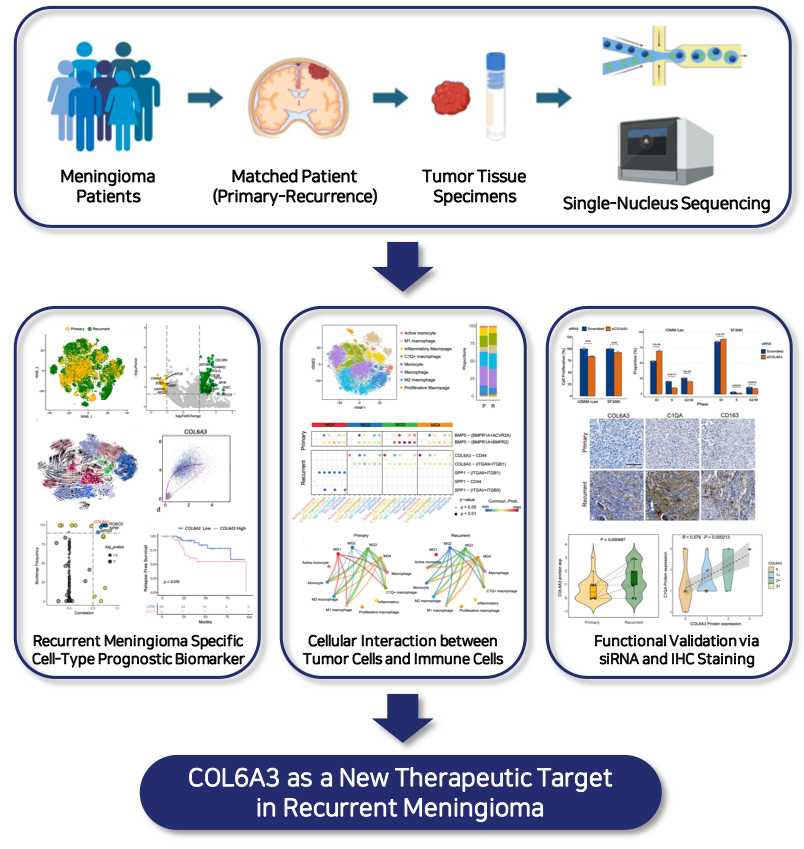
Their results showed that recurrent meningiomas exhibit accelerated cell proliferation and increased COL6A3 expression. By tracing tumor transcriptional changes over time and performing cellular interaction analysis, the team found that COL6A3 was increasingly activated in the later stages of tumor progression. Moreover, it interacts with immunosuppressive macrophages, facilitating malignant transformation.
Further analysis between the meningioma risk prediction index and COL6A3 expression confirmed that overexpression of COL6A3 significantly increases tumor malignancy. In an independent dataset of 110 meningioma patients, those with high COL6A3 expression showed markedly higher recurrence rates.
“This study is significant as it precisely compared primary and recurrent tumors from the same patient using single-cell transcriptomics, revealing how meningiomas evolve and interact with the tumor microenvironment,” said Professor Sa. “For recurrent meningiomas, where treatment options are limited, our findings provide a crucial starting point for developing new therapeutic strategies targeting COL6A3.”
Source – Korea University College of Medicine


Korea University College of Medicine Research Team Identifies New Therapeutic Target by Tracing Meningioma Recurrence Mechanism
A research team led by Professor Jason Kyungha Sa from the Department of Biomedical Informatics at Korea University College of Medicine has identified a novel therapeutic target for recurrent meningioma through precision genomic analysis.
By performing single-cell RNA profiling of recurrent meningiomas, the team systematically mapped the tumor’s evolutionary process and its interactions with surrounding immune cells. The study revealed that the COL6A3 gene is a key driver of recurrence risk and a promising therapeutic target.
Meningiomas account for approximately 30% of all brain tumors and are generally classified as benign tumors. However, high-grade or recurrent meningiomas are notoriously difficult to treat and are associated with poor prognoses.
Until now, few studies have precisely compared primary and recurrent tumors from the same patient at the single-cell resolution to track the tumor evolutionary pattern. To address this gap, Professor Sa’s team conducted single-nuclei RNA sequencing (snRNA-seq) on matched primary and recurrent tumors from Korean meningioma patients.
Their results showed that recurrent meningiomas exhibit accelerated cell proliferation and increased COL6A3 expression. By tracing tumor transcriptional changes over time and performing cellular interaction analysis, the team found that COL6A3 was increasingly activated in the later stages of tumor progression. Moreover, it interacts with immunosuppressive macrophages, facilitating malignant transformation.
Further analysis between the meningioma risk prediction index and COL6A3 expression confirmed that overexpression of COL6A3 significantly increases tumor malignancy. In an independent dataset of 110 meningioma patients, those with high COL6A3 expression showed markedly higher recurrence rates.
Source – Korea University College of Medicine
Lee JY, Lee E, Seo B, Kim J, Song Y, Lee D, Moon N, Koo H, Park C, Kim M, Park S, Nam D, Kong D, Sa J. (2025) Single-cell analysis reveals a longitudinal trajectory of meningioma evolution and heterogeneity. Nature Communications 16(1): 5481. [article]
Related Posts
Scientists identify the neuroblastoma cells that signal poor outcomes
Novel biosensor uses DNA ‘barcodes’ to uncover disease signals in cells
CellART extracts single-cell information from high-resolution spatial transcriptomics
Cell2space restores spatial context to single-cell RNA sequencing data
Urine test may improve bladder cancer diagnosis and guide treatment decisions
DeCoRE – a computational method to resolve RNA structural heterogeneity from RNA structure probing data by direct RNA sequencing
Tracing 700 million years of cell evolution
How should biological replicates be handled in long-read RNA sequencing?
RNA-Seq reveals a new way the developing heart controls its growth
The Human RNome Project Consortium seeks to publish first-ever complete sequence of the body’s RNA
scFlowReport brings multiple single-cell RNA sequencing analyses into one workflow
Long-read RNA sequencing reveals how neurons choose alternative RNA endings
DeOPUS improves cell-type estimates from bulk RNA sequencing
ResolVI improves accuracy in spatial transcriptomics analysis
RNA sequencing reveals transcriptional allele differences in prostate cancer stem cells
Unmasking “zombie cells” in aging tissue with an AI-powered barcode
RNA variant imaging for cancer diagnosis
Autism-risk mutations reveal two opposing patterns of brain gene activity
A real-data approach to evaluating RNA transcript analysis methods
Detection and sequencing of Ap2N-capped RNAs in human cells
Stay Connected
Submit a Post to the Blog
Recent Posts
Subscribe to the RNA-Seq Blog
RNA-Seq Products & Services