

Single-cell technologies, like single-cell RNA sequencing (scRNA-seq), have become essential for exploring the complexity of tissues and organs, helping scientists understand how individual cells behave in health and disease. A key step in analyzing this data is clustering—grouping cells based on their gene expression profiles to identify distinct cell types or states. However, many commonly used clustering tools don’t check if the clusters they create are statistically sound. This can lead to overclustering, where one type of cell gets split into many meaningless groups, or underclustering, where different cell types get lumped together.
To tackle this challenge, researchers at the Gladstone Institute of Neurological Disease have developed a powerful new tool called CHOIR—short for Cluster Hierarchy Optimization by Iterative Random forests. CHOIR adds a crucial statistical component to clustering by using a combination of random forest classifiers and permutation tests. This means it not only groups cells, but also tests whether those groupings are truly meaningful based on the underlying data.
CHOIR is a hierarchical clustering algorithm that uses permutation testing
for cluster identification by statistical inference
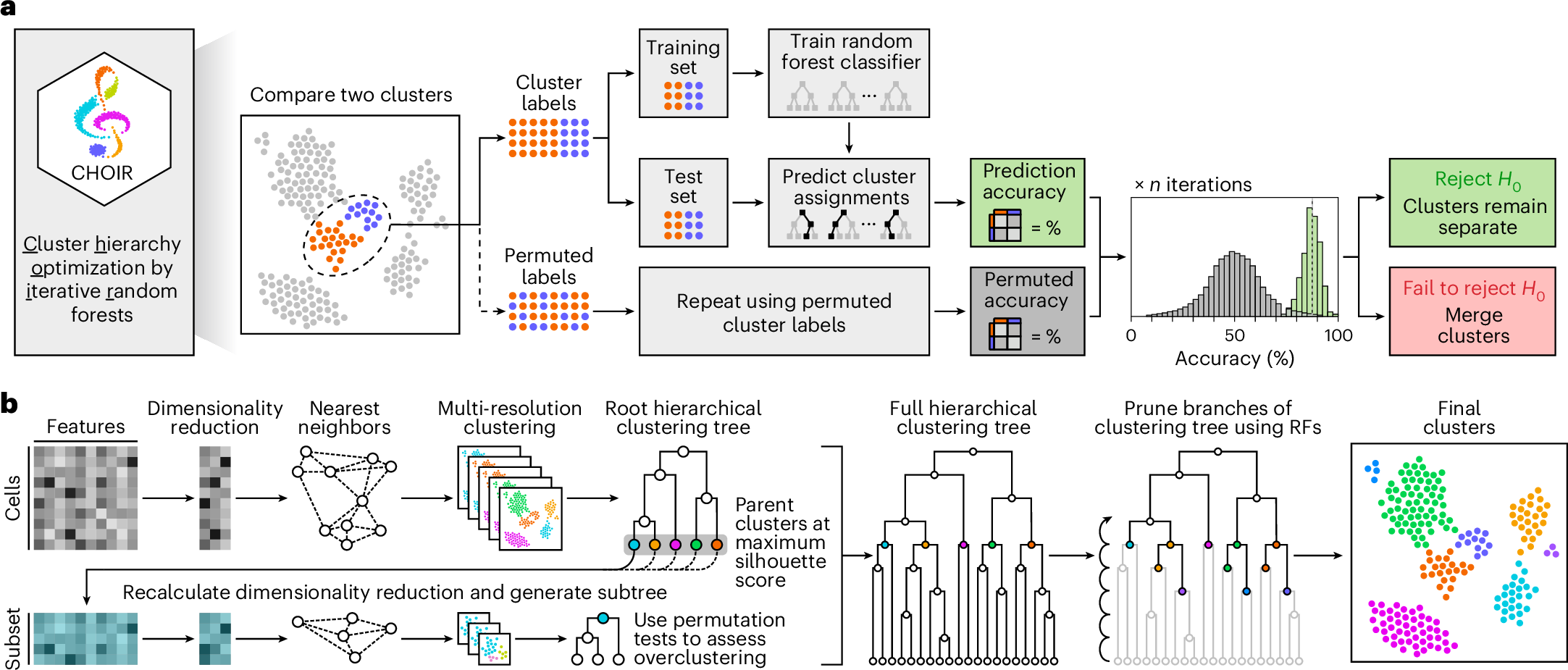
a, Schematic demonstrating how CHOIR identifies clusters that should be merged by applying a permutation testing approach to assess the accuracy of random forest classifiers (RFs) in predicting cluster assignments from a normalized feature matrix. b, Schematic demonstrating how CHOIR constructs and iteratively prunes a hierarchical clustering tree using statistical inference to prevent underclustering and overclustering.
What sets CHOIR apart is its flexibility and robustness. The authors benchmarked CHOIR across 230 simulated datasets and five real datasets, including not just single-cell RNA sequencing but also spatial transcriptomics, multi-omics, and ATAC-seq data (a method to look at open regions of DNA). In all cases, CHOIR outperformed 15 existing clustering methods, particularly in identifying rare or subtle cell populations that other tools often miss.
This method represents a big step forward for researchers working with complex single-cell data. By building statistical rigor into the clustering process, CHOIR helps ensure that scientists are drawing conclusions from biologically meaningful patterns—not just noise. And because it can be applied to virtually any single-cell data type, it’s poised to become a go-to solution for a wide range of research areas, from neuroscience and immunology to cancer biology and developmental studies.
As single-cell datasets continue to grow in size and complexity, tools like CHOIR will be essential for unlocking the full potential of RNA sequencing and related technologies.
Availability – CHOIR is available as an R package at GitHub (https://github.com/corceslab/CHOIR) and Zenodo (https://zenodo.org/records/14719515), and documentation for CHOIR is hosted at https://www.CHOIRclustering.com.
Sant C, Mucke L, Corces M R. (2025) CHOIR improves significance-based detection of cell types and states from single-cell data. Nature Genetics. [Epub ahead of print]. [article]
Related Posts


Single-cell technologies, like single-cell RNA sequencing (scRNA-seq), have become essential for exploring the complexity of tissues and organs, helping scientists understand how individual cells behave in health and disease. A key step in analyzing this data is clustering—grouping cells based on their gene expression profiles to identify distinct cell types or states. However, many commonly used clustering tools don’t check if the clusters they create are statistically sound. This can lead to overclustering, where one type of cell gets split into many meaningless groups, or underclustering, where different cell types get lumped together.
To tackle this challenge, researchers at the Gladstone Institute of Neurological Disease have developed a powerful new tool called CHOIR—short for Cluster Hierarchy Optimization by Iterative Random forests. CHOIR adds a crucial statistical component to clustering by using a combination of random forest classifiers and permutation tests. This means it not only groups cells, but also tests whether those groupings are truly meaningful based on the underlying data.
CHOIR is a hierarchical clustering algorithm that uses permutation testing
for cluster identification by statistical inference
a, Schematic demonstrating how CHOIR identifies clusters that should be merged by applying a permutation testing approach to assess the accuracy of random forest classifiers (RFs) in predicting cluster assignments from a normalized feature matrix. b, Schematic demonstrating how CHOIR constructs and iteratively prunes a hierarchical clustering tree using statistical inference to prevent underclustering and overclustering.
What sets CHOIR apart is its flexibility and robustness. The authors benchmarked CHOIR across 230 simulated datasets and five real datasets, including not just single-cell RNA sequencing but also spatial transcriptomics, multi-omics, and ATAC-seq data (a method to look at open regions of DNA). In all cases, CHOIR outperformed 15 existing clustering methods, particularly in identifying rare or subtle cell populations that other tools often miss.
This method represents a big step forward for researchers working with complex single-cell data. By building statistical rigor into the clustering process, CHOIR helps ensure that scientists are drawing conclusions from biologically meaningful patterns—not just noise. And because it can be applied to virtually any single-cell data type, it’s poised to become a go-to solution for a wide range of research areas, from neuroscience and immunology to cancer biology and developmental studies.
As single-cell datasets continue to grow in size and complexity, tools like CHOIR will be essential for unlocking the full potential of RNA sequencing and related technologies.
Availability – CHOIR is available as an R package at GitHub (https://github.com/corceslab/CHOIR) and Zenodo (https://zenodo.org/records/14719515), and documentation for CHOIR is hosted at https://www.CHOIRclustering.com.
Sant C, Mucke L, Corces M R. (2025) CHOIR improves significance-based detection of cell types and states from single-cell data. Nature Genetics. [Epub ahead of print]. [article]
Related Posts
Recent Posts
 PANGEA – an integrated cell atlas across diverse biological contexts enables systematic profiling of multicellular responses in human diseases
 UMIche – a UMI-centric analysis platform for enhancing molecular quantification accuracy in bulk and single-cell sequencing
 New AI tool uses RNA sequencing to uncover gene interactions in Alzheimer’s disease
 New RNA sequencing tool reveals how stem cells develop into heart cells
 Estimating the completeness of large-scale single-cell sequencing projects
 New RNA sequencing tool improves transcriptome reconstruction using machine learning
RNA-Seq Products & Services



Stay Connected