The easy-to-implement technology reduces the per-reaction cost of target capture by 2-3 orders of magnitude, as compared to standard commercial solutions
In a development that could accelerate the discovery of new diagnostics and treatments, researchers at Children’s Hospital of Philadelphia (CHOP) have developed a versatile and low-cost technology for targeted sequencing of full-length RNA molecules. The technology, called TEQUILA-seq, is highly cost-effective compared to commercially available solutions for targeted RNA sequencing and can be adapted for different research and clinical purposes. The details were described in a paper in Nature Communications.
On the journey from gene to protein, an RNA molecule can be cut and joined in different ways before being translated into a protein. This process is known as alternative splicing, and it allows a single gene to encode several different proteins. Although alternative splicing occurs in many biological processes, it can be dysregulated in diseases like cancer, leading to pathogenic RNA molecules. To understand how alternative splicing might lead to disease, researchers need to have accurate accounting of all the RNA molecules (known as “transcript isoforms”) that emanate from a single gene.
One way of doing so is using “long-read” RNA sequencing platforms, which sequence RNA molecules over 10,000 bases in length end-to-end, capturing the entirety of the transcript isoforms. However, these long-read platforms have modest sequencing yield, which has hampered their widespread adoption, especially in the clinical setting, as generating long-read RNA sequencing data at clinically informative depth could be prohibitively expensive. Targeted sequencing, which involves enriching specific nucleic acid sequences of interest prior to sequencing, is a useful strategy that can substantially enhance coverage of predefined targets, but the cost and complexity of target capture have been barriers to wider use.
“Targeted long-read RNA sequencing is a powerful strategy for elucidating the RNA repertoire for any predefined set of genes. However, existing technologies for targeted sequencing of full-length RNA molecules are either expensive or difficult to set up, putting them out of reach for many labs,” said co-senior author Lan Lin, PhD, Assistant Professor of Pathology and Laboratory Medicine and a member of the Raymond G. Perelman Center for Cellular and Molecular Therapeutics at CHOP. “TEQUILA-seq solves that problem by being both inexpensive and easy to use. The technology can be adapted by users for different purposes, and researchers can choose which genes they want to sequence and make the reagents for target capture in their own labs. This has the potential to accelerate discovery of new diagnostic and therapeutic solutions for a wide range of diseases.”
One method that allows for targeted sequencing is called hybridization capture-based enrichment, which uses short pieces of nucleic acids called oligonucleotides as capture probes. These oligonucleotides (often simply referred to as “oligos”) are tagged with biotin molecules and designed to hybridize to their targets based on nucleic acid sequence complementarity, which allows for easy capture and isolation of their target sequences from a biological sample. However, although hybridization capture-based enrichment is an efficient method for targeted sequencing, commercially synthesized biotinylated capture probes are expensive and can only be used for a limited number of reactions, making the per-sample cost high for each capture reaction.
To address this limitation, the CHOP researchers developed TEQUILA-seq (Transcript Enrichment and Quantification Utilizing Isothermally Linear-Amplified probes in conjunction with long-read sequencing). A key innovation in TEQUILA-seq is a nicking-endonuclease triggered isothermal strand displacement amplification reaction, which can synthesize large quantities of biotinylated capture probes from a cheap pool of non-biotinylated oligos as the templates. Using an input of only 2 ng of template oligos, the researchers can generate 25 ug of TEQUILA probes, which can be used for at least 250 capture reactions. This innovative strategy for synthesizing capture probes makes TEQUILA-seq highly cost-effective and scalable for large target panels and many biological samples.
Overview of TEQUILA-seq
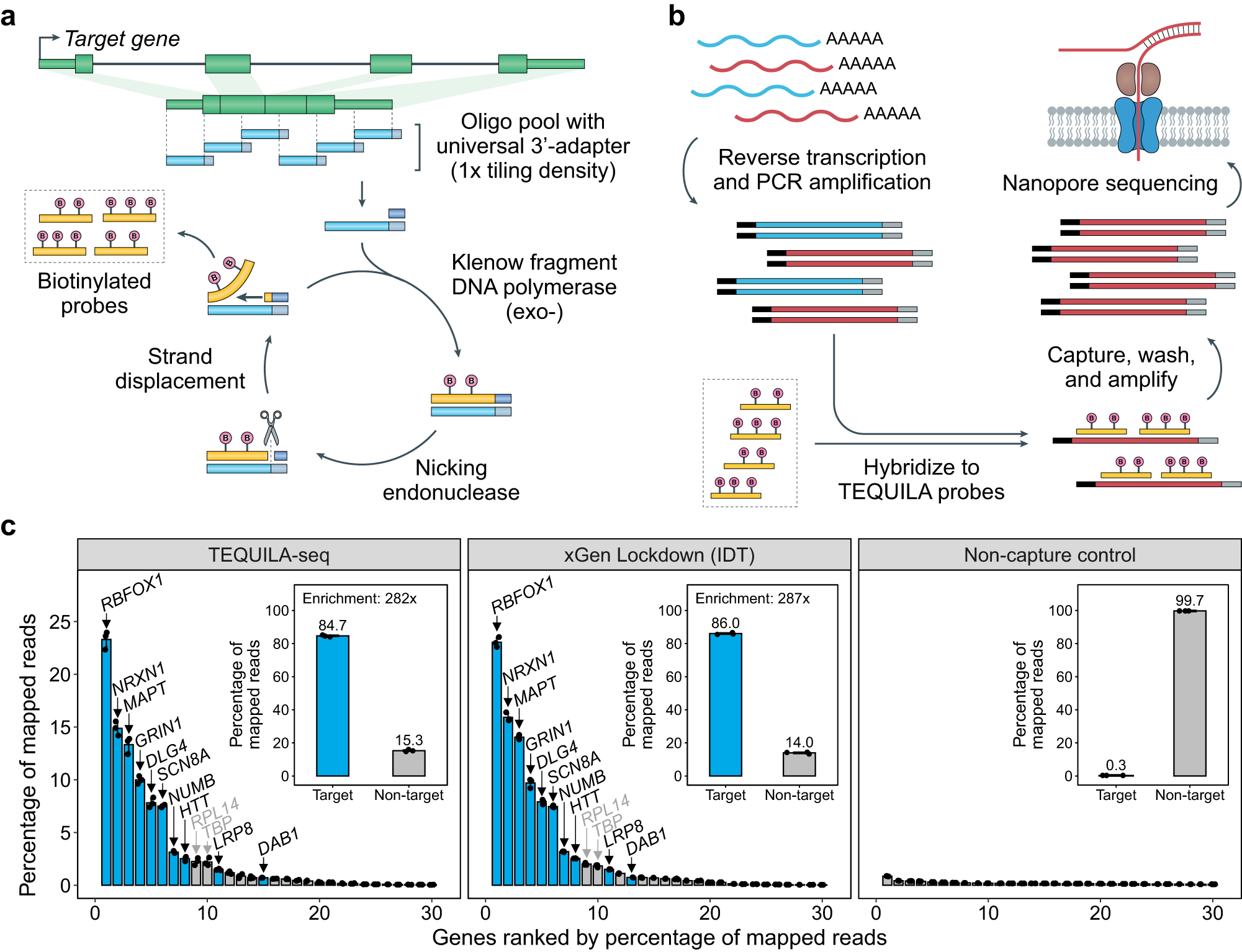
a, b Schematic of TEQUILA-seq. a Single-stranded DNA (ssDNA) oligonucleotides are designed to tile across all annotated exons of target genes and synthesized using an array-based DNA synthesis technology. TEQUILA probes are amplified from ssDNA oligo templates in a single pool using nickase-triggered strand displacement amplification with universal primers and biotin-dUTPs. b Full-length cDNAs are synthesized from poly(A)+ RNAs by reverse transcription and PCR amplification. TEQUILA probes are then hybridized to cDNAs. Upon capture and washing, cDNA-to-probe hybrids are immobilized to streptavidin magnetic beads, whereas unbound cDNAs are washed away. Captured cDNAs are further amplified by PCR and subjected to nanopore 1D library preparation and sequencing. c Comparison of TEQUILA-seq vs xGen Lockdown (IDT) probe-based target enrichment and sequencing. Main graphs: percentage of reads mapped to a given gene (mean ± s.d. of n = 3 replicates), for the top 30 genes with the highest number of mapped reads. Insets: percentage of reads mapped to target genes and non-target genes (mean ± s.d. of n = 3 replicates). Blue: target genes. Gray: non-target genes. Target gene panel: ten human genes with long transcripts in the brain. All sequencing methods were applied to the same human brain RNA mix from multiple donors.
To benchmark its performance, the researchers performed TEQUILA-seq for multiple gene panels on synthetic RNAs or human RNAs. TEQUILA probes performed as well as commercial capture probes in target capture and enrichment, while being hundreds of times cheaper for each capture reaction. Moreover, the researchers demonstrated that TEQUILA-seq can substantially enhance detection while preserving quantification of target RNA molecules.
“Using cheap reagents and an easy experimental workflow, TEQUILA-seq allows us to deeply sequence the full-length RNA molecules for any gene set across many biological samples,” said co-senior author Yi Xing, PhD, director of the Center for Computational and Genomic Medicine at CHOP. “This is very exciting and enables a wide range of medical applications, from RNA-guided genetic diagnosis to therapy development.”
To illustrate its biomedical utility, the researchers applied TEQUILA-seq to profile full-length RNA molecules of 468 actionable cancer genes across 40 breast cancer cell lines. They discovered previously unknown transcript isoforms in extensively studied cancer genes that may shed light on how genes that protect the body from cancer are inactivated in individual tumors.
“Our work shows that TEQUILA-seq can be broadly used for targeted sequencing of full-length RNA molecules,” Dr. Lin said. “Moreover, TEQUILA probes are general-purpose capture probes. They are compatible for both targeted RNA and DNA sequencing, on both long-read and short-read sequencing platforms. The ability to easily generate large quantities of biotinylated capture probes for any target panel at a low cost and with ease can facilitate large-scale and population-level studies for many basic, translational, and clinical applications.”
Availability – The scripts used for processing, analyzing, and visualizing TEQUILA-seq data are publicly available on GitHub (https://github.com/Xinglab/TEQUILA-seq)
Source – Children’s Hospital of Philadelphia (CHOP)


The easy-to-implement technology reduces the per-reaction cost of target capture by 2-3 orders of magnitude, as compared to standard commercial solutions
In a development that could accelerate the discovery of new diagnostics and treatments, researchers at Children’s Hospital of Philadelphia (CHOP) have developed a versatile and low-cost technology for targeted sequencing of full-length RNA molecules. The technology, called TEQUILA-seq, is highly cost-effective compared to commercially available solutions for targeted RNA sequencing and can be adapted for different research and clinical purposes. The details were described in a paper in Nature Communications.
On the journey from gene to protein, an RNA molecule can be cut and joined in different ways before being translated into a protein. This process is known as alternative splicing, and it allows a single gene to encode several different proteins. Although alternative splicing occurs in many biological processes, it can be dysregulated in diseases like cancer, leading to pathogenic RNA molecules. To understand how alternative splicing might lead to disease, researchers need to have accurate accounting of all the RNA molecules (known as “transcript isoforms”) that emanate from a single gene.
One way of doing so is using “long-read” RNA sequencing platforms, which sequence RNA molecules over 10,000 bases in length end-to-end, capturing the entirety of the transcript isoforms. However, these long-read platforms have modest sequencing yield, which has hampered their widespread adoption, especially in the clinical setting, as generating long-read RNA sequencing data at clinically informative depth could be prohibitively expensive. Targeted sequencing, which involves enriching specific nucleic acid sequences of interest prior to sequencing, is a useful strategy that can substantially enhance coverage of predefined targets, but the cost and complexity of target capture have been barriers to wider use.
One method that allows for targeted sequencing is called hybridization capture-based enrichment, which uses short pieces of nucleic acids called oligonucleotides as capture probes. These oligonucleotides (often simply referred to as “oligos”) are tagged with biotin molecules and designed to hybridize to their targets based on nucleic acid sequence complementarity, which allows for easy capture and isolation of their target sequences from a biological sample. However, although hybridization capture-based enrichment is an efficient method for targeted sequencing, commercially synthesized biotinylated capture probes are expensive and can only be used for a limited number of reactions, making the per-sample cost high for each capture reaction.
To address this limitation, the CHOP researchers developed TEQUILA-seq (Transcript Enrichment and Quantification Utilizing Isothermally Linear-Amplified probes in conjunction with long-read sequencing). A key innovation in TEQUILA-seq is a nicking-endonuclease triggered isothermal strand displacement amplification reaction, which can synthesize large quantities of biotinylated capture probes from a cheap pool of non-biotinylated oligos as the templates. Using an input of only 2 ng of template oligos, the researchers can generate 25 ug of TEQUILA probes, which can be used for at least 250 capture reactions. This innovative strategy for synthesizing capture probes makes TEQUILA-seq highly cost-effective and scalable for large target panels and many biological samples.
Overview of TEQUILA-seq
a, b Schematic of TEQUILA-seq. a Single-stranded DNA (ssDNA) oligonucleotides are designed to tile across all annotated exons of target genes and synthesized using an array-based DNA synthesis technology. TEQUILA probes are amplified from ssDNA oligo templates in a single pool using nickase-triggered strand displacement amplification with universal primers and biotin-dUTPs. b Full-length cDNAs are synthesized from poly(A)+ RNAs by reverse transcription and PCR amplification. TEQUILA probes are then hybridized to cDNAs. Upon capture and washing, cDNA-to-probe hybrids are immobilized to streptavidin magnetic beads, whereas unbound cDNAs are washed away. Captured cDNAs are further amplified by PCR and subjected to nanopore 1D library preparation and sequencing. c Comparison of TEQUILA-seq vs xGen Lockdown (IDT) probe-based target enrichment and sequencing. Main graphs: percentage of reads mapped to a given gene (mean ± s.d. of n = 3 replicates), for the top 30 genes with the highest number of mapped reads. Insets: percentage of reads mapped to target genes and non-target genes (mean ± s.d. of n = 3 replicates). Blue: target genes. Gray: non-target genes. Target gene panel: ten human genes with long transcripts in the brain. All sequencing methods were applied to the same human brain RNA mix from multiple donors.
To benchmark its performance, the researchers performed TEQUILA-seq for multiple gene panels on synthetic RNAs or human RNAs. TEQUILA probes performed as well as commercial capture probes in target capture and enrichment, while being hundreds of times cheaper for each capture reaction. Moreover, the researchers demonstrated that TEQUILA-seq can substantially enhance detection while preserving quantification of target RNA molecules.
To illustrate its biomedical utility, the researchers applied TEQUILA-seq to profile full-length RNA molecules of 468 actionable cancer genes across 40 breast cancer cell lines. They discovered previously unknown transcript isoforms in extensively studied cancer genes that may shed light on how genes that protect the body from cancer are inactivated in individual tumors.
Availability – The scripts used for processing, analyzing, and visualizing TEQUILA-seq data are publicly available on GitHub (https://github.com/Xinglab/TEQUILA-seq)
Source – Children’s Hospital of Philadelphia (CHOP)
Wang F, Xu Y, Wang R, Zhang B, Smith N, Notaro A, Gaerlan S, Kutschera E, Kadash-Edmondson K E, Xing Y, Lin L. (2023) TEQUILA-seq: a versatile and low-cost method for targeted long-read RNA sequencing. Nature Communications 14(1): 4760. [article]
Related Posts
Scientists identify the neuroblastoma cells that signal poor outcomes
Machine learning reveals how RNA splicing is regulated in individual cell types
Novel biosensor uses DNA ‘barcodes’ to uncover disease signals in cells
Urine test may improve bladder cancer diagnosis and guide treatment decisions
Tracing 700 million years of cell evolution
RNA-Seq reveals a new way the developing heart controls its growth
The Human RNome Project Consortium seeks to publish first-ever complete sequence of the body’s RNA
Unmasking “zombie cells” in aging tissue with an AI-powered barcode
Single-cell TimeLapse-seq reveals MTA is an essential retrotransposon
RNA variant imaging for cancer diagnosis
Autism-risk mutations reveal two opposing patterns of brain gene activity
Detection and sequencing of Ap2N-capped RNAs in human cells
Single-cell RNA sequencing provides a closer look at the Aedes aegypti midgut
Avoiding a sticky situation: how cells stop messenger RNAs from clumping together
Benchmarking RNA sequencing for more accurate alternative splicing analysis
RNA Sequencing identifies new tick-borne virus that causes flu-like illness
POND-seq enables non-destructive RNA sequencing in living cells
Worm’s radical transformation shows metamorphosis can change the functions of cells
New method allows scientists to follow gene activity over time in the same cells
Single-cell and single-embryo RNA sequencing
Stay Connected
Submit a Post to the Blog
Recent Posts
Subscribe to the RNA-Seq Blog
RNA-Seq Products & Services