

Circular RNAs (circRNAs) are a unique type of RNA molecule that form a closed loop, unlike the more familiar linear RNAs. These loops may look simple, but they play surprisingly important roles in regulating genes and contributing to diseases like cancer and neurological disorders. Despite their potential, circRNAs are hard to detect because they’re often present in very small amounts and look a lot like regular RNA.
Researchers from the Chinese Academy of Sciences explore how cutting-edge tools like long-read RNA sequencing and single-cell analysis are making it easier to identify and study circRNAs in fine detail. These advances are giving scientists a clearer view of how these molecules function inside individual cells—something that wasn’t possible just a few years ago.
But there’s more: artificial intelligence (AI) is playing a major role, too. Deep learning models are now being used to sift through massive amounts of RNA sequencing data to accurately detect circRNAs and predict their functions. The researchers highlight how combining sequencing technologies with AI tools could help researchers unlock new insights into circRNA biology, improve diagnostics, and possibly even lead to new treatments.
Challenges and opportunities in large-scale analysis of circRNA data
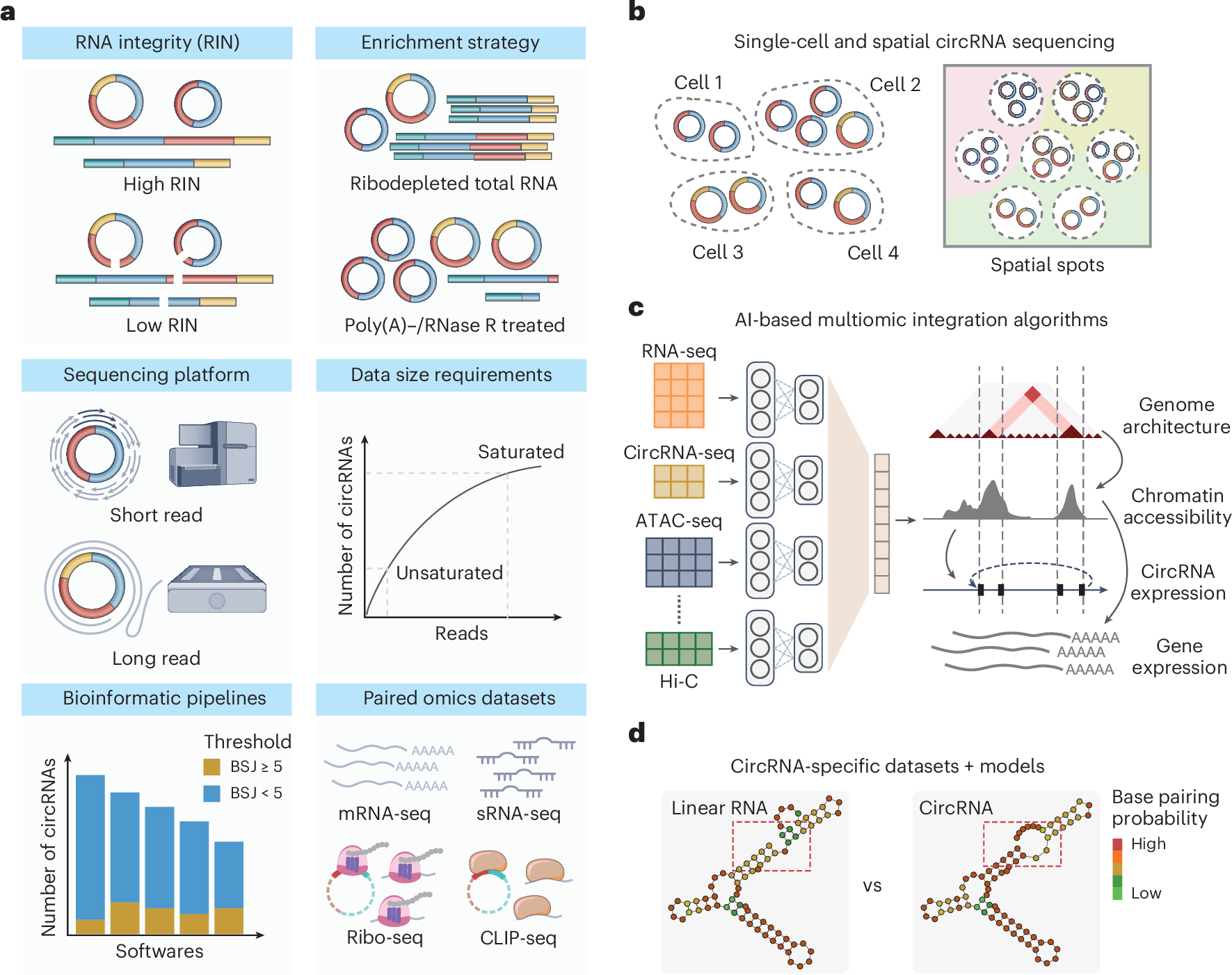
a, Challenges in integrating large-scale circRNA sequencing data. First, RIN is critical, as degraded circRNAs are lost during downstream processing, impeding the detection of BSJ reads. Diverse circRNA-enrichment strategies also lead to variations in detection efficiency and give rise to substantial batch effects, affecting the accuracy of circRNA quantification. Furthermore, short-read sequencing typically provides results at the BSJ level, while long-read methods allow for more complicated isoform-level quantification. Sequencing depth affects the saturation of circRNA detection, and variation in the sensitivity and filter threshold of different bioinformatic pipelines also increases the difficulty of integration. In addition, although paired sequencing datasets can provide evidence to infer circRNA regulation and functions, heterogeneity between different studies poses further challenges in the integration process. CLIP–seq, cross-linking immunoprecipitation followed by high-throughput sequencing. sRNA-seq, small RNA sequencing. b, Development of single-cell and spatial circRNA sequencing technologies provides an opportunity to characterize circRNA expression patterns with improved resolution. Here, optimized circRNA sequencing strategies are essential to detect circRNAs from limited material from single cells and spatial spots. c, Development of AI-based multiomic algorithms could integrate omic-specific features, providing critical insights into how genome architecture, chromatin accessibility and other epigenetic features affect circRNA biogenesis. ATAC–seq, assay for transposase-accessible chromatin with sequencing. d, A circRNA and its cognate linear RNA can exhibit distinct structures and functionalities. Therefore, the development of circRNA-specific AI models requires the accumulation of circRNA training sets and the development of tailored algorithms to incorporate circRNA-specific features, such as exon scrambling patterns and unique BSJ sequences.
As scientists continue to refine these methods and address challenges like data integration and analysis, the future looks bright for circRNA research and its applications in medicine.
Zhang J, Zhao F. (2025) Circular RNA discovery with emerging sequencing and deep learning technologies. Nature Genetics [Epub ahead of print]. [article]
Related Posts


Circular RNAs (circRNAs) are a unique type of RNA molecule that form a closed loop, unlike the more familiar linear RNAs. These loops may look simple, but they play surprisingly important roles in regulating genes and contributing to diseases like cancer and neurological disorders. Despite their potential, circRNAs are hard to detect because they’re often present in very small amounts and look a lot like regular RNA.
Researchers from the Chinese Academy of Sciences explore how cutting-edge tools like long-read RNA sequencing and single-cell analysis are making it easier to identify and study circRNAs in fine detail. These advances are giving scientists a clearer view of how these molecules function inside individual cells—something that wasn’t possible just a few years ago.
But there’s more: artificial intelligence (AI) is playing a major role, too. Deep learning models are now being used to sift through massive amounts of RNA sequencing data to accurately detect circRNAs and predict their functions. The researchers highlight how combining sequencing technologies with AI tools could help researchers unlock new insights into circRNA biology, improve diagnostics, and possibly even lead to new treatments.
Challenges and opportunities in large-scale analysis of circRNA data
a, Challenges in integrating large-scale circRNA sequencing data. First, RIN is critical, as degraded circRNAs are lost during downstream processing, impeding the detection of BSJ reads. Diverse circRNA-enrichment strategies also lead to variations in detection efficiency and give rise to substantial batch effects, affecting the accuracy of circRNA quantification. Furthermore, short-read sequencing typically provides results at the BSJ level, while long-read methods allow for more complicated isoform-level quantification. Sequencing depth affects the saturation of circRNA detection, and variation in the sensitivity and filter threshold of different bioinformatic pipelines also increases the difficulty of integration. In addition, although paired sequencing datasets can provide evidence to infer circRNA regulation and functions, heterogeneity between different studies poses further challenges in the integration process. CLIP–seq, cross-linking immunoprecipitation followed by high-throughput sequencing. sRNA-seq, small RNA sequencing. b, Development of single-cell and spatial circRNA sequencing technologies provides an opportunity to characterize circRNA expression patterns with improved resolution. Here, optimized circRNA sequencing strategies are essential to detect circRNAs from limited material from single cells and spatial spots. c, Development of AI-based multiomic algorithms could integrate omic-specific features, providing critical insights into how genome architecture, chromatin accessibility and other epigenetic features affect circRNA biogenesis. ATAC–seq, assay for transposase-accessible chromatin with sequencing. d, A circRNA and its cognate linear RNA can exhibit distinct structures and functionalities. Therefore, the development of circRNA-specific AI models requires the accumulation of circRNA training sets and the development of tailored algorithms to incorporate circRNA-specific features, such as exon scrambling patterns and unique BSJ sequences.
As scientists continue to refine these methods and address challenges like data integration and analysis, the future looks bright for circRNA research and its applications in medicine.
Zhang J, Zhao F. (2025) Circular RNA discovery with emerging sequencing and deep learning technologies. Nature Genetics [Epub ahead of print]. [article]
Related Posts
Recent Posts
 Scientists identify the neuroblastoma cells that signal poor outcomes
 GARAGE improves rare cell detection in single-cell RNA sequencing analysis using AI
 Machine learning reveals how RNA splicing is regulated in individual cell types
 Illumina releases SpliceAI2 to help advance rare disease research
 Postdoctoral Fellow – Long-Read RNA Methods Development for Neurodegeneration
 Novel biosensor uses DNA ‘barcodes’ to uncover disease signals in cells
RNA-Seq Products & Services


Stay Connected