


Scientists are continuing to uncover new types of genetic elements that challenge how we think about life at the molecular level. One such group is called covalently closed circular RNA replicons, small rod-shaped RNA molecules that can replicate themselves and are similar in some ways to viroids.
Researchers at the University of Tsukuba explored extreme environments to search for these unusual RNA elements. They focused on acidic hot springs in Japan, where microbial life has adapted to harsh conditions.
To identify these RNA molecules, the team used a specialized approach called double stranded RNA sequencing. This method targets double stranded RNA, which often appears during the replication of RNA based elements. By focusing on these intermediates, researchers can detect replicating RNA molecules even when they do not resemble known sequences.
Schematic workflow of cccRNA replicon surveillance
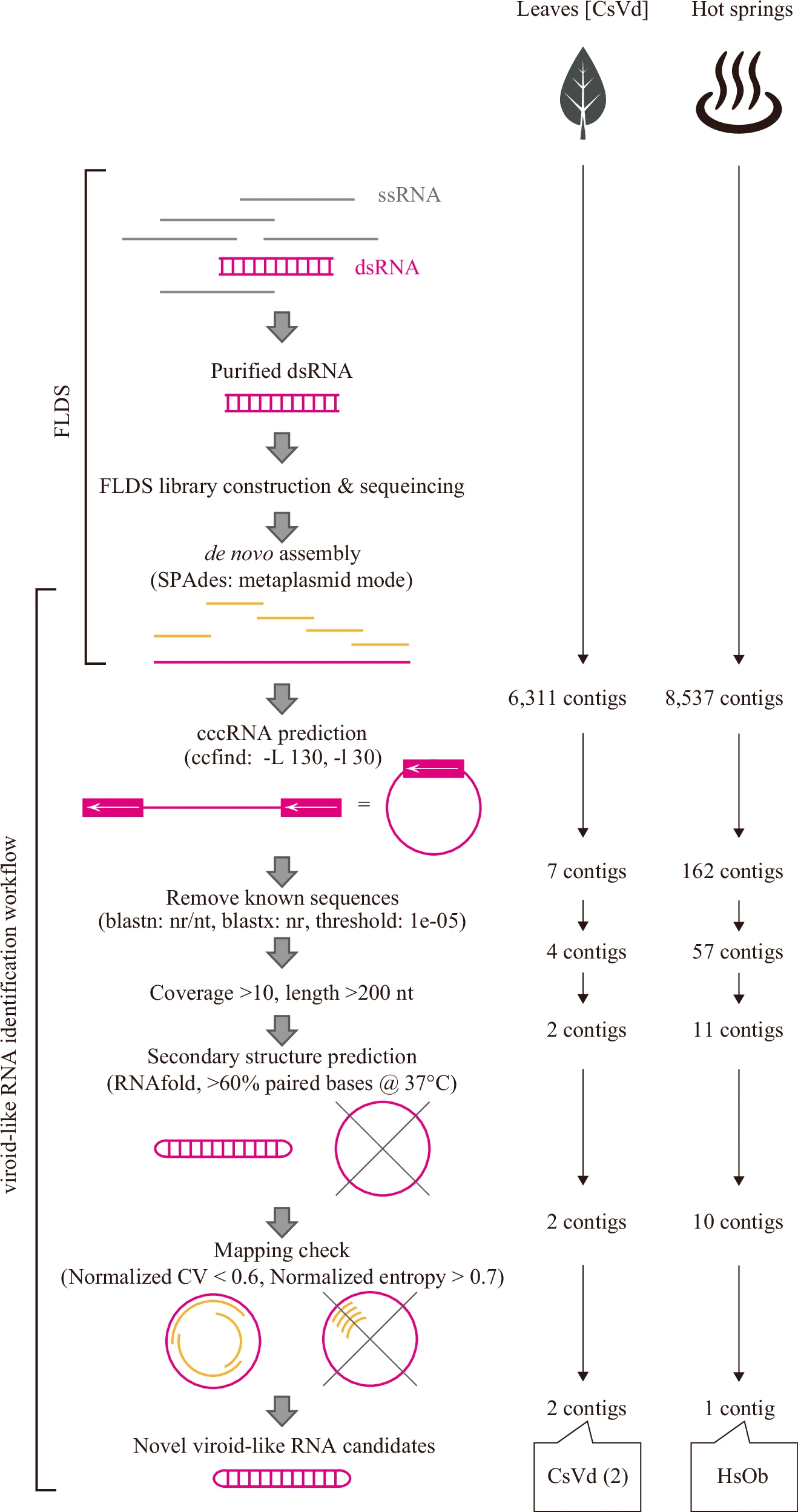
DsRNAs obtained from samples were sequenced using the FLDS method. The contigs assembled through de novo assembly were used for circular RNA prediction. After removing sequences with low coverage, those that were too short, and duplicated sequences, the predicted secondary structure and mapping patterns were also checked.
Using this strategy, the team discovered a new group of circular RNA replicons related to a family known as Obelisks. These newly identified elements, called hot spring Obelisks, share key structural features with previously known members. They are about 1 kilobase in length and form rod like shapes due to extensive base pairing within the RNA molecule.
Although their sequences differ, these replicons appear to encode proteins with similar three dimensional structures, suggesting a shared evolutionary origin. Some of the newly identified variants may also encode additional small proteins, hinting at more complex biological roles than previously recognized.
Further analysis across global datasets showed that these Obelisk like elements are more widespread than originally thought. This suggests that circular RNA replicons may play an important and previously overlooked role in microbial ecosystems.
By combining environmental sampling with RNA sequencing, this research expands our understanding of RNA based life and highlights the diversity of genetic systems that exist beyond traditional viruses and cells.
Urayama S I, Fukudome A, Mutz P, Matsushita Y, Takaki Y, Nishimura Y, Medvedeva S, Krupovic M, Koonin E V, Nunoura T. (2025) Identification of Obelisk-like covalently closed circular RNA replicon in hot springs by double-stranded RNA sequencing and expansion of the diversity of the Obelisk superfamily. bioRxiv [Epub ahead of print]. [article]
Related Posts






Scientists are continuing to uncover new types of genetic elements that challenge how we think about life at the molecular level. One such group is called covalently closed circular RNA replicons, small rod-shaped RNA molecules that can replicate themselves and are similar in some ways to viroids.
Researchers at the University of Tsukuba explored extreme environments to search for these unusual RNA elements. They focused on acidic hot springs in Japan, where microbial life has adapted to harsh conditions.
To identify these RNA molecules, the team used a specialized approach called double stranded RNA sequencing. This method targets double stranded RNA, which often appears during the replication of RNA based elements. By focusing on these intermediates, researchers can detect replicating RNA molecules even when they do not resemble known sequences.
Schematic workflow of cccRNA replicon surveillance
DsRNAs obtained from samples were sequenced using the FLDS method. The contigs assembled through de novo assembly were used for circular RNA prediction. After removing sequences with low coverage, those that were too short, and duplicated sequences, the predicted secondary structure and mapping patterns were also checked.
Using this strategy, the team discovered a new group of circular RNA replicons related to a family known as Obelisks. These newly identified elements, called hot spring Obelisks, share key structural features with previously known members. They are about 1 kilobase in length and form rod like shapes due to extensive base pairing within the RNA molecule.
Although their sequences differ, these replicons appear to encode proteins with similar three dimensional structures, suggesting a shared evolutionary origin. Some of the newly identified variants may also encode additional small proteins, hinting at more complex biological roles than previously recognized.
Further analysis across global datasets showed that these Obelisk like elements are more widespread than originally thought. This suggests that circular RNA replicons may play an important and previously overlooked role in microbial ecosystems.
By combining environmental sampling with RNA sequencing, this research expands our understanding of RNA based life and highlights the diversity of genetic systems that exist beyond traditional viruses and cells.
Urayama S I, Fukudome A, Mutz P, Matsushita Y, Takaki Y, Nishimura Y, Medvedeva S, Krupovic M, Koonin E V, Nunoura T. (2025) Identification of Obelisk-like covalently closed circular RNA replicon in hot springs by double-stranded RNA sequencing and expansion of the diversity of the Obelisk superfamily. bioRxiv [Epub ahead of print]. [article]
Related Posts
Recent Posts
 Scientists identify the neuroblastoma cells that signal poor outcomes
 GARAGE improves rare cell detection in single-cell RNA sequencing analysis using AI
 Machine learning reveals how RNA splicing is regulated in individual cell types
 Illumina releases SpliceAI2 to help advance rare disease research
 Postdoctoral Fellow – Long-Read RNA Methods Development for Neurodegeneration
 Novel biosensor uses DNA ‘barcodes’ to uncover disease signals in cells
RNA-Seq Products & Services



Stay Connected