Scientists developed a new framework to improve the ability of doctors to use precision medicine to identify therapeutic targets and potentially spotlight ways to prevent disease recurrence
City of Hope®, one of the largest and most advanced cancer research and treatment organizations in the U.S. with its National Medical Center named top 5 in the nation for cancer by U.S. News & World Report, co-led the first study to demonstrate that characterizing genetic material near chromosomes forecasts how mutated, cancer-causing genes reengineer DNA and alter the tumor microenvironment. The leading-edge brain cancer research provides foundational knowledge that one day will improve the practice of precision medicine and allow oncologists to deliver more personalized therapies to cancer patients.
Tiny DNA molecules outside of chromosomes were once disregarded, but in the past decade research has revealed that these circles called extrachromosomal DNA, or ecDNA, fuel cancer by breaking the laws of biology.
“Our study offers new insights into the interplay between different ecDNA. Importantly, when there is a prevalence of ecDNA and cancer-causing ingredients like the EGFR protein or tumor protein p53, the tumor microenvironment becomes hypoxic. It falls into a state of reduced oxygen, which has been linked to cancer progression, resistance to therapy and poor clinical outcomes,” said David Craig, Ph.D., professor and chair of the Department of Integrative Translational Sciences at City of Hope and co-corresponding author of a study published today in Nature Communications.
Spatial transcriptomics (measuring and mapping of DNA activity) combined with genomic data can help identify groups of cells within a tumor that share a common ancestor but have acquired additional mutations. How they are distributed spatially informs the understanding of tumor evolution. The new translational science data underpins City of Hope’s precision medicine research, which applies innovation to create better outcomes with fewer side effects for more patients. City of Hope aspires to cure more cancer patients.
City of Hope researchers led a team that performed bulk RNA sequencing, tumor/normal DNA sequencing and spatial transcriptomics in a small sample of gliomas — tumors that develop in the brain or spinal cord. Through varied experiments and validation cohorts, they were able to identify common and distinct characteristics of the tumor microenvironment, developing an integrated analysis framework that can be leveraged by others.
Validation cohort B examining transcriptomic and genomic subclonal heterogeneity in EGFR+ glioblastoma
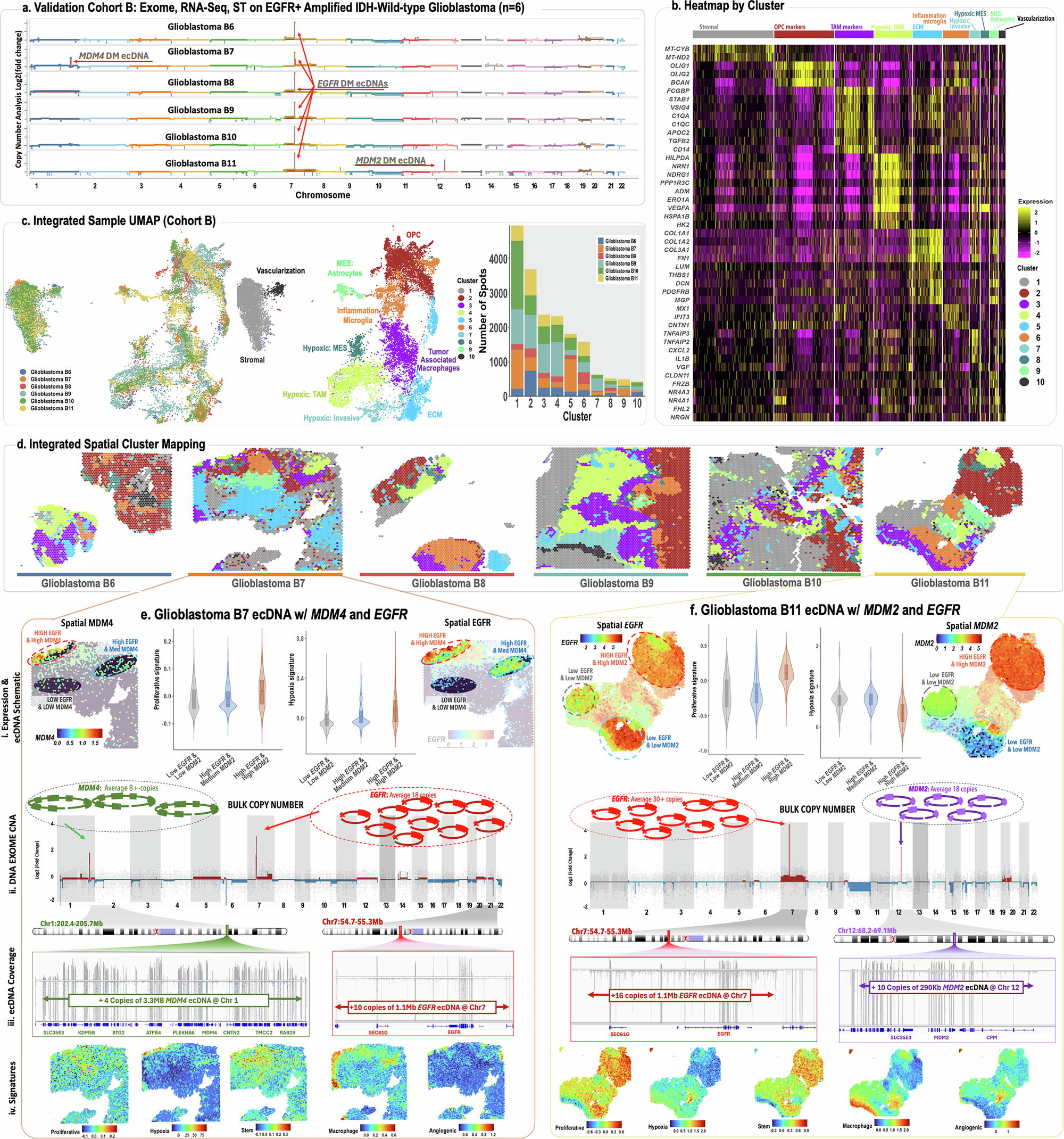
Exome sequencing, bulk RNA sequencing, and FFPE ST were used in the validation set, following a similar analysis to cohort A. a Copy number analysis through exome sequencing, showing the location of focal amplifications. b Expression heatmap of top marker genes per cluster. c UMAP plot of integrated dataset, color-coded by sample, cluster, and the distribution of samples within integrated clusters. d Spatial maps of integrated cluster assignments for each sample. While all six samples contained amplified EGFR within a DM ecDNA, two of the six samples also had amplification of negative regulators of TP53. e Glioblastoma B7 contains independent DMs of MDM4 and EGFR. f Glioblastoma B11, showing independent DMs with MDM2 and EGFR. Evidence for DMs based on copy number analysis and corresponding expression data are shown in both panels: i Spatial expression of MDM4/MDM2 and EGFR, alone with violin plots of hypoxia and proliferative signatures, ii Detailed copy number analysis, showing focal amplification zooms, iii Coverage at locus, iv Expression profiles for key pathways highlight that regions expressing genes within the DM regions in both samples also align with areas of high proliferative and hypoxic gene signatures.
“While our paper solely evaluated different types of brain cancers, the spatial transcriptomic principles and genome sequencing techniques we outlined will one day enable physicians to provide more personalized therapies for cancer patients,” said Gabriel Zada, M.D., a neurosurgeon with Keck Medicine of USC, professor of neurological surgery and physiology and neuroscience at the Keck School of Medicine of USC, co-director of the USC Brain Tumor Center and co-corresponding study author. “Cancer and its treatment is not one-size-fits-all. Understanding the molecular activity of ecDNA near inheritable and non-inheritable cells provides deep insights into potential therapeutic targets and risk of cancer recurrence.”
The researchers demonstrated that ecDNA drives rapid cancer cell (oncogene) proliferation outside of chromosomes, the thread-like structures inside the cell nucleus that houses DNA and RNA. EcDNA contributes to the development of gliomas, genetic instability and distinct tumor cell populations within a single tumor, making cancer more difficult to eliminate.
The dynamic nature of ecDNA may be what enables cancer cells to adapt and reprogram their genomes, driving tumor progression in response to changes in their microenvironment, including changes resulting from therapies.
“We have now demonstrated how cancer cells dynamically reprogram their own genome to control and respond to the tumor microenvironment. By uncovering these mechanisms, we are paving the way for more precise and effective treatments tailored to the unique biology of each patient,” Dr. Craig said.
Source – City of Hope


Scientists developed a new framework to improve the ability of doctors to use precision medicine to identify therapeutic targets and potentially spotlight ways to prevent disease recurrence
City of Hope®, one of the largest and most advanced cancer research and treatment organizations in the U.S. with its National Medical Center named top 5 in the nation for cancer by U.S. News & World Report, co-led the first study to demonstrate that characterizing genetic material near chromosomes forecasts how mutated, cancer-causing genes reengineer DNA and alter the tumor microenvironment. The leading-edge brain cancer research provides foundational knowledge that one day will improve the practice of precision medicine and allow oncologists to deliver more personalized therapies to cancer patients.
Tiny DNA molecules outside of chromosomes were once disregarded, but in the past decade research has revealed that these circles called extrachromosomal DNA, or ecDNA, fuel cancer by breaking the laws of biology.
Spatial transcriptomics (measuring and mapping of DNA activity) combined with genomic data can help identify groups of cells within a tumor that share a common ancestor but have acquired additional mutations. How they are distributed spatially informs the understanding of tumor evolution. The new translational science data underpins City of Hope’s precision medicine research, which applies innovation to create better outcomes with fewer side effects for more patients. City of Hope aspires to cure more cancer patients.
City of Hope researchers led a team that performed bulk RNA sequencing, tumor/normal DNA sequencing and spatial transcriptomics in a small sample of gliomas — tumors that develop in the brain or spinal cord. Through varied experiments and validation cohorts, they were able to identify common and distinct characteristics of the tumor microenvironment, developing an integrated analysis framework that can be leveraged by others.
Validation cohort B examining transcriptomic and genomic subclonal heterogeneity in EGFR+ glioblastoma
Exome sequencing, bulk RNA sequencing, and FFPE ST were used in the validation set, following a similar analysis to cohort A. a Copy number analysis through exome sequencing, showing the location of focal amplifications. b Expression heatmap of top marker genes per cluster. c UMAP plot of integrated dataset, color-coded by sample, cluster, and the distribution of samples within integrated clusters. d Spatial maps of integrated cluster assignments for each sample. While all six samples contained amplified EGFR within a DM ecDNA, two of the six samples also had amplification of negative regulators of TP53. e Glioblastoma B7 contains independent DMs of MDM4 and EGFR. f Glioblastoma B11, showing independent DMs with MDM2 and EGFR. Evidence for DMs based on copy number analysis and corresponding expression data are shown in both panels: i Spatial expression of MDM4/MDM2 and EGFR, alone with violin plots of hypoxia and proliferative signatures, ii Detailed copy number analysis, showing focal amplification zooms, iii Coverage at locus, iv Expression profiles for key pathways highlight that regions expressing genes within the DM regions in both samples also align with areas of high proliferative and hypoxic gene signatures.
The researchers demonstrated that ecDNA drives rapid cancer cell (oncogene) proliferation outside of chromosomes, the thread-like structures inside the cell nucleus that houses DNA and RNA. EcDNA contributes to the development of gliomas, genetic instability and distinct tumor cell populations within a single tumor, making cancer more difficult to eliminate.
The dynamic nature of ecDNA may be what enables cancer cells to adapt and reprogram their genomes, driving tumor progression in response to changes in their microenvironment, including changes resulting from therapies.
Source – City of Hope
Webb M, Chow F, McCullough C, Zhang B, Lee J, Bassiouni R, Garrett N, Hurth K, Carpten J, Zada G, Craig D. (2025) Resolving spatial subclonal genomic heterogeneity of loss of heterozygosity and extrachromosomal DNA in gliomas. Nature Communications 16(1):5290. [article]
Related Posts
RNAmel simplifies RNA sequencing data analysis with a reproducible, integrated platform
Heart failure reshapes bone marrow to create inflammation-related immune memory
Overlooked DNA regions surrounding ‘microexons’ hold missing pieces of autism’s genetic puzzle
RiboBA improves detection of hidden protein-coding regions using ribosome profiling
An anti-senescence gene may fight spinal disc deterioration
Scientists identify the neuroblastoma cells that signal poor outcomes
Novel biosensor uses DNA ‘barcodes’ to uncover disease signals in cells
CellART extracts single-cell information from high-resolution spatial transcriptomics
Cell2space restores spatial context to single-cell RNA sequencing data
Urine test may improve bladder cancer diagnosis and guide treatment decisions
DeCoRE – a computational method to resolve RNA structural heterogeneity from RNA structure probing data by direct RNA sequencing
Tracing 700 million years of cell evolution
How should biological replicates be handled in long-read RNA sequencing?
RNA-Seq reveals a new way the developing heart controls its growth
The Human RNome Project Consortium seeks to publish first-ever complete sequence of the body’s RNA
scFlowReport brings multiple single-cell RNA sequencing analyses into one workflow
Long-read RNA sequencing reveals how neurons choose alternative RNA endings
DeOPUS improves cell-type estimates from bulk RNA sequencing
ResolVI improves accuracy in spatial transcriptomics analysis
RNA sequencing reveals transcriptional allele differences in prostate cancer stem cells
Stay Connected
Submit a Post to the Blog
Recent Posts
Subscribe to the RNA-Seq Blog
RNA-Seq Products & Services