UNSW scientists have uncovered the hidden switches in DNA, revealing new insights into Alzheimer’s disease.
When most of us think of DNA, we have a vague idea it’s made up of genes that give us our physical features, our behavioural quirks, and keep our cells and organs running.
But only a tiny percentage of our DNA, around 2%, contains our 20,000-odd genes. The remaining 98%, long known as the non-coding genome, or so-called ‘junk’ DNA – includes many of the switches that control when and how strongly genes are expressed.
Now researchers from UNSW Sydney have identified the DNA switches that help control how astrocytes work – these are brain cells that support neurons, and are known to play a role in Alzheimer’s disease.
In research published today in Nature Neuroscience, researchers from UNSW’s School of Biotechnology & Biomolecular Sciences described how they tested nearly 1000 potential switches – strings of DNA known as enhancers, in human astrocytes grown in the lab. Enhancers can be located very far away from the gene they control, sometimes hundreds of thousands of DNA letters away, making them difficult to study.
The team used CRISPRi, a tool that lets you turn off small sections of DNA without cutting it, combined with single-cell RNA sequencing, which measures gene expression in individual cells. This approach allowed them to test the function of nearly 1000 enhancers at once.
CRISPRi screen of intergenic enhancers in astrocytes
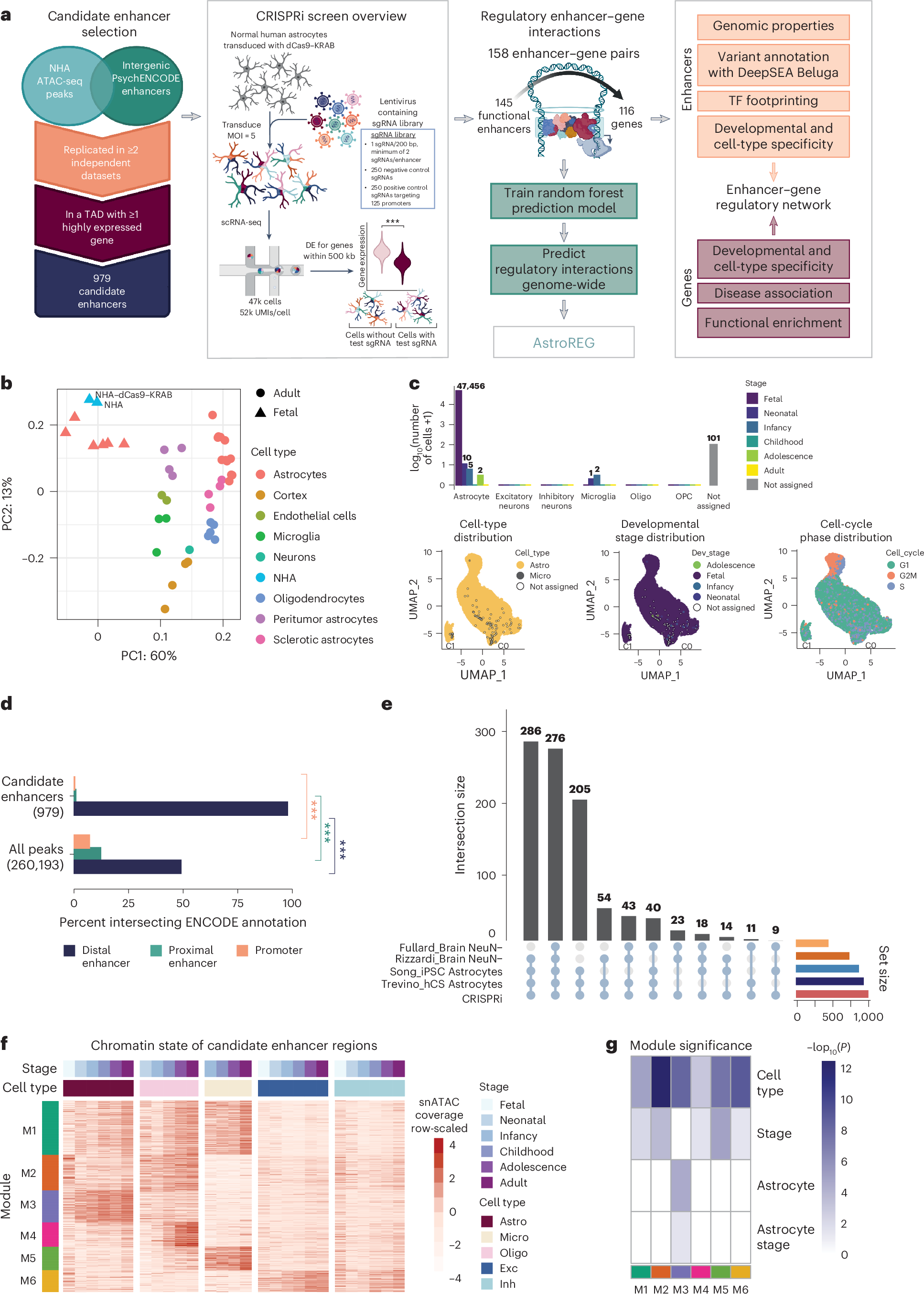
a, Study overview. b, PCA plot of RNA-seq data from NHAs and brain samples immunopanned with cell-type-specific antibodies c, Top, barplot of cell type and developmental stage annotation of NHA CRISPRi screen scRNA-seq data (n = 47,577 cells). Reference-based annotation of single cells was performed using SingleR, with reference snRNA-seq from the human brain maturation atlas. d, Overlap of candidate peaks with ENCODE-annotated genomic regions. e, Upset plot displaying the overlap between the selected candidate enhancer set and four datasets used in the selection pipeline—two ATAC–seq datasets of NeuN− cells from adult human brain f, Heatmap of candidate enhancer chromatin accessibility based on pseudobulked snATAC–seq data across cell types and developmental stages.
“We used CRISPRi to turn off potential enhancers in the astrocytes to see whether it changed gene expression,” says lead author Dr Nicole Green.
“And if it did, then we knew we’d found a functional enhancer and could then figure out which gene, or genes, it controls. That’s what happened for about 150 of the potential enhancers we tested. And strikingly, a large fraction of these functional enhancers controlled genes implicated in Alzheimer’s disease.”
Going from 1000 candidates to 150 real switches dramatically narrows where scientists need to look in the non-coding genome to find clues to the genetics of Alzheimer’s disease.
“These findings suggest that similar studies in other brain cell types are needed to highlight the functional enhancers in the vast space of non-coding DNA.”
Reading between the lines
Professor Irina Voineagu, who oversaw the study, says the results give researchers a catalogue of DNA regions that can help interpret the results of other genetic studies as well.
“When researchers look for genetic changes that explain diseases like hypertension, diabetes and also psychiatric and neurodegenerative disorders like Alzheimer’s disease – we often end up with changes not within genes so much, but in-between,” she says.
Those “in-between” regions are the enhancers her team has now tested directly in human astrocytes, revealing which ones genuinely control important brain genes.
From gene switches to AI
Testing nearly a thousand enhancers in the lab was painstaking work. And it is the first time a CRISPRi screen of enhancers of this scale has been done in brain cells. But with the groundwork now done, the data can be used to train computer tools to predict which potential enhancers are true switches, potentially saving years of experimental time.
“This dataset can help computational biologists test how good their prediction models are at predicting enhancer function,” says Prof. Voineagu.
In fact, Google’s DeepMind team is already using the dataset to benchmark their recent deep learning model called AlphaGenome, she adds.
Potential tools for gene therapy
Because specific enhancers are only active in specific cell types, targeting them could allow precise control of gene expression in astrocytes without affecting neurons or other brain cells.
“While this is not close to being used in the clinic yet, and much work remains before these findings could lead to treatments, there is a clear precedent,” Prof. Voineagu says.
“The first gene editing drug approved for a blood disease, sickle cell anaemia, targets a cell-type specific enhancer.”
Dr Green adds that research into DNA enhancers is a promising direction in precision medicine.
“This is something we want to look at more deeply: finding out which enhancers we can use to turn genes on or off in a single brain cell type, and in a very controlled way,” she says.
Source – UNSW


UNSW scientists have uncovered the hidden switches in DNA, revealing new insights into Alzheimer’s disease.
When most of us think of DNA, we have a vague idea it’s made up of genes that give us our physical features, our behavioural quirks, and keep our cells and organs running.
But only a tiny percentage of our DNA, around 2%, contains our 20,000-odd genes. The remaining 98%, long known as the non-coding genome, or so-called ‘junk’ DNA – includes many of the switches that control when and how strongly genes are expressed.
Now researchers from UNSW Sydney have identified the DNA switches that help control how astrocytes work – these are brain cells that support neurons, and are known to play a role in Alzheimer’s disease.
In research published today in Nature Neuroscience, researchers from UNSW’s School of Biotechnology & Biomolecular Sciences described how they tested nearly 1000 potential switches – strings of DNA known as enhancers, in human astrocytes grown in the lab. Enhancers can be located very far away from the gene they control, sometimes hundreds of thousands of DNA letters away, making them difficult to study.
The team used CRISPRi, a tool that lets you turn off small sections of DNA without cutting it, combined with single-cell RNA sequencing, which measures gene expression in individual cells. This approach allowed them to test the function of nearly 1000 enhancers at once.
CRISPRi screen of intergenic enhancers in astrocytes
a, Study overview. b, PCA plot of RNA-seq data from NHAs and brain samples immunopanned with cell-type-specific antibodies c, Top, barplot of cell type and developmental stage annotation of NHA CRISPRi screen scRNA-seq data (n = 47,577 cells). Reference-based annotation of single cells was performed using SingleR, with reference snRNA-seq from the human brain maturation atlas. d, Overlap of candidate peaks with ENCODE-annotated genomic regions. e, Upset plot displaying the overlap between the selected candidate enhancer set and four datasets used in the selection pipeline—two ATAC–seq datasets of NeuN− cells from adult human brain f, Heatmap of candidate enhancer chromatin accessibility based on pseudobulked snATAC–seq data across cell types and developmental stages.
Reading between the lines
Professor Irina Voineagu, who oversaw the study, says the results give researchers a catalogue of DNA regions that can help interpret the results of other genetic studies as well.
Those “in-between” regions are the enhancers her team has now tested directly in human astrocytes, revealing which ones genuinely control important brain genes.
From gene switches to AI
Testing nearly a thousand enhancers in the lab was painstaking work. And it is the first time a CRISPRi screen of enhancers of this scale has been done in brain cells. But with the groundwork now done, the data can be used to train computer tools to predict which potential enhancers are true switches, potentially saving years of experimental time.
In fact, Google’s DeepMind team is already using the dataset to benchmark their recent deep learning model called AlphaGenome, she adds.
Potential tools for gene therapy
Because specific enhancers are only active in specific cell types, targeting them could allow precise control of gene expression in astrocytes without affecting neurons or other brain cells.
Dr Green adds that research into DNA enhancers is a promising direction in precision medicine.
Source – UNSW
Green N, Sutton GJ, Pérez-Burillo J, Wang J, Bagot S, Danon HG, Walsh K, Gokool A, Miles SA, Yang G, Herring CA, Liang Y, Pfundstein G, Sytnyk V, Alinejad-Rokny H, Lister R, Rosenbluh J, Gagnon-Bartsch JA, Voineagu I. (2025) CRISPRi screening in cultured human astrocytes uncovers distal enhancers controlling genes dysregulated in Alzheimer’s disease. Nature Neuroscience [Epub ahead of print]. [article]
Related Posts
Novel biosensor uses DNA ‘barcodes’ to uncover disease signals in cells
CellART extracts single-cell information from high-resolution spatial transcriptomics
Cell2space restores spatial context to single-cell RNA sequencing data
Urine test may improve bladder cancer diagnosis and guide treatment decisions
DeCoRE – a computational method to resolve RNA structural heterogeneity from RNA structure probing data by direct RNA sequencing
Tracing 700 million years of cell evolution
How should biological replicates be handled in long-read RNA sequencing?
RNA-Seq reveals a new way the developing heart controls its growth
The Human RNome Project Consortium seeks to publish first-ever complete sequence of the body’s RNA
scFlowReport brings multiple single-cell RNA sequencing analyses into one workflow
Long-read RNA sequencing reveals how neurons choose alternative RNA endings
DeOPUS improves cell-type estimates from bulk RNA sequencing
ResolVI improves accuracy in spatial transcriptomics analysis
RNA sequencing reveals transcriptional allele differences in prostate cancer stem cells
Unmasking “zombie cells” in aging tissue with an AI-powered barcode
RNA variant imaging for cancer diagnosis
Autism-risk mutations reveal two opposing patterns of brain gene activity
A real-data approach to evaluating RNA transcript analysis methods
Detection and sequencing of Ap2N-capped RNAs in human cells
Single-cell RNA sequencing provides a closer look at the Aedes aegypti midgut
Stay Connected
Submit a Post to the Blog
Recent Posts
Subscribe to the RNA-Seq Blog
RNA-Seq Products & Services