

RNA molecules are not just simple copies of DNA, they are chemically modified in many ways that affect how genes are used by cells. One of the most common and important RNA modifications is N6-methyladenosine, or m6A, which can influence RNA stability, translation, and cell fate decisions. Despite its importance, accurately detecting and measuring RNA modifications across the transcriptome has been difficult.
Researchers at Seoul National University have developed a new approach called DeepRM to overcome these limitations. DeepRM combines Nanopore RNA sequencing with deep learning to directly detect RNA modifications from individual RNA molecules. A key advance is the creation of an exceptionally large and high-quality training dataset that closely reflects real cellular RNA, allowing the model to learn subtle modification signatures that were previously missed.
Design of a random oligonucleotide-based RNA modification (RM) training dataset
with diverse sequence contexts and distinguishable RM signals
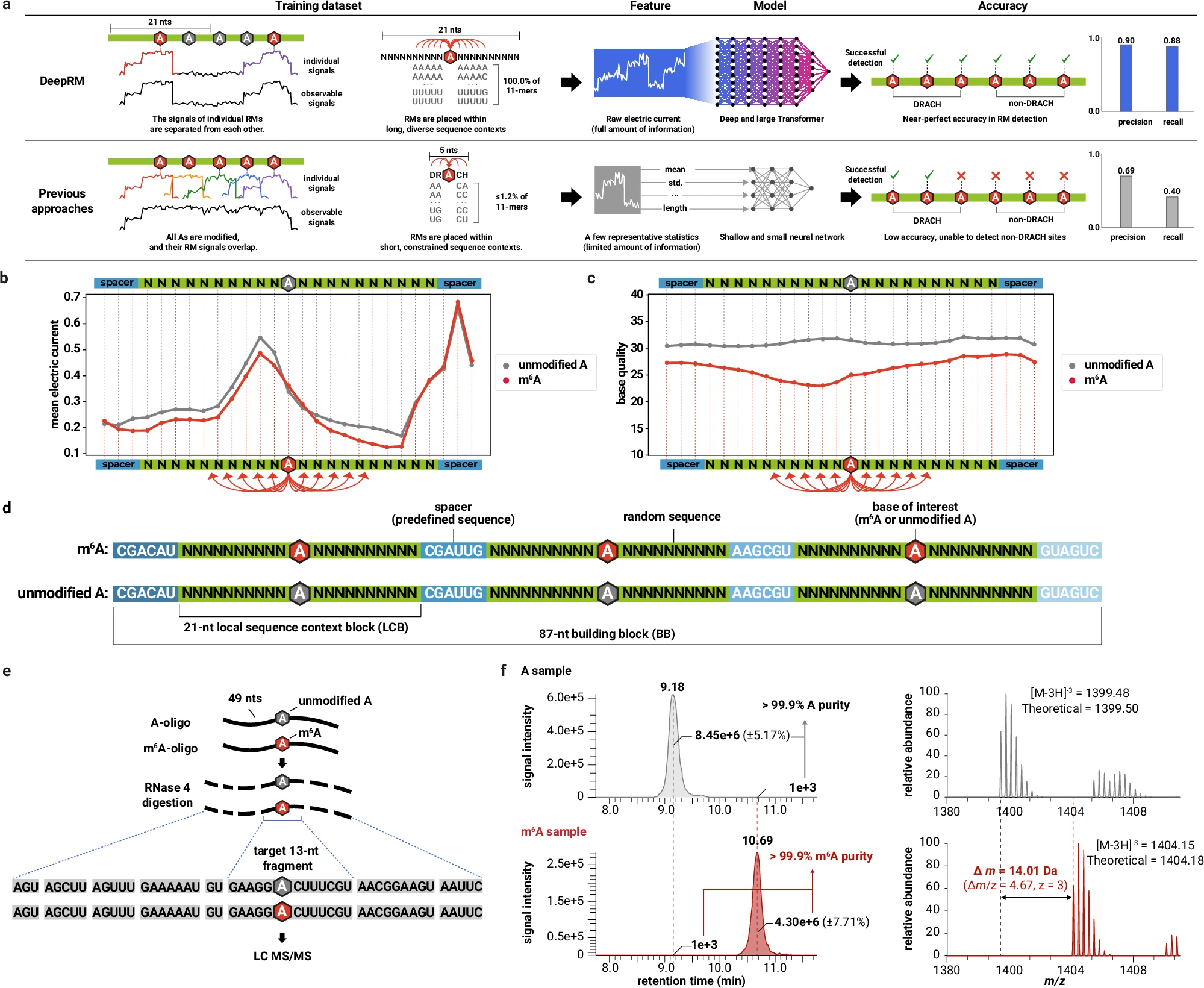
a Overview of DeepRM (top) versus previous approaches (bottom). In the DeepRM dataset, signals of individual modifications are isolated (see panel b), while in most previous datasets, modification signals overlap because all adenosines are modified into m6A, reducing prediction accuracy. Since nanopore signals are largely affected by flanking sequences, it is essential to include various local sequence contexts in the training dataset for sensitive RM detection. The DeepRM dataset encompasses all possible 11-mer sequence contexts, while the previous datasets contain limited and short sequence contexts. DeepRM uses raw electric currents as a feature, employing a large Transformer architecture to capture full information from Nanopore sequencing. In contrast, previous models use a few statistical features and shallow architectures. Consequently, DeepRM achieves unprecedentedly high accuracy in RM detection. The precision and recall values shown were calculated from the precision-recall curves of DeepRM (top) and m6Anet (bottom) in, using the F1-maximizing threshold. b, c Effects of a single RM on surrounding nucleotides. Mean electric currents (b) and base quality (c) are plotted for 20 flanking random unmodified nucleotides centered on A or m6A (gray or red hexagons). The number of central 5-mer sequences was equally selected. n = 1,228,800 for both A and m6A. d Design of 87-nt building blocks (BBs) for large-scale dataset generation. Each BB contains three 21-nt local sequence context blocks (LCBs) in green and four 6-nt spacers in light blue. The base of interest is A (gray) and m6A (red). e Sequence of synthetic 49-nt RNA oligonucleotides and digested fragments for liquid chromatography tandem mass spectrometry (LC MS/MS). f MS chromatogram (left) and spectra (right) of a 13-nt fragment containing the designated site, showing different retention times between A (gray) and m6A oligonucleotides (red). Peak areas for each fragment were integrated to measure A or m6A purity. MS1 spectra of triply charged ions ([M-3H]−3) display measured and theoretical mass/charge ratio (m/z) values and mass difference (△m) between A and m6A oligonucleotides indicated.
Using DeepRM, the team achieved near-perfect accuracy in identifying RNA modification sites and measuring how frequently each site is modified. Applying this method to human cells, they generated a comprehensive atlas of m6A modifications at single-molecule resolution. This atlas revealed many non-canonical m6A sites and transcripts with highly variable modification patterns, underscoring how dynamic and complex RNA regulation can be.
Because DeepRM is freely available and can be adapted to other RNA modifications and organisms, it provides a powerful new foundation for studying the epitranscriptome. By pairing advanced deep learning with RNA sequencing, this work opens the door to a much deeper understanding of how chemical marks on RNA shape biology and disease.
Availability – DeepRM model and code are available on GitHub (https://github.com/vadanamu/DeepRM) for non-commercial academic purposes.
Kang G, Hwang H, Jeon H, Choi H, Chang HR, Yeo N, Park J, Son N, Jeon E, Lim J, Yun J, Choi W, Jo JY, Kim JS, Park S, Kim YK, Baek D. (2025) Comprehensive discovery of m6A sites in the human transcriptome at single-molecule resolution. Nature Communications 17(1):664. [article]
Related Posts






RNA molecules are not just simple copies of DNA, they are chemically modified in many ways that affect how genes are used by cells. One of the most common and important RNA modifications is N6-methyladenosine, or m6A, which can influence RNA stability, translation, and cell fate decisions. Despite its importance, accurately detecting and measuring RNA modifications across the transcriptome has been difficult.
Researchers at Seoul National University have developed a new approach called DeepRM to overcome these limitations. DeepRM combines Nanopore RNA sequencing with deep learning to directly detect RNA modifications from individual RNA molecules. A key advance is the creation of an exceptionally large and high-quality training dataset that closely reflects real cellular RNA, allowing the model to learn subtle modification signatures that were previously missed.
Design of a random oligonucleotide-based RNA modification (RM) training dataset
with diverse sequence contexts and distinguishable RM signals
a Overview of DeepRM (top) versus previous approaches (bottom). In the DeepRM dataset, signals of individual modifications are isolated (see panel b), while in most previous datasets, modification signals overlap because all adenosines are modified into m6A, reducing prediction accuracy. Since nanopore signals are largely affected by flanking sequences, it is essential to include various local sequence contexts in the training dataset for sensitive RM detection. The DeepRM dataset encompasses all possible 11-mer sequence contexts, while the previous datasets contain limited and short sequence contexts. DeepRM uses raw electric currents as a feature, employing a large Transformer architecture to capture full information from Nanopore sequencing. In contrast, previous models use a few statistical features and shallow architectures. Consequently, DeepRM achieves unprecedentedly high accuracy in RM detection. The precision and recall values shown were calculated from the precision-recall curves of DeepRM (top) and m6Anet (bottom) in, using the F1-maximizing threshold. b, c Effects of a single RM on surrounding nucleotides. Mean electric currents (b) and base quality (c) are plotted for 20 flanking random unmodified nucleotides centered on A or m6A (gray or red hexagons). The number of central 5-mer sequences was equally selected. n = 1,228,800 for both A and m6A. d Design of 87-nt building blocks (BBs) for large-scale dataset generation. Each BB contains three 21-nt local sequence context blocks (LCBs) in green and four 6-nt spacers in light blue. The base of interest is A (gray) and m6A (red). e Sequence of synthetic 49-nt RNA oligonucleotides and digested fragments for liquid chromatography tandem mass spectrometry (LC MS/MS). f MS chromatogram (left) and spectra (right) of a 13-nt fragment containing the designated site, showing different retention times between A (gray) and m6A oligonucleotides (red). Peak areas for each fragment were integrated to measure A or m6A purity. MS1 spectra of triply charged ions ([M-3H]−3) display measured and theoretical mass/charge ratio (m/z) values and mass difference (△m) between A and m6A oligonucleotides indicated.
Using DeepRM, the team achieved near-perfect accuracy in identifying RNA modification sites and measuring how frequently each site is modified. Applying this method to human cells, they generated a comprehensive atlas of m6A modifications at single-molecule resolution. This atlas revealed many non-canonical m6A sites and transcripts with highly variable modification patterns, underscoring how dynamic and complex RNA regulation can be.
Because DeepRM is freely available and can be adapted to other RNA modifications and organisms, it provides a powerful new foundation for studying the epitranscriptome. By pairing advanced deep learning with RNA sequencing, this work opens the door to a much deeper understanding of how chemical marks on RNA shape biology and disease.
Availability – DeepRM model and code are available on GitHub (https://github.com/vadanamu/DeepRM) for non-commercial academic purposes.
Kang G, Hwang H, Jeon H, Choi H, Chang HR, Yeo N, Park J, Son N, Jeon E, Lim J, Yun J, Choi W, Jo JY, Kim JS, Park S, Kim YK, Baek D. (2025) Comprehensive discovery of m6A sites in the human transcriptome at single-molecule resolution. Nature Communications 17(1):664. [article]
Related Posts
Recent Posts
 RNAmel simplifies RNA sequencing data analysis with a reproducible, integrated platform
 Heart failure reshapes bone marrow to create inflammation-related immune memory
 Overlooked DNA regions surrounding ‘microexons’ hold missing pieces of autism’s genetic puzzle
 RiboBA improves detection of hidden protein-coding regions using ribosome profiling
 An anti-senescence gene may fight spinal disc deterioration
 Bulk RNA-seq Analysis: A Complete Beginner’s Guide
RNA-Seq Products & Services


Stay Connected