

Understanding which genes keep brain cells alive is one of the biggest challenges in neuroscience. When neurons, the cells of the brain, die or lose function, it can lead to devastating conditions such as Alzheimer’s or Parkinson’s disease. Scientists have long searched for effective ways to identify which genes are most critical for neuron survival, but testing thousands of genes at once directly inside the brain has been difficult.
A new study led by researchers from the University of California, San Francisco introduces an innovative solution. The team developed a method called CrAAVe-seq, which combines CRISPR gene-editing technology with adeno-associated viruses, or AAVs, to screen large numbers of genes in specific types of brain cells inside living mice.
In vivo CrAAVe-seq uncovers neuron-essential genes in the mouse brain
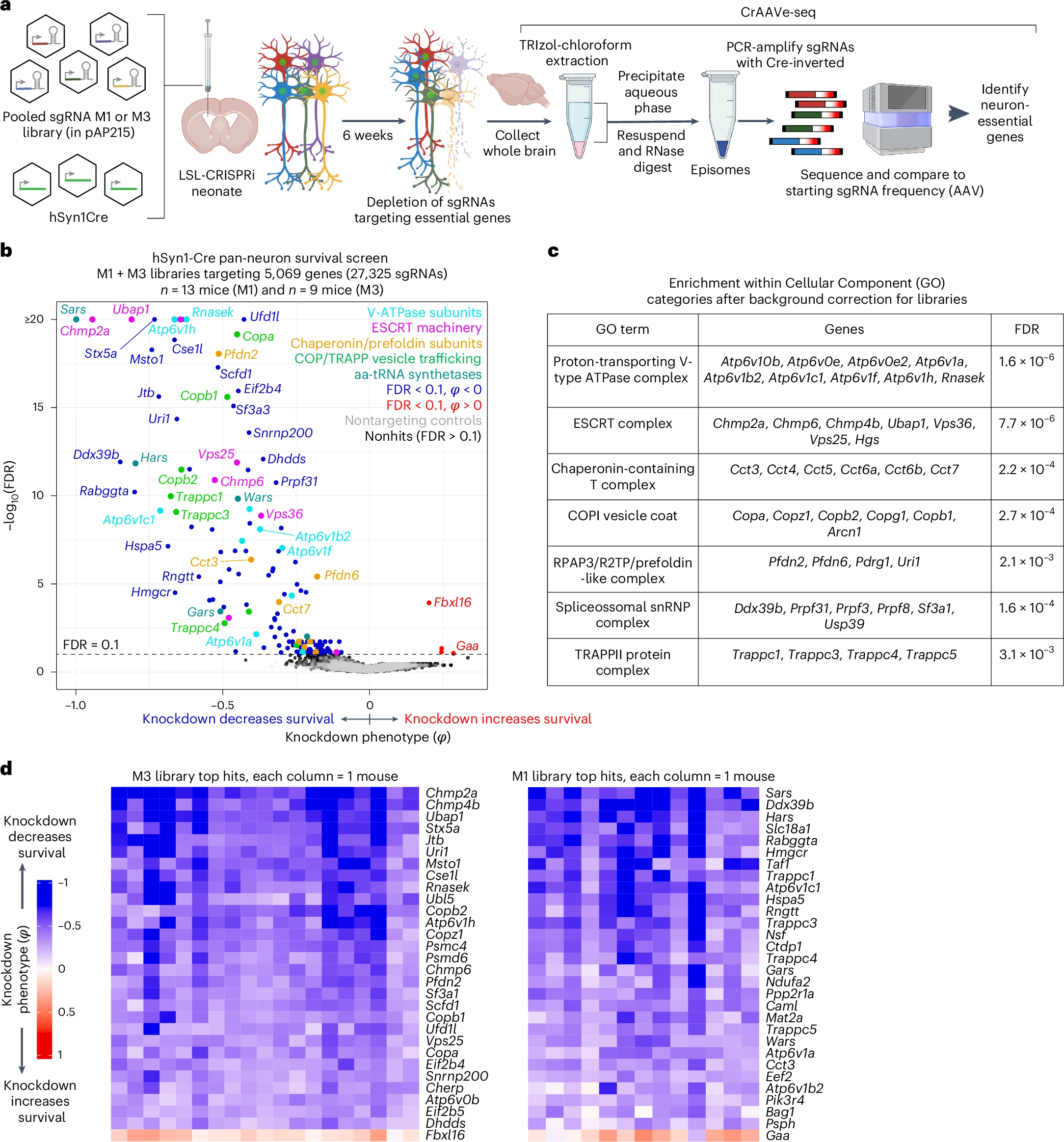
a, Experimental design for CrAAVe-seq to identify neuron-essential genes across two different pooled sgRNA libraries (pAP215 expressing the M1 or M3 libraries). M1 targets kinases, phosphatases and druggable targets—2,269 genes (12,100 targeting sgRNAs and 250 nontargeting controls); M3 targets stress and proteostasis targets—2,800 genes (14,685 targeting sgRNAs and 290 nontargeting controls). The sgRNA libraries and hSyn1-Cre were packaged into AAV (PHP.eB capsid) and co-injected into neonatal LSL-CRISPRi mice. b, Results from CRISPRi screen described in a—knockdown phenotype for 5,069 genes and nontargeting (quasi-gene) controls at 6 weeks postinjection (n = 13 mice injected with pAP215-M1 library, and n = 19 mice injected with pAP215-M3 library). Hit genes (FDR < 0.1) within enriched pathways are color coded. Nontargeting controls (gray) are plotted on top of nonhit genes (black). c, Table showing enrichment of hit genes in different Cellular Component GO terms. d, Knockdown phenotype for each individual mouse (columns) for 30 top hit genes (rows, 29 with negative and 1 with positive knockdown phenotypes). Rows are ranked by average knockdown phenotype. GO, Gene Ontology.
What makes CrAAVe-seq so powerful is its precision. By using a Cre-sensitive system, the researchers could target only certain groups of neurons in the brain. They then tested over 5,000 genes and identified key ones that are absolutely necessary for neurons to survive, including Rabggta and Hspa5. These discoveries provide valuable clues about how neurons maintain their health and what might go wrong in disease.
The researchers also carefully evaluated the method itself. They examined how factors like the number of mice used, the number of viral particles delivered, and the size of the gene library affect the reliability of the screen. This step is crucial, because it gives other scientists guidelines for applying the method to their own experiments.
CrAAVe-seq represents a leap forward for large-scale genetic research in living tissues. By making it possible to test many genes in specific cell populations with high sensitivity, this platform opens the door to finding new targets for treating brain diseases.
Availability – The sgRNA mapping utility is available on GitHub (https://github.com/noamteyssier/sgcount)
Ramani B, Rose IVL, Teyssier N, Pan A, Danner-Bocks S, Sanghal T, Yadanar L, Tian R, Ma K, Palop JJ, Kampmann M. (2025) CRISPR screening by AAV episome-sequencing (CrAAVe-seq) a scalable cell-type-specific in vivo platform uncovers neuronal essential genes. Nature Neuroscience 28(8): [Online ahead of print]. [article]
Related Posts






Understanding which genes keep brain cells alive is one of the biggest challenges in neuroscience. When neurons, the cells of the brain, die or lose function, it can lead to devastating conditions such as Alzheimer’s or Parkinson’s disease. Scientists have long searched for effective ways to identify which genes are most critical for neuron survival, but testing thousands of genes at once directly inside the brain has been difficult.
A new study led by researchers from the University of California, San Francisco introduces an innovative solution. The team developed a method called CrAAVe-seq, which combines CRISPR gene-editing technology with adeno-associated viruses, or AAVs, to screen large numbers of genes in specific types of brain cells inside living mice.
In vivo CrAAVe-seq uncovers neuron-essential genes in the mouse brain
a, Experimental design for CrAAVe-seq to identify neuron-essential genes across two different pooled sgRNA libraries (pAP215 expressing the M1 or M3 libraries). M1 targets kinases, phosphatases and druggable targets—2,269 genes (12,100 targeting sgRNAs and 250 nontargeting controls); M3 targets stress and proteostasis targets—2,800 genes (14,685 targeting sgRNAs and 290 nontargeting controls). The sgRNA libraries and hSyn1-Cre were packaged into AAV (PHP.eB capsid) and co-injected into neonatal LSL-CRISPRi mice. b, Results from CRISPRi screen described in a—knockdown phenotype for 5,069 genes and nontargeting (quasi-gene) controls at 6 weeks postinjection (n = 13 mice injected with pAP215-M1 library, and n = 19 mice injected with pAP215-M3 library). Hit genes (FDR < 0.1) within enriched pathways are color coded. Nontargeting controls (gray) are plotted on top of nonhit genes (black). c, Table showing enrichment of hit genes in different Cellular Component GO terms. d, Knockdown phenotype for each individual mouse (columns) for 30 top hit genes (rows, 29 with negative and 1 with positive knockdown phenotypes). Rows are ranked by average knockdown phenotype. GO, Gene Ontology.
What makes CrAAVe-seq so powerful is its precision. By using a Cre-sensitive system, the researchers could target only certain groups of neurons in the brain. They then tested over 5,000 genes and identified key ones that are absolutely necessary for neurons to survive, including Rabggta and Hspa5. These discoveries provide valuable clues about how neurons maintain their health and what might go wrong in disease.
The researchers also carefully evaluated the method itself. They examined how factors like the number of mice used, the number of viral particles delivered, and the size of the gene library affect the reliability of the screen. This step is crucial, because it gives other scientists guidelines for applying the method to their own experiments.
CrAAVe-seq represents a leap forward for large-scale genetic research in living tissues. By making it possible to test many genes in specific cell populations with high sensitivity, this platform opens the door to finding new targets for treating brain diseases.
Availability – The sgRNA mapping utility is available on GitHub (https://github.com/noamteyssier/sgcount)
Ramani B, Rose IVL, Teyssier N, Pan A, Danner-Bocks S, Sanghal T, Yadanar L, Tian R, Ma K, Palop JJ, Kampmann M. (2025) CRISPR screening by AAV episome-sequencing (CrAAVe-seq) a scalable cell-type-specific in vivo platform uncovers neuronal essential genes. Nature Neuroscience 28(8): [Online ahead of print]. [article]
Related Posts
Recent Posts
 Machine learning reveals how RNA splicing is regulated in individual cell types
 Illumina releases SpliceAI2 to help advance rare disease research
 Postdoctoral Fellow – Long-Read RNA Methods Development for Neurodegeneration
 Novel biosensor uses DNA ‘barcodes’ to uncover disease signals in cells
 GP-DHT uses single-cell RNA sequencing to map gene regulatory networks
 Boehringer taps Envisagenics’ AI to mine RNA splicing for cancer targets
RNA-Seq Products & Services



Stay Connected