

Messenger RNAs (mRNAs) are best known for carrying instructions from DNA to make proteins. But researchers are learning that mRNAs do much more than that. In addition to encoding proteins, mRNAs have regulatory regions that play important roles in how the cell works. These include parts of the RNA that do not code for proteins, such as introns and the 5′ and 3′ untranslated regions (UTRs), which help control how the RNA is processed, where it goes in the cell, and how long it lasts.
A team led by researchers from the Idiap Research Institute discusses how artificial intelligence (AI) can help scientists understand these hidden functions of RNA. Traditional lab methods often struggle to reveal how these non-coding regions behave or interact with other molecules in the cell. The researchers propose using large language models and graph neural networks, types of AI that can detect patterns in data, to analyze huge amounts of publicly available RNA sequencing and biological data.
Roadmap for refined RNA sequence representation and comprehensive RNA interactome modelling
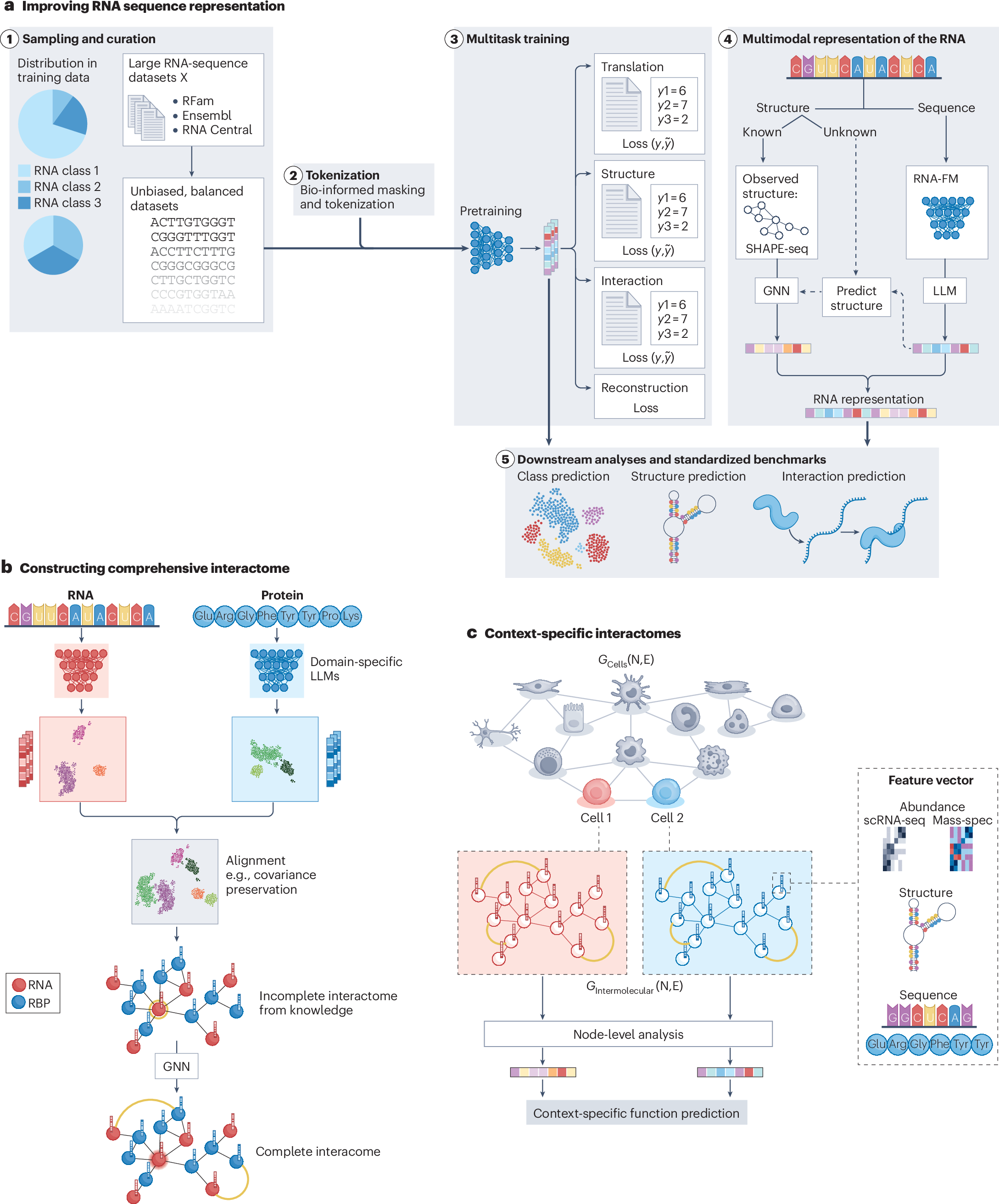
RNA language models (RNA-LMs) and graph neural networks (GNNs) have shown promise in representing RNA sequences and modelling biological interactomes. We propose strategies to advance and integrate these technologies, aiming to enhance RNA sequence representation and enable multimodal and context-specific modelling of the RNA interactome. a, We foresee improvements in four key training components to refine RNA-LM representations. (1) Sampling and curation. RNA databases often exhibit biases in RNA family representation; diverse sampling strategies can be developed to mitigate this issue, including oversampling from under-represented RNA families to balance the training data. Recent automated data curation techniques, such as clustering and sampling within clusters, may be a promising avenue. (2) Tokenization and masking. Current tokenization mainly splits RNA sequences into individual nucleotides. Future models could tokenize RNA into meaningful regulatory motifs. Additionally, masking, the process of hiding input segments that the model learns to reconstruct, is typically random. By masking biologically relevant parts of the sequence, the model may better capture key dependencies within the RNA. (3) Multitask training. To ensure that the model learns biologically relevant representations, it can be trained simultaneously on a self-supervised reconstruction task and multiple supervised tasks, jointly optimizing their respective losses. This approach encourages the model to develop representations that generalize across different tasks, ultimately enhancing its ability to identify meaningful patterns, even from limited labelled data. (4) Multimodal RNA representation. We propose to perform the multimodal fusion of sequence and experimentally derived structure representations, respectively encoded by RNA-LM and GNN, to obtain a comprehensive RNA representation. As emphasized by the dashed lines, sequences whose structures are unknown can be further included, by estimating structures from RNA-FM representations fitting SHAPE-seq data before being embedded through the GNN. Other modalities and multimodal fusion mechanisms could also be considered. b, Modelling a comprehensive interactome requires encoding interactions between RNA and various molecule types (multimodality), as well as interactions within and between these molecular layers (multilayered). Current RNA–protein interaction networks provide a valuable foundation, but are incomplete. To address multimodality, we propose aligning biological sequence representations for each molecule type (for example, protein and RNA) derived from specific language models across modalities. This can be achieved, for instance, using global alignment techniques such as covariance-preserving methods. Additionally, beginning with incomplete interactome data from existing databases, we propose employing GNN-based strategies to infer missing connections (in yellow) within networks, thus facilitating the automatic completion of comprehensive interactomes. c, Interactions between molecules are further constrained by cellular and tissue context, driving each RNA molecule to exhibit context-specific functionality. Modelling this context specificity can be achieved through hierarchical frameworks that represent biological scales, linking graph-based interactome representations across cells or subcellular contexts. Recent methods for modelling cell-specific protein–protein interactomes provide a foundation for such work. Additionally, contextual information on protein abundance, either derived from single-cell RNA sequencing, proteomics or knowledge databases, could further enrich molecular representations through hierarchical graph layers. Once these representations are established, RNA function predictions could be framed as a node classification task within a cell-specific graph. LLM, large language models; mass-spec, mass spectrometry; RBP, RNA-binding protein; RNA-FM, RNA foundation model; scRNA-seq, single-cell RNA sequencing.
This roadmap could allow scientists to predict which proteins or RNAs a specific mRNA might interact with under different conditions. It could also lead to better tools for understanding diseases, where these interactions go wrong, and new possibilities for RNA-based therapies. By bringing together computational experts and RNA biologists, this approach opens new frontiers in decoding the full language of RNA.
Jung V, Vincent-Cuaz C, Tumescheit C, Fournier L, Darsinou M, Xu ZM, Saadat A, Wang Y, Tsantoulis P, Michielin O, Fellay J, Patani R, Ramos A, Frossard P, Hastings J, Riccio A, van der Plas L, Luisier R. (2025) Decoding the interactions and functions of non-coding RNA with artificial intelligence. Nat Rev Mol Cell Biol [Epub ahead of print]. [article]
Related Posts


Messenger RNAs (mRNAs) are best known for carrying instructions from DNA to make proteins. But researchers are learning that mRNAs do much more than that. In addition to encoding proteins, mRNAs have regulatory regions that play important roles in how the cell works. These include parts of the RNA that do not code for proteins, such as introns and the 5′ and 3′ untranslated regions (UTRs), which help control how the RNA is processed, where it goes in the cell, and how long it lasts.
A team led by researchers from the Idiap Research Institute discusses how artificial intelligence (AI) can help scientists understand these hidden functions of RNA. Traditional lab methods often struggle to reveal how these non-coding regions behave or interact with other molecules in the cell. The researchers propose using large language models and graph neural networks, types of AI that can detect patterns in data, to analyze huge amounts of publicly available RNA sequencing and biological data.
Roadmap for refined RNA sequence representation and comprehensive RNA interactome modelling
RNA language models (RNA-LMs) and graph neural networks (GNNs) have shown promise in representing RNA sequences and modelling biological interactomes. We propose strategies to advance and integrate these technologies, aiming to enhance RNA sequence representation and enable multimodal and context-specific modelling of the RNA interactome. a, We foresee improvements in four key training components to refine RNA-LM representations. (1) Sampling and curation. RNA databases often exhibit biases in RNA family representation; diverse sampling strategies can be developed to mitigate this issue, including oversampling from under-represented RNA families to balance the training data. Recent automated data curation techniques, such as clustering and sampling within clusters, may be a promising avenue. (2) Tokenization and masking. Current tokenization mainly splits RNA sequences into individual nucleotides. Future models could tokenize RNA into meaningful regulatory motifs. Additionally, masking, the process of hiding input segments that the model learns to reconstruct, is typically random. By masking biologically relevant parts of the sequence, the model may better capture key dependencies within the RNA. (3) Multitask training. To ensure that the model learns biologically relevant representations, it can be trained simultaneously on a self-supervised reconstruction task and multiple supervised tasks, jointly optimizing their respective losses. This approach encourages the model to develop representations that generalize across different tasks, ultimately enhancing its ability to identify meaningful patterns, even from limited labelled data. (4) Multimodal RNA representation. We propose to perform the multimodal fusion of sequence and experimentally derived structure representations, respectively encoded by RNA-LM and GNN, to obtain a comprehensive RNA representation. As emphasized by the dashed lines, sequences whose structures are unknown can be further included, by estimating structures from RNA-FM representations fitting SHAPE-seq data before being embedded through the GNN. Other modalities and multimodal fusion mechanisms could also be considered. b, Modelling a comprehensive interactome requires encoding interactions between RNA and various molecule types (multimodality), as well as interactions within and between these molecular layers (multilayered). Current RNA–protein interaction networks provide a valuable foundation, but are incomplete. To address multimodality, we propose aligning biological sequence representations for each molecule type (for example, protein and RNA) derived from specific language models across modalities. This can be achieved, for instance, using global alignment techniques such as covariance-preserving methods. Additionally, beginning with incomplete interactome data from existing databases, we propose employing GNN-based strategies to infer missing connections (in yellow) within networks, thus facilitating the automatic completion of comprehensive interactomes. c, Interactions between molecules are further constrained by cellular and tissue context, driving each RNA molecule to exhibit context-specific functionality. Modelling this context specificity can be achieved through hierarchical frameworks that represent biological scales, linking graph-based interactome representations across cells or subcellular contexts. Recent methods for modelling cell-specific protein–protein interactomes provide a foundation for such work. Additionally, contextual information on protein abundance, either derived from single-cell RNA sequencing, proteomics or knowledge databases, could further enrich molecular representations through hierarchical graph layers. Once these representations are established, RNA function predictions could be framed as a node classification task within a cell-specific graph. LLM, large language models; mass-spec, mass spectrometry; RBP, RNA-binding protein; RNA-FM, RNA foundation model; scRNA-seq, single-cell RNA sequencing.
This roadmap could allow scientists to predict which proteins or RNAs a specific mRNA might interact with under different conditions. It could also lead to better tools for understanding diseases, where these interactions go wrong, and new possibilities for RNA-based therapies. By bringing together computational experts and RNA biologists, this approach opens new frontiers in decoding the full language of RNA.
Jung V, Vincent-Cuaz C, Tumescheit C, Fournier L, Darsinou M, Xu ZM, Saadat A, Wang Y, Tsantoulis P, Michielin O, Fellay J, Patani R, Ramos A, Frossard P, Hastings J, Riccio A, van der Plas L, Luisier R. (2025) Decoding the interactions and functions of non-coding RNA with artificial intelligence. Nat Rev Mol Cell Biol [Epub ahead of print]. [article]
Related Posts
Recent Posts
 Scientists identify the neuroblastoma cells that signal poor outcomes
 GARAGE improves rare cell detection in single-cell RNA sequencing analysis using AI
 Machine learning reveals how RNA splicing is regulated in individual cell types
 Illumina releases SpliceAI2 to help advance rare disease research
 Postdoctoral Fellow – Long-Read RNA Methods Development for Neurodegeneration
 Novel biosensor uses DNA ‘barcodes’ to uncover disease signals in cells
RNA-Seq Products & Services



Stay Connected