A far-reaching study has cast doubt on statistical methods used to identify long distance signalling networks in plants.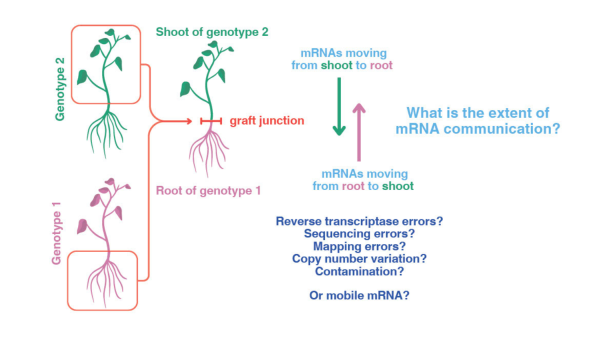
The surprising findings by a John Innes Centre-led collaboration mean we may need to reevaluate a vital area of the life sciences.
The movement of messenger RNAs (mobile mRNAs) between cells and tissues has been reported to play a significant role in long-distance signalling in plants.
Thousands of mobile mRNAs have been reported and proposed to act like a plant internet, as components of a complex intercellular communications system that regulates plant development and physiological processes.
Understanding how plants communicate and respond to their environment has potential applications for agriculture, biotechnology, and even our fundamental understanding of evolution.
To determine the presence of these messaging molecules, researchers use a technique that involves grafting one plant onto another and tracking the progress of mRNAs as they pass from root to shoot, or vice versa, across the graft junction.
The actual tracking is enabled by an experimental technique called RNA sequencing (RNA seq) which can identify differences in the sequences of mRNAs that might indicate the presence of mobile mRNA.
However, a problem when analysing RNA seq data sets lies in distinguishing between differences in the sequences, which might arise from a graft-mobile mRNA signal, and “noise.”
To investigate, the John Innes Centre team used bioinformatics, genomic tools and machine learning approaches, devising a series of statistical tests to distinguish potential signals from noise in the data.
In a study, which appears in Nature Plants, meta-analysis of RNA seq datasets found that up to 83% of data obtained from grafted plants are indistinguishable from the sort of background noise that can be expected in this approach. Taking genome mis-mapping and potential contamination into account reduces the number of mobile candidates even further.
Grafting coupled with RNA-seq to identify transcripts that move from tissue of one genotype/species/ecotype/cultivar into tissue of another across the graft junction

Grafting-based strategy for identification of mRNAs that move from shoot (scion) to root (stock), from genotype 2 to genotype 1, using a scion:stock = genotype 2:genotype 1 heterograft. The same strategy can be used to identify transcripts that move from shoot to root from genotype 1 to genotype 2 using a genotype 1:genotype 2 graft. Transcripts that move root to shoot can be identified by analysing mRNAs in shoot tissue. Natural grafts, such as those established between the parasitic dodder plant and its host plants, can be used in place of artificial grafts. A key challenge in all such approaches is how to assign transcripts to each genotype; methods for doing so are based on (1) SNP identification or on (2) the alignment to different reference genomes. For grafts from the same species, or similar genotypes, SNPs can be used to distinguish between genotypes and thus identify the source genotype of each transcript (1). For grafts between different species, mapping (2) each RNA-seq read to the genome assemblies can be an effective method for determining which transcripts are specific to one species.
The research has uncovered what one expert reviewer described as an “elephant in the room” and has major implications for the field.
The finding that currently annotated mobile mRNAs lack statistical basis challenges current thinking on the extent of mRNA communication.
Professor Richard Morris, corresponding author of the study which appears in Nature Plants, said: “Our analysis questions the number and signaling potential of mobile mRNAs in plants.”
Dr Melissa Tomkins, co-first author, explains: “The aim was to develop models for mRNA transport but the lack of features in the data motivated us to take a closer look.”
Franziska Hoerbst, co-first author, added “The deeper we dug, the less support we found for mobile mRNA. The science took us in quite different directions than expected, leading us back to 18th century maths.”
Dr Pirita Paajanen, lead and co-corresponding author, commented: “This study highlights the importance of making data openly accessible. It is a nice example of the power of mathematics in biology.”
Following these findings, the team have put together a set of recommendations to help future researchers develop more robust approaches for studying long distance mRNA transport.
Professor Morris added: “I wish to think the fantastic team at JIC for their outstanding work and our excellent collaborators – their contributions were key to unravelling causality in what is perhaps one of most challenging datasets we’ve dealt with to date.”
Source – The John Innes Centre


A far-reaching study has cast doubt on statistical methods used to identify long distance signalling networks in plants.
The surprising findings by a John Innes Centre-led collaboration mean we may need to reevaluate a vital area of the life sciences.
The movement of messenger RNAs (mobile mRNAs) between cells and tissues has been reported to play a significant role in long-distance signalling in plants.
Thousands of mobile mRNAs have been reported and proposed to act like a plant internet, as components of a complex intercellular communications system that regulates plant development and physiological processes.
Understanding how plants communicate and respond to their environment has potential applications for agriculture, biotechnology, and even our fundamental understanding of evolution.
To determine the presence of these messaging molecules, researchers use a technique that involves grafting one plant onto another and tracking the progress of mRNAs as they pass from root to shoot, or vice versa, across the graft junction.
The actual tracking is enabled by an experimental technique called RNA sequencing (RNA seq) which can identify differences in the sequences of mRNAs that might indicate the presence of mobile mRNA.
However, a problem when analysing RNA seq data sets lies in distinguishing between differences in the sequences, which might arise from a graft-mobile mRNA signal, and “noise.”
To investigate, the John Innes Centre team used bioinformatics, genomic tools and machine learning approaches, devising a series of statistical tests to distinguish potential signals from noise in the data.
In a study, which appears in Nature Plants, meta-analysis of RNA seq datasets found that up to 83% of data obtained from grafted plants are indistinguishable from the sort of background noise that can be expected in this approach. Taking genome mis-mapping and potential contamination into account reduces the number of mobile candidates even further.
Grafting coupled with RNA-seq to identify transcripts that move from tissue of one genotype/species/ecotype/cultivar into tissue of another across the graft junction
Grafting-based strategy for identification of mRNAs that move from shoot (scion) to root (stock), from genotype 2 to genotype 1, using a scion:stock = genotype 2:genotype 1 heterograft. The same strategy can be used to identify transcripts that move from shoot to root from genotype 1 to genotype 2 using a genotype 1:genotype 2 graft. Transcripts that move root to shoot can be identified by analysing mRNAs in shoot tissue. Natural grafts, such as those established between the parasitic dodder plant and its host plants, can be used in place of artificial grafts. A key challenge in all such approaches is how to assign transcripts to each genotype; methods for doing so are based on (1) SNP identification or on (2) the alignment to different reference genomes. For grafts from the same species, or similar genotypes, SNPs can be used to distinguish between genotypes and thus identify the source genotype of each transcript (1). For grafts between different species, mapping (2) each RNA-seq read to the genome assemblies can be an effective method for determining which transcripts are specific to one species.
The research has uncovered what one expert reviewer described as an “elephant in the room” and has major implications for the field.
The finding that currently annotated mobile mRNAs lack statistical basis challenges current thinking on the extent of mRNA communication.
Following these findings, the team have put together a set of recommendations to help future researchers develop more robust approaches for studying long distance mRNA transport.
Source – The John Innes Centre
Paajanen P, Tomkins M, Hoerbst F, Morris R, et al. (2025) Re-analysis of mobile mRNA datasets raises questions about the extent of long-distance mRNA communication. Nature Plants [Online ahead of print]. [article]
Related Posts
RNAmel simplifies RNA sequencing data analysis with a reproducible, integrated platform
Heart failure reshapes bone marrow to create inflammation-related immune memory
Overlooked DNA regions surrounding ‘microexons’ hold missing pieces of autism’s genetic puzzle
RiboBA improves detection of hidden protein-coding regions using ribosome profiling
An anti-senescence gene may fight spinal disc deterioration
Scientists identify the neuroblastoma cells that signal poor outcomes
Novel biosensor uses DNA ‘barcodes’ to uncover disease signals in cells
CellART extracts single-cell information from high-resolution spatial transcriptomics
Cell2space restores spatial context to single-cell RNA sequencing data
Urine test may improve bladder cancer diagnosis and guide treatment decisions
DeCoRE – a computational method to resolve RNA structural heterogeneity from RNA structure probing data by direct RNA sequencing
Tracing 700 million years of cell evolution
How should biological replicates be handled in long-read RNA sequencing?
RNA-Seq reveals a new way the developing heart controls its growth
The Human RNome Project Consortium seeks to publish first-ever complete sequence of the body’s RNA
scFlowReport brings multiple single-cell RNA sequencing analyses into one workflow
Long-read RNA sequencing reveals how neurons choose alternative RNA endings
DeOPUS improves cell-type estimates from bulk RNA sequencing
ResolVI improves accuracy in spatial transcriptomics analysis
RNA sequencing reveals transcriptional allele differences in prostate cancer stem cells
A far-reaching study has cast doubt on statistical methods used to identify long distance signalling networks in plants.
The surprising findings by a John Innes Centre-led collaboration mean we may need to reevaluate a vital area of the life sciences.
The movement of messenger RNAs (mobile mRNAs) between cells and tissues has been reported to play a significant role in long-distance signalling in plants.
Thousands of mobile mRNAs have been reported and proposed to act like a plant internet, as components of a complex intercellular communications system that regulates plant development and physiological processes.
Understanding how plants communicate and respond to their environment has potential applications for agriculture, biotechnology, and even our fundamental understanding of evolution.
To determine the presence of these messaging molecules, researchers use a technique that involves grafting one plant onto another and tracking the progress of mRNAs as they pass from root to shoot, or vice versa, across the graft junction.
The actual tracking is enabled by an experimental technique called RNA sequencing (RNA seq) which can identify differences in the sequences of mRNAs that might indicate the presence of mobile mRNA.
However, a problem when analysing RNA seq data sets lies in distinguishing between differences in the sequences, which might arise from a graft-mobile mRNA signal, and “noise.”
To investigate, the John Innes Centre team used bioinformatics, genomic tools and machine learning approaches, devising a series of statistical tests to distinguish potential signals from noise in the data.
In a study, which appears in Nature Plants, meta-analysis of RNA seq datasets found that up to 83% of data obtained from grafted plants are indistinguishable from the sort of background noise that can be expected in this approach. Taking genome mis-mapping and potential contamination into account reduces the number of mobile candidates even further.
Grafting coupled with RNA-seq to identify transcripts that move from tissue of one genotype/species/ecotype/cultivar into tissue of another across the graft junction
Grafting-based strategy for identification of mRNAs that move from shoot (scion) to root (stock), from genotype 2 to genotype 1, using a scion:stock = genotype 2:genotype 1 heterograft. The same strategy can be used to identify transcripts that move from shoot to root from genotype 1 to genotype 2 using a genotype 1:genotype 2 graft. Transcripts that move root to shoot can be identified by analysing mRNAs in shoot tissue. Natural grafts, such as those established between the parasitic dodder plant and its host plants, can be used in place of artificial grafts. A key challenge in all such approaches is how to assign transcripts to each genotype; methods for doing so are based on (1) SNP identification or on (2) the alignment to different reference genomes. For grafts from the same species, or similar genotypes, SNPs can be used to distinguish between genotypes and thus identify the source genotype of each transcript (1). For grafts between different species, mapping (2) each RNA-seq read to the genome assemblies can be an effective method for determining which transcripts are specific to one species.
The research has uncovered what one expert reviewer described as an “elephant in the room” and has major implications for the field.
The finding that currently annotated mobile mRNAs lack statistical basis challenges current thinking on the extent of mRNA communication.
Following these findings, the team have put together a set of recommendations to help future researchers develop more robust approaches for studying long distance mRNA transport.
Source – The John Innes Centre
Paajanen P, Tomkins M, Hoerbst F, Morris R, et al. (2025) Re-analysis of mobile mRNA datasets raises questions about the extent of long-distance mRNA communication. Nature Plants [Online ahead of print]. [article]
Related Posts
RNAmel simplifies RNA sequencing data analysis with a reproducible, integrated platform
Heart failure reshapes bone marrow to create inflammation-related immune memory
Overlooked DNA regions surrounding ‘microexons’ hold missing pieces of autism’s genetic puzzle
RiboBA improves detection of hidden protein-coding regions using ribosome profiling
An anti-senescence gene may fight spinal disc deterioration
Scientists identify the neuroblastoma cells that signal poor outcomes
Novel biosensor uses DNA ‘barcodes’ to uncover disease signals in cells
CellART extracts single-cell information from high-resolution spatial transcriptomics
Cell2space restores spatial context to single-cell RNA sequencing data
Urine test may improve bladder cancer diagnosis and guide treatment decisions
DeCoRE – a computational method to resolve RNA structural heterogeneity from RNA structure probing data by direct RNA sequencing
Tracing 700 million years of cell evolution
How should biological replicates be handled in long-read RNA sequencing?
RNA-Seq reveals a new way the developing heart controls its growth
The Human RNome Project Consortium seeks to publish first-ever complete sequence of the body’s RNA
scFlowReport brings multiple single-cell RNA sequencing analyses into one workflow
Long-read RNA sequencing reveals how neurons choose alternative RNA endings
DeOPUS improves cell-type estimates from bulk RNA sequencing
ResolVI improves accuracy in spatial transcriptomics analysis
RNA sequencing reveals transcriptional allele differences in prostate cancer stem cells
Stay Connected
Submit a Post to the Blog
Recent Posts
Subscribe to the RNA-Seq Blog
RNA-Seq Products & Services