

With the explosion of RNA sequencing in research and medicine, scientists are getting an increasingly detailed look at how genes behave in different cells. Now, researchers at Cal Tech have developed a powerful tool that goes even further by detecting viral sequences hidden within gene expression data, all the way down to the single-cell level.
Traditional methods for identifying viruses in sequencing data often rely on having known reference genomes. This limits their ability to catch previously unidentified or highly mutated viruses. The researchers approached this problem by focusing on the RNA-dependent RNA polymerase (RdRP)—a protein that’s found in nearly all RNA viruses and is highly conserved across species. By searching for RdRP in RNA sequencing data, the method can spot over 100,000 RNA virus species, even in complex datasets.
Translated search with kallisto and PalmDB enables the detection of orders of magnitude more RNA viruses than reference-based approaches while retaining single-cell resolution
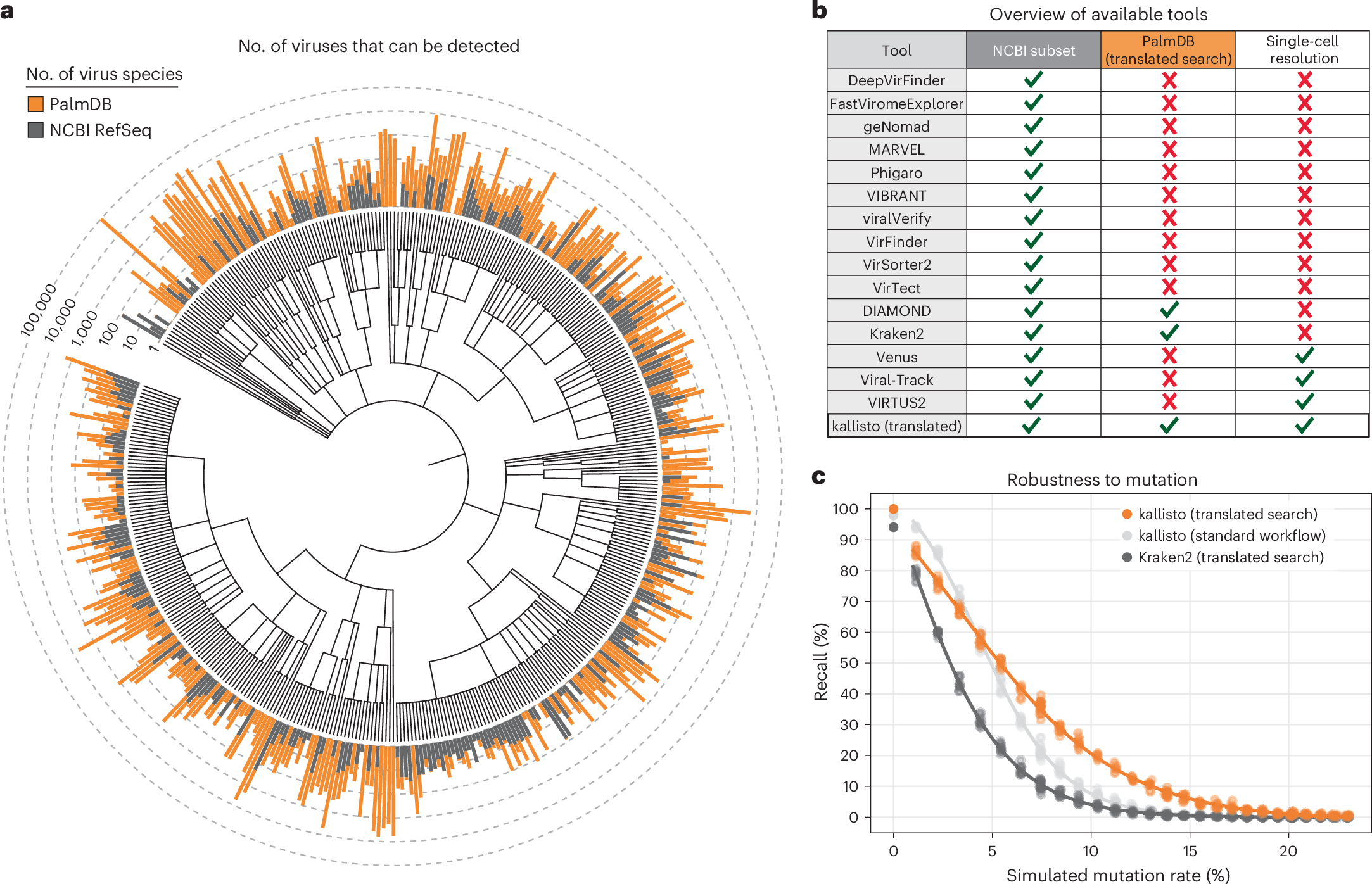
a, Taxonomic tree of the viral sequences and genomes included in the PalmDB sOTUs and NCBI RefSeq databases, from phylum to genus. Barplots indicate the number of sequences or species available for each taxonomy in each database. The tree was generated with iTOL. Although PalmDB primarily consists of RdRP sequences, and hence most of the taxonomies belong to the realm of Riboviria, it also includes few high-confidence non-RdRP sequences from non-Riboviria viruses, including Caudovirales, Mimiviridae and Herpesvirales. This tree, complete with taxonomic labels, can also be viewed interactively at tinyurl.com/y48enbae. Some taxonomic labels may no longer align with current ICTV guidelines, as they were derived from a specific version of the PalmDB sOTUs. b, Overview of available tools for the detection of viral sequences in next-generation sequencing data and their ability to align to NCBI RefSeq nucleotide genomes, perform translated alignment of nucleotide data against an amino acid reference, such as the PalmDB, and retain single-cell resolution through cell barcode tracking. c, Mutation-Simulator was used to add random single nucleotide base substitutions to 676 EBOV RdRP sequences obtained by Seq-Well sequencing at increasing mutation rates. We performed ten simulations per mutation rate. The sequences were subsequently aligned using kallisto translated search against the complete PalmDB, Kraken2 translated search against the RdRP amino acid sequence of EBOV with a manually adjusted NCBI Taxonomy ID (to allow compatibility with Kraken2) and kallisto standard workflow against the complete EBOV nucleotide genome. The plot shows the recall percentage of the 676 sequences for each of the ten simulations at each mutation rate. Each was fitted with an inverse sigmoid for mutation rates of >0.
The new approach works on both bulk and single-cell RNA-seq data, which means it can track viral infections cell by cell. That matters a lot because it allows researchers to pinpoint exactly which cells are infected, what genes those cells are expressing, and how their behavior changes in response to the virus. For example, when applied to blood samples from rhesus macaques infected with Ebola virus, the method not only detected Ebola but also identified potential new viruses that hadn’t been previously described.
Even more exciting? The researchers could accurately predict viral infection based purely on gene expression patterns in the host cells. This could open new doors for early virus detection, understanding how viruses spread through tissues, and developing targeted therapies.
In short, this work shows how combining RNA sequencing with smart viral detection techniques can vastly improve our understanding of how viruses interact with their hosts—cell by cell.
Luebbert L, Sullivan DK, Carilli M, et al. (2025) Detection of viral sequences at single-cell resolution identifies novel viruses associated with host gene expression changes. Nature Biotechnology [Epub ahead of print]. [article]
Related Posts




With the explosion of RNA sequencing in research and medicine, scientists are getting an increasingly detailed look at how genes behave in different cells. Now, researchers at Cal Tech have developed a powerful tool that goes even further by detecting viral sequences hidden within gene expression data, all the way down to the single-cell level.
Traditional methods for identifying viruses in sequencing data often rely on having known reference genomes. This limits their ability to catch previously unidentified or highly mutated viruses. The researchers approached this problem by focusing on the RNA-dependent RNA polymerase (RdRP)—a protein that’s found in nearly all RNA viruses and is highly conserved across species. By searching for RdRP in RNA sequencing data, the method can spot over 100,000 RNA virus species, even in complex datasets.
Translated search with kallisto and PalmDB enables the detection of orders of magnitude more RNA viruses than reference-based approaches while retaining single-cell resolution
a, Taxonomic tree of the viral sequences and genomes included in the PalmDB sOTUs and NCBI RefSeq databases, from phylum to genus. Barplots indicate the number of sequences or species available for each taxonomy in each database. The tree was generated with iTOL. Although PalmDB primarily consists of RdRP sequences, and hence most of the taxonomies belong to the realm of Riboviria, it also includes few high-confidence non-RdRP sequences from non-Riboviria viruses, including Caudovirales, Mimiviridae and Herpesvirales. This tree, complete with taxonomic labels, can also be viewed interactively at tinyurl.com/y48enbae. Some taxonomic labels may no longer align with current ICTV guidelines, as they were derived from a specific version of the PalmDB sOTUs. b, Overview of available tools for the detection of viral sequences in next-generation sequencing data and their ability to align to NCBI RefSeq nucleotide genomes, perform translated alignment of nucleotide data against an amino acid reference, such as the PalmDB, and retain single-cell resolution through cell barcode tracking. c, Mutation-Simulator was used to add random single nucleotide base substitutions to 676 EBOV RdRP sequences obtained by Seq-Well sequencing at increasing mutation rates. We performed ten simulations per mutation rate. The sequences were subsequently aligned using kallisto translated search against the complete PalmDB, Kraken2 translated search against the RdRP amino acid sequence of EBOV with a manually adjusted NCBI Taxonomy ID (to allow compatibility with Kraken2) and kallisto standard workflow against the complete EBOV nucleotide genome. The plot shows the recall percentage of the 676 sequences for each of the ten simulations at each mutation rate. Each was fitted with an inverse sigmoid for mutation rates of >0.
The new approach works on both bulk and single-cell RNA-seq data, which means it can track viral infections cell by cell. That matters a lot because it allows researchers to pinpoint exactly which cells are infected, what genes those cells are expressing, and how their behavior changes in response to the virus. For example, when applied to blood samples from rhesus macaques infected with Ebola virus, the method not only detected Ebola but also identified potential new viruses that hadn’t been previously described.
Even more exciting? The researchers could accurately predict viral infection based purely on gene expression patterns in the host cells. This could open new doors for early virus detection, understanding how viruses spread through tissues, and developing targeted therapies.
In short, this work shows how combining RNA sequencing with smart viral detection techniques can vastly improve our understanding of how viruses interact with their hosts—cell by cell.
Luebbert L, Sullivan DK, Carilli M, et al. (2025) Detection of viral sequences at single-cell resolution identifies novel viruses associated with host gene expression changes. Nature Biotechnology [Epub ahead of print]. [article]
Related Posts
Recent Posts
 RNAmel simplifies RNA sequencing data analysis with a reproducible, integrated platform
 Heart failure reshapes bone marrow to create inflammation-related immune memory
 Overlooked DNA regions surrounding ‘microexons’ hold missing pieces of autism’s genetic puzzle
 RiboBA improves detection of hidden protein-coding regions using ribosome profiling
 An anti-senescence gene may fight spinal disc deterioration
 Bulk RNA-seq Analysis: A Complete Beginner’s Guide
RNA-Seq Products & Services


Stay Connected