

Brain implants hold promise for treating neurological disorders and expanding our understanding of the brain. However, their long-term effectiveness is often limited by the brain’s response to these foreign objects. Understanding what drives this tissue reaction is critical for developing more stable and biocompatible implants. To explore this, researchers from Michigan State University have created a powerful new tool called DiffCoRank.
DiffCoRank is a comprehensive framework that helps researchers analyze RNA sequencing data from brain tissue surrounding implants. Instead of simply identifying which genes are turned on or off, DiffCoRank looks at how groups of genes behave together, a method called differential coexpression analysis. This allows scientists to discover important gene clusters that might control how the brain responds to implants.
Overview of the computational workflow for hub gene identification
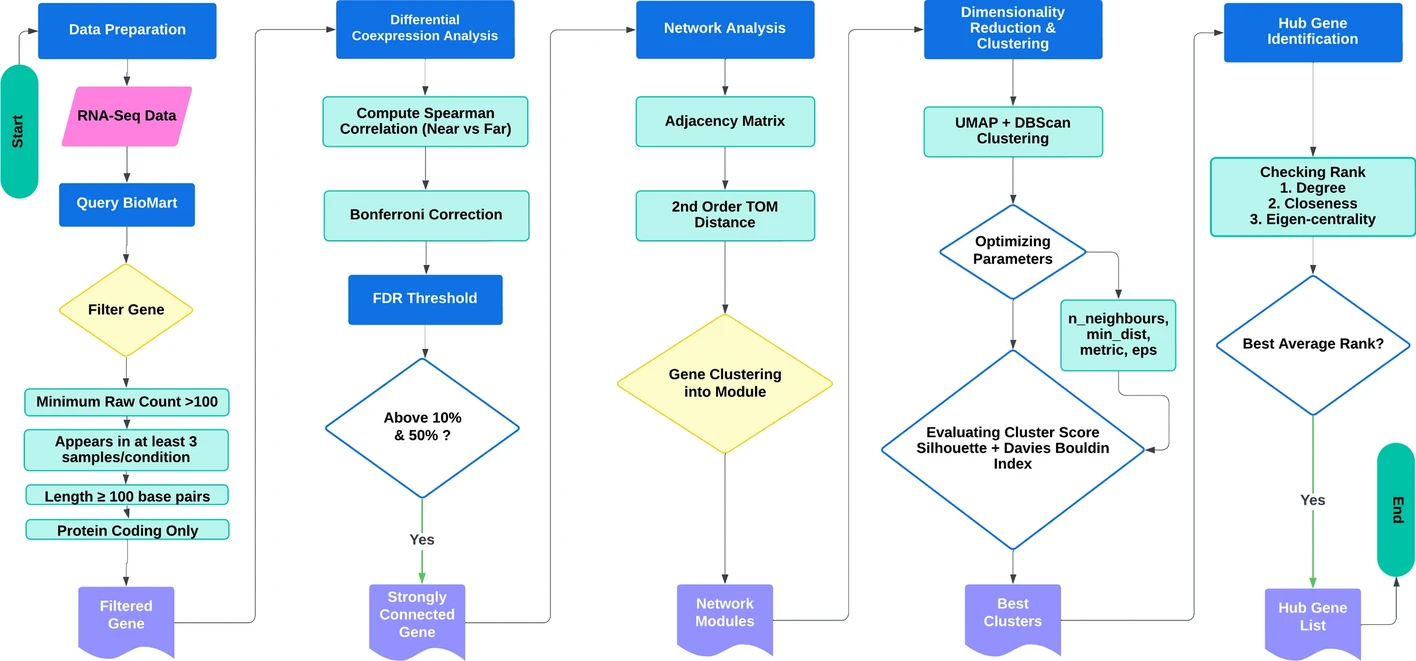
Key steps include differential coexpression analysis, network clustering via TOM, UMAP+DBSCAN-based dimensionality reduction, and centrality-based ranking to identify biologically relevant hub genes
What makes DiffCoRank unique is its ability to filter out noise and highlight strong, meaningful gene relationships that might otherwise be missed. It uses advanced techniques like UMAP and DBSCAN to group related genes, and then applies a multi-step scoring system to rank the most influential “hub genes” based on how central they are in the network. The team also developed an easy-to-use app that lets researchers explore the gene modules and networks visually.
Using this tool, the researchers identified gene clusters involved in key processes such as oxidative stress, immune responses, calcium signaling, autophagy (cellular cleanup), and blood vessel remodeling. These insights could help scientists design better implants that are less likely to be rejected or cause inflammation, making future therapies more effective and longer-lasting.
By comparing DiffCoRank to other analysis tools, the team showed it offers improved detection of gene networks and reveals previously overlooked molecular regulators. This innovative approach opens new doors for improving the design and function of brain-machine interfaces.
Availability – The code for this project can be found in our GitHub Repository (https://github.com/msureil/DiffCoRank)
Chakraborty A, Purcell EK, Moore MG. (2025) DiffCoRank: a comprehensive framework for discovering hub genes and differential gene co-expression in brain implant-associated tissue responses. BMC Bioinformatics 26(1):191. [article]
Related Posts






Brain implants hold promise for treating neurological disorders and expanding our understanding of the brain. However, their long-term effectiveness is often limited by the brain’s response to these foreign objects. Understanding what drives this tissue reaction is critical for developing more stable and biocompatible implants. To explore this, researchers from Michigan State University have created a powerful new tool called DiffCoRank.
DiffCoRank is a comprehensive framework that helps researchers analyze RNA sequencing data from brain tissue surrounding implants. Instead of simply identifying which genes are turned on or off, DiffCoRank looks at how groups of genes behave together, a method called differential coexpression analysis. This allows scientists to discover important gene clusters that might control how the brain responds to implants.
Overview of the computational workflow for hub gene identification
Key steps include differential coexpression analysis, network clustering via TOM, UMAP+DBSCAN-based dimensionality reduction, and centrality-based ranking to identify biologically relevant hub genes
What makes DiffCoRank unique is its ability to filter out noise and highlight strong, meaningful gene relationships that might otherwise be missed. It uses advanced techniques like UMAP and DBSCAN to group related genes, and then applies a multi-step scoring system to rank the most influential “hub genes” based on how central they are in the network. The team also developed an easy-to-use app that lets researchers explore the gene modules and networks visually.
Using this tool, the researchers identified gene clusters involved in key processes such as oxidative stress, immune responses, calcium signaling, autophagy (cellular cleanup), and blood vessel remodeling. These insights could help scientists design better implants that are less likely to be rejected or cause inflammation, making future therapies more effective and longer-lasting.
By comparing DiffCoRank to other analysis tools, the team showed it offers improved detection of gene networks and reveals previously overlooked molecular regulators. This innovative approach opens new doors for improving the design and function of brain-machine interfaces.
Availability – The code for this project can be found in our GitHub Repository (https://github.com/msureil/DiffCoRank)
Chakraborty A, Purcell EK, Moore MG. (2025) DiffCoRank: a comprehensive framework for discovering hub genes and differential gene co-expression in brain implant-associated tissue responses. BMC Bioinformatics 26(1):191. [article]
Related Posts
Recent Posts
 Scientists identify the neuroblastoma cells that signal poor outcomes
 GARAGE improves rare cell detection in single-cell RNA sequencing analysis using AI
 Machine learning reveals how RNA splicing is regulated in individual cell types
 Illumina releases SpliceAI2 to help advance rare disease research
 Postdoctoral Fellow – Long-Read RNA Methods Development for Neurodegeneration
 Novel biosensor uses DNA ‘barcodes’ to uncover disease signals in cells
RNA-Seq Products & Services



Stay Connected