

Researchers at Fujian Medical University have developed a powerful new method for studying chemical modifications on RNA molecules, offering a clearer view of the epitranscriptome. The team’s new platform, called DirectRM, takes advantage of Nanopore direct RNA sequencing to identify six common RNA modifications at once, including N4-acetylcytidine, 1-methyladenosine, 5-methylcytidine, N7-methylguanosine, N6-methyladenosine, and pseudouridine.
Overall design of DirectRM
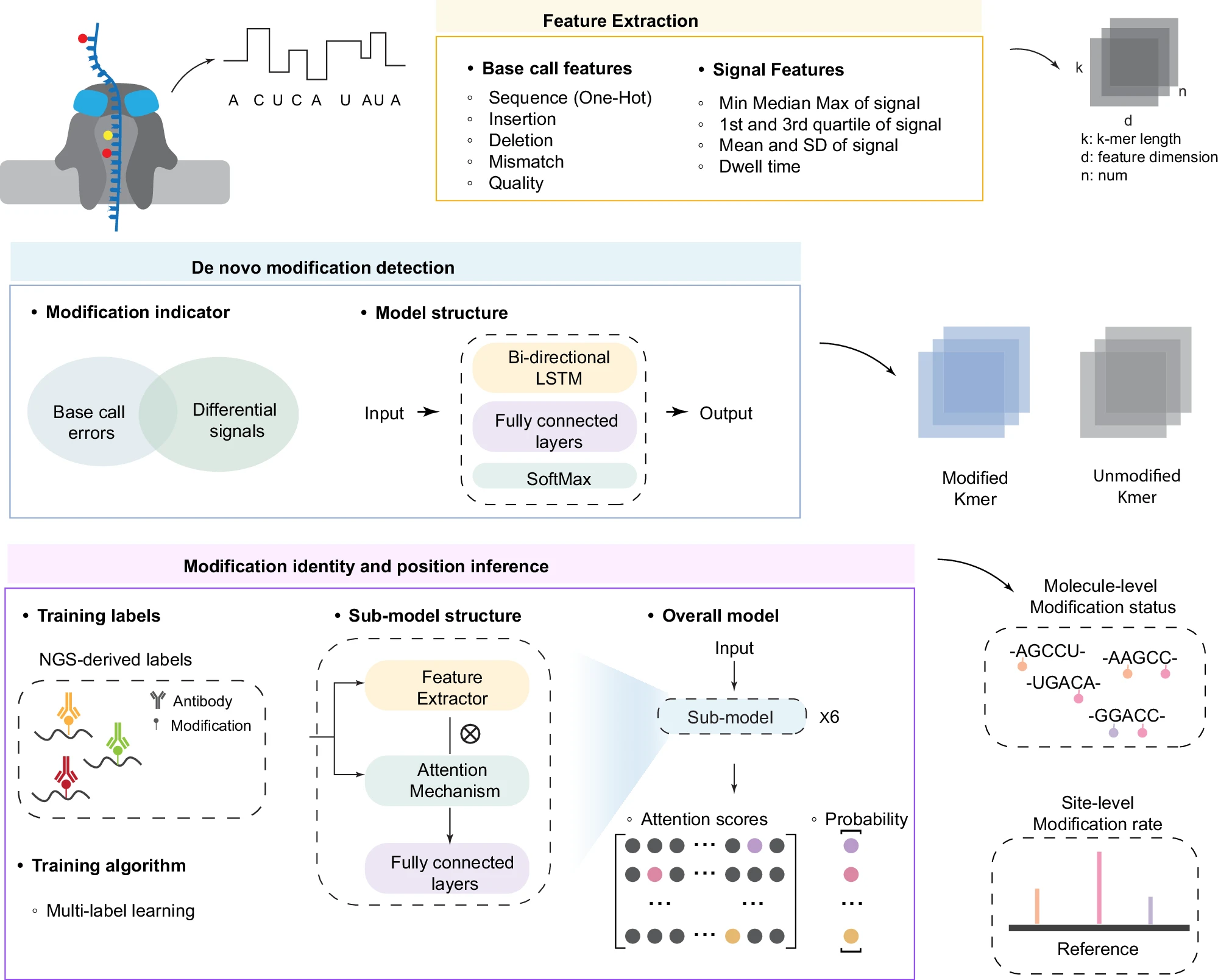
RNA modifications are chemical marks that influence how RNAs function, interact with proteins, and regulate gene expression. Until recently, detecting multiple types of modifications in the same RNA molecule was technically challenging. DirectRM changes that by combining machine learning with real-time sequencing data to simultaneously detect both the type and exact position of modifications in native RNA samples.
The researchers designed a two-step process, starting with a binary classifier that identifies potentially modified RNA sequences, followed by an attention-based neural network that pinpoints specific modification sites. Using RNA samples from human cell lines and viruses, they demonstrated that DirectRM is more sensitive, precise, and robust than previous tools.
One of the most intriguing findings was the pattern of how RNA modifications interact. At the transcript level, modifications tend to cluster together, while within individual RNA molecules, the presence of one modification may actually reduce the likelihood of another occurring nearby. These insights suggest a complex layer of regulation in RNA biology, one that could influence how genes are expressed and how cells respond to changing conditions.
By expanding the ability to detect and interpret RNA modifications, DirectRM provides scientists with a new lens to explore RNA biology. Its open framework also means it can be adapted to future discoveries and applied to a wide range of biological systems.
Availability – The code used to develop the model, perform the analyses, and generate results in this study is publicly available and has been deposited in https://github.com/yuxinPenny/DirectRM at GitHub repository.
Zhang Y, Wu Y, Ma J, Wu Y, Li L, Wang H, Jia G, Rigden D.J., Meng J, Huang D, Chen K. (2025) DirectRM: integrated detection of landscape and crosstalk between multiple RNA modifications using direct RNA sequencing. Nature Communications 16(1):9450. [article]
Related Posts







Researchers at Fujian Medical University have developed a powerful new method for studying chemical modifications on RNA molecules, offering a clearer view of the epitranscriptome. The team’s new platform, called DirectRM, takes advantage of Nanopore direct RNA sequencing to identify six common RNA modifications at once, including N4-acetylcytidine, 1-methyladenosine, 5-methylcytidine, N7-methylguanosine, N6-methyladenosine, and pseudouridine.
Overall design of DirectRM
RNA modifications are chemical marks that influence how RNAs function, interact with proteins, and regulate gene expression. Until recently, detecting multiple types of modifications in the same RNA molecule was technically challenging. DirectRM changes that by combining machine learning with real-time sequencing data to simultaneously detect both the type and exact position of modifications in native RNA samples.
The researchers designed a two-step process, starting with a binary classifier that identifies potentially modified RNA sequences, followed by an attention-based neural network that pinpoints specific modification sites. Using RNA samples from human cell lines and viruses, they demonstrated that DirectRM is more sensitive, precise, and robust than previous tools.
One of the most intriguing findings was the pattern of how RNA modifications interact. At the transcript level, modifications tend to cluster together, while within individual RNA molecules, the presence of one modification may actually reduce the likelihood of another occurring nearby. These insights suggest a complex layer of regulation in RNA biology, one that could influence how genes are expressed and how cells respond to changing conditions.
By expanding the ability to detect and interpret RNA modifications, DirectRM provides scientists with a new lens to explore RNA biology. Its open framework also means it can be adapted to future discoveries and applied to a wide range of biological systems.
Availability – The code used to develop the model, perform the analyses, and generate results in this study is publicly available and has been deposited in https://github.com/yuxinPenny/DirectRM at GitHub repository.
Zhang Y, Wu Y, Ma J, Wu Y, Li L, Wang H, Jia G, Rigden D.J., Meng J, Huang D, Chen K. (2025) DirectRM: integrated detection of landscape and crosstalk between multiple RNA modifications using direct RNA sequencing. Nature Communications 16(1):9450. [article]
Related Posts
Recent Posts
 RNAmel simplifies RNA sequencing data analysis with a reproducible, integrated platform
 Heart failure reshapes bone marrow to create inflammation-related immune memory
 Overlooked DNA regions surrounding ‘microexons’ hold missing pieces of autism’s genetic puzzle
 RiboBA improves detection of hidden protein-coding regions using ribosome profiling
 An anti-senescence gene may fight spinal disc deterioration
 Bulk RNA-seq Analysis: A Complete Beginner’s Guide
RNA-Seq Products & Services


Stay Connected