Chondrocytes play a crucial role in skeletal development. Many bones, such as those in the arms and legs, are formed through endochondral ossification, in which chondrocytes assemble to create a cartilage scaffold that is later replaced by bone. The maturation of chondrocytes, required for their diverse functions, is regulated by epigenetic mechanisms that modulate gene activity without altering DNA sequences. Among these, DNA methylation is especially important, serving as a switch to suppress gene expression. Maintenance of proper DNA methylation requires the enzyme DNA methyltransferase 1 (Dnmt1). However, the role of Dnmt1 in bone and cartilage remained unclear.
In this study, researchers at Ehime University investigated the function of Dnmt1 in bone growth. Using the musculoskeletal database “MSK-KP,” they identified a strong association between genetic variation in DNMT1 and human height. To examine its biological role, the researchers generated mice lacking Dnmt1 specifically in mesenchymal progenitors of the limbs. These mutant mice displayed markedly shortened tibial length compared with controls. Detailed analysis revealed that Dnmt1 is expressed in the proliferative zone (PZ) of the growth plate cartilage, which is essential for longitudinal bone growth. Mutant mice showed reduced PZ, expanded hypertrophic zone (HZ), and accelerated calcification, indicating premature chondrocyte maturation.
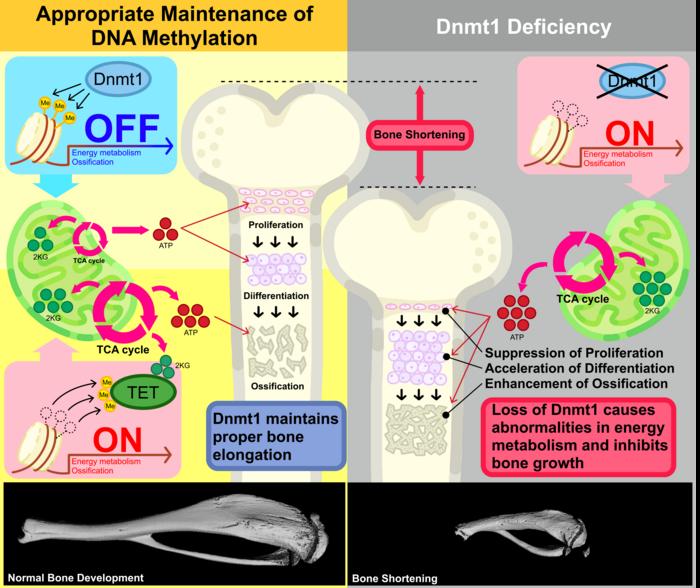
Loss of Dnmt1 disrupted normal DNA methylation in chondrocytes, leading to increased expression of genes involved in cellular energy metabolism. As a result, metabolic abnormalities occurred, promoting the differentiation and calcification of growth plate chondrocytes and ultimately inhibiting bone growth. These findings suggest that proper maintenance of DNA methylation mediated by Dnmt1 during chondrocyte differentiation regulates intracellular energy metabolism through gene expression control, thereby maintaining the balance of chondrocyte differentiation and calcification and ensuring normal bone growth. [Illustrated by Taro Kuroda (ADRES, Ehime univ.)]
To clarify the molecular basis, the researchers performed RNA sequencing and DNA methylation analysis of cartilage from mutant and control mice. These experiments revealed that Dnmt1 directly regulates genes involved in cellular energy metabolism. Indeed, chondrocytes from mutant mice showed enhanced metabolic activity, and inhibition of metabolism suppressed the accelerated maturation phenotype. Furthermore, experiments using human chondrocytes isolated from surgical samples demonstrated similar results: reduction of Dnmt1 enhanced energy metabolism and increased markers of chondrocyte maturation, such as osteocalcin.
Taken together, these findings reveal that Dnmt1 regulates energy metabolism to ensure proper chondrocyte maturation and normal bone elongation. This discovery highlights the potential of nutritional and metabolic interventions in the prevention and treatment of impaired bone growth and osteoarthritis.
Source – Ehime University


Chondrocytes play a crucial role in skeletal development. Many bones, such as those in the arms and legs, are formed through endochondral ossification, in which chondrocytes assemble to create a cartilage scaffold that is later replaced by bone. The maturation of chondrocytes, required for their diverse functions, is regulated by epigenetic mechanisms that modulate gene activity without altering DNA sequences. Among these, DNA methylation is especially important, serving as a switch to suppress gene expression. Maintenance of proper DNA methylation requires the enzyme DNA methyltransferase 1 (Dnmt1). However, the role of Dnmt1 in bone and cartilage remained unclear.
In this study, researchers at Ehime University investigated the function of Dnmt1 in bone growth. Using the musculoskeletal database “MSK-KP,” they identified a strong association between genetic variation in DNMT1 and human height. To examine its biological role, the researchers generated mice lacking Dnmt1 specifically in mesenchymal progenitors of the limbs. These mutant mice displayed markedly shortened tibial length compared with controls. Detailed analysis revealed that Dnmt1 is expressed in the proliferative zone (PZ) of the growth plate cartilage, which is essential for longitudinal bone growth. Mutant mice showed reduced PZ, expanded hypertrophic zone (HZ), and accelerated calcification, indicating premature chondrocyte maturation.
Loss of Dnmt1 disrupted normal DNA methylation in chondrocytes, leading to increased expression of genes involved in cellular energy metabolism. As a result, metabolic abnormalities occurred, promoting the differentiation and calcification of growth plate chondrocytes and ultimately inhibiting bone growth. These findings suggest that proper maintenance of DNA methylation mediated by Dnmt1 during chondrocyte differentiation regulates intracellular energy metabolism through gene expression control, thereby maintaining the balance of chondrocyte differentiation and calcification and ensuring normal bone growth. [Illustrated by Taro Kuroda (ADRES, Ehime univ.)]
To clarify the molecular basis, the researchers performed RNA sequencing and DNA methylation analysis of cartilage from mutant and control mice. These experiments revealed that Dnmt1 directly regulates genes involved in cellular energy metabolism. Indeed, chondrocytes from mutant mice showed enhanced metabolic activity, and inhibition of metabolism suppressed the accelerated maturation phenotype. Furthermore, experiments using human chondrocytes isolated from surgical samples demonstrated similar results: reduction of Dnmt1 enhanced energy metabolism and increased markers of chondrocyte maturation, such as osteocalcin.
Taken together, these findings reveal that Dnmt1 regulates energy metabolism to ensure proper chondrocyte maturation and normal bone elongation. This discovery highlights the potential of nutritional and metabolic interventions in the prevention and treatment of impaired bone growth and osteoarthritis.
Source – Ehime University
Yanagihara Y, Takahashi M, Izumi Y, Kinoshita T, Takao M, Bamba T, Imai Y. (2025) Dnmt1 determines bone length by regulating energy metabolism of growth plate chondrocytes. Nature Communications 16(1): 9492. [article]
Related Posts
RNAmel simplifies RNA sequencing data analysis with a reproducible, integrated platform
Heart failure reshapes bone marrow to create inflammation-related immune memory
Overlooked DNA regions surrounding ‘microexons’ hold missing pieces of autism’s genetic puzzle
RiboBA improves detection of hidden protein-coding regions using ribosome profiling
An anti-senescence gene may fight spinal disc deterioration
Scientists identify the neuroblastoma cells that signal poor outcomes
Novel biosensor uses DNA ‘barcodes’ to uncover disease signals in cells
CellART extracts single-cell information from high-resolution spatial transcriptomics
Cell2space restores spatial context to single-cell RNA sequencing data
Urine test may improve bladder cancer diagnosis and guide treatment decisions
DeCoRE – a computational method to resolve RNA structural heterogeneity from RNA structure probing data by direct RNA sequencing
Tracing 700 million years of cell evolution
How should biological replicates be handled in long-read RNA sequencing?
RNA-Seq reveals a new way the developing heart controls its growth
The Human RNome Project Consortium seeks to publish first-ever complete sequence of the body’s RNA
scFlowReport brings multiple single-cell RNA sequencing analyses into one workflow
Long-read RNA sequencing reveals how neurons choose alternative RNA endings
DeOPUS improves cell-type estimates from bulk RNA sequencing
ResolVI improves accuracy in spatial transcriptomics analysis
RNA sequencing reveals transcriptional allele differences in prostate cancer stem cells
Stay Connected
Submit a Post to the Blog
Recent Posts
Subscribe to the RNA-Seq Blog
RNA-Seq Products & Services