

Researchers from the Weizmann Institute of Science explore how single-cell RNA sequencing (scRNA-seq) is reshaping our understanding of cancer biology and its potential clinical applications. They discuss how this technology helps uncover the diverse genetic and functional states of cancer cells and their surrounding environment.
The Power of scRNA-seq in Cancer Research
For years, scientists studied tumors by sequencing bulk samples, which provided an average view of gene expression across many cells. However, this approach masked important differences between individual cells within a tumor. With scRNA-seq, researchers can analyze gene expression at the single-cell level, revealing the complexity of each tumor as a unique ecosystem composed of various cell types with different roles in disease progression.
Key Findings from Cancer Studies
Over the past decade, hundreds of studies have used scRNA-seq to analyze tumor samples, leading to several key insights:
Understanding Tumor Heterogeneity: scRNA-seq has shown that cancer is not made up of uniform cells but rather consists of distinct subpopulations with different genetic mutations and behaviors. This insight is critical for understanding how tumors evolve and develop resistance to treatments.
Characterizing the Tumor Microenvironment: Cancer cells interact with immune cells, fibroblasts, and other components in their environment. scRNA-seq has helped map these interactions, providing clues on how to manipulate the immune system to better target tumors.
Identifying New Therapeutic Targets: By pinpointing specific cell states that contribute to tumor progression, scRNA-seq has identified potential drug targets that might not have been detected using traditional sequencing methods.
Towards Clinical Applications: Although most scRNA-seq studies focus on basic biology, there is growing interest in applying these findings to clinical settings. The technology holds promise for improving cancer diagnostics, predicting patient responses to therapies, and developing personalized treatment plans.
Challenges and Future Directions
Despite its promise, scRNA-seq still faces challenges, including high costs, technical limitations, and the need for sophisticated computational analysis. However, ongoing advancements in sequencing technology and data interpretation methods are expected to make scRNA-seq more accessible and clinically relevant in the coming years.
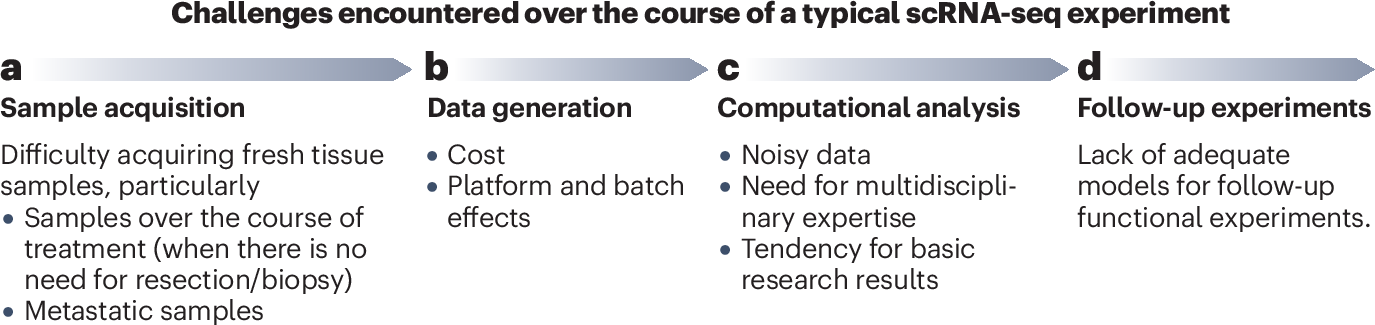
The challenges faced during single-cell RNA sequencing (scRNA-seq) experiments can be divided into four main categories. a, Sample acquisition. Fresh tissue samples, including on-treatment samples from patients with metastatic disease, and particularly from exceptional responders, are notoriously difficult to obtain. This difficulty precludes making important experimental comparisons that could provide clinically meaningful results. b, Data generation. Differences in sample handling and sequencing protocols can induce ‘batch effects’ — technical artefacts that might be mistaken for genuine biological differences, thus complicating the interpretation of results. c, Computational analysis. Proper analysis of scRNA-seq data requires a multidisciplinary skill set. Additionally, the applicability of the results can be limited, given that RNA expression does not always directly correspond to the expression or functional proteins. d, Follow-up experiments. Functional validation of findings from scRNA-seq is often limited by a lack of suitable models capable of accurately replicating the complexity of the TME. This complicates efforts to translate scRNA-seq insights into clinically actionable outcomes.
Conclusion
Single-cell RNA sequencing is revolutionizing cancer research by providing unprecedented insights into tumor biology. As technology improves, it is expected to play an increasingly important role in precision oncology, helping doctors make more informed treatment decisions for cancer patients. This review underscores the exciting potential of scRNA-seq and highlights the need for continued research to bridge the gap between laboratory discoveries and clinical applications.
Boxer E, Feigin N, Tschernichovsky R, Darnell NG, Greenwald AR, Hoefflin R, Kovarsky D, Simkin D, Turgeman S, Zhang L, Tirosh I. (2025) Emerging clinical applications of single-cell RNA sequencing in oncology. Nat Rev Clin Oncol [Epub ahead of print]. [article]
Related Posts


Researchers from the Weizmann Institute of Science explore how single-cell RNA sequencing (scRNA-seq) is reshaping our understanding of cancer biology and its potential clinical applications. They discuss how this technology helps uncover the diverse genetic and functional states of cancer cells and their surrounding environment.
The Power of scRNA-seq in Cancer Research
For years, scientists studied tumors by sequencing bulk samples, which provided an average view of gene expression across many cells. However, this approach masked important differences between individual cells within a tumor. With scRNA-seq, researchers can analyze gene expression at the single-cell level, revealing the complexity of each tumor as a unique ecosystem composed of various cell types with different roles in disease progression.
Key Findings from Cancer Studies
Over the past decade, hundreds of studies have used scRNA-seq to analyze tumor samples, leading to several key insights:
Understanding Tumor Heterogeneity: scRNA-seq has shown that cancer is not made up of uniform cells but rather consists of distinct subpopulations with different genetic mutations and behaviors. This insight is critical for understanding how tumors evolve and develop resistance to treatments.
Characterizing the Tumor Microenvironment: Cancer cells interact with immune cells, fibroblasts, and other components in their environment. scRNA-seq has helped map these interactions, providing clues on how to manipulate the immune system to better target tumors.
Identifying New Therapeutic Targets: By pinpointing specific cell states that contribute to tumor progression, scRNA-seq has identified potential drug targets that might not have been detected using traditional sequencing methods.
Towards Clinical Applications: Although most scRNA-seq studies focus on basic biology, there is growing interest in applying these findings to clinical settings. The technology holds promise for improving cancer diagnostics, predicting patient responses to therapies, and developing personalized treatment plans.
Challenges and Future Directions
Despite its promise, scRNA-seq still faces challenges, including high costs, technical limitations, and the need for sophisticated computational analysis. However, ongoing advancements in sequencing technology and data interpretation methods are expected to make scRNA-seq more accessible and clinically relevant in the coming years.
The challenges faced during single-cell RNA sequencing (scRNA-seq) experiments can be divided into four main categories. a, Sample acquisition. Fresh tissue samples, including on-treatment samples from patients with metastatic disease, and particularly from exceptional responders, are notoriously difficult to obtain. This difficulty precludes making important experimental comparisons that could provide clinically meaningful results. b, Data generation. Differences in sample handling and sequencing protocols can induce ‘batch effects’ — technical artefacts that might be mistaken for genuine biological differences, thus complicating the interpretation of results. c, Computational analysis. Proper analysis of scRNA-seq data requires a multidisciplinary skill set. Additionally, the applicability of the results can be limited, given that RNA expression does not always directly correspond to the expression or functional proteins. d, Follow-up experiments. Functional validation of findings from scRNA-seq is often limited by a lack of suitable models capable of accurately replicating the complexity of the TME. This complicates efforts to translate scRNA-seq insights into clinically actionable outcomes.
Conclusion
Single-cell RNA sequencing is revolutionizing cancer research by providing unprecedented insights into tumor biology. As technology improves, it is expected to play an increasingly important role in precision oncology, helping doctors make more informed treatment decisions for cancer patients. This review underscores the exciting potential of scRNA-seq and highlights the need for continued research to bridge the gap between laboratory discoveries and clinical applications.
Boxer E, Feigin N, Tschernichovsky R, Darnell NG, Greenwald AR, Hoefflin R, Kovarsky D, Simkin D, Turgeman S, Zhang L, Tirosh I. (2025) Emerging clinical applications of single-cell RNA sequencing in oncology. Nat Rev Clin Oncol [Epub ahead of print]. [article]
Related Posts
Recent Posts
 RNAmel simplifies RNA sequencing data analysis with a reproducible, integrated platform
 Heart failure reshapes bone marrow to create inflammation-related immune memory
 Overlooked DNA regions surrounding ‘microexons’ hold missing pieces of autism’s genetic puzzle
 RiboBA improves detection of hidden protein-coding regions using ribosome profiling
 An anti-senescence gene may fight spinal disc deterioration
 Bulk RNA-seq Analysis: A Complete Beginner’s Guide
RNA-Seq Products & Services


Stay Connected