

Fungal infections are becoming an increasingly important global health concern. They affect millions of people worldwide, threaten food production, and are responsible for significant illness and death. Despite their growing impact, fungal diseases have historically received less research attention than bacterial and viral infections, slowing progress in diagnosis and treatment.
Researchers at the University of Szeged in Hungary discuss how single-cell RNA sequencing is helping scientists better understand fungal infections and the complex interactions between fungal pathogens and their hosts.
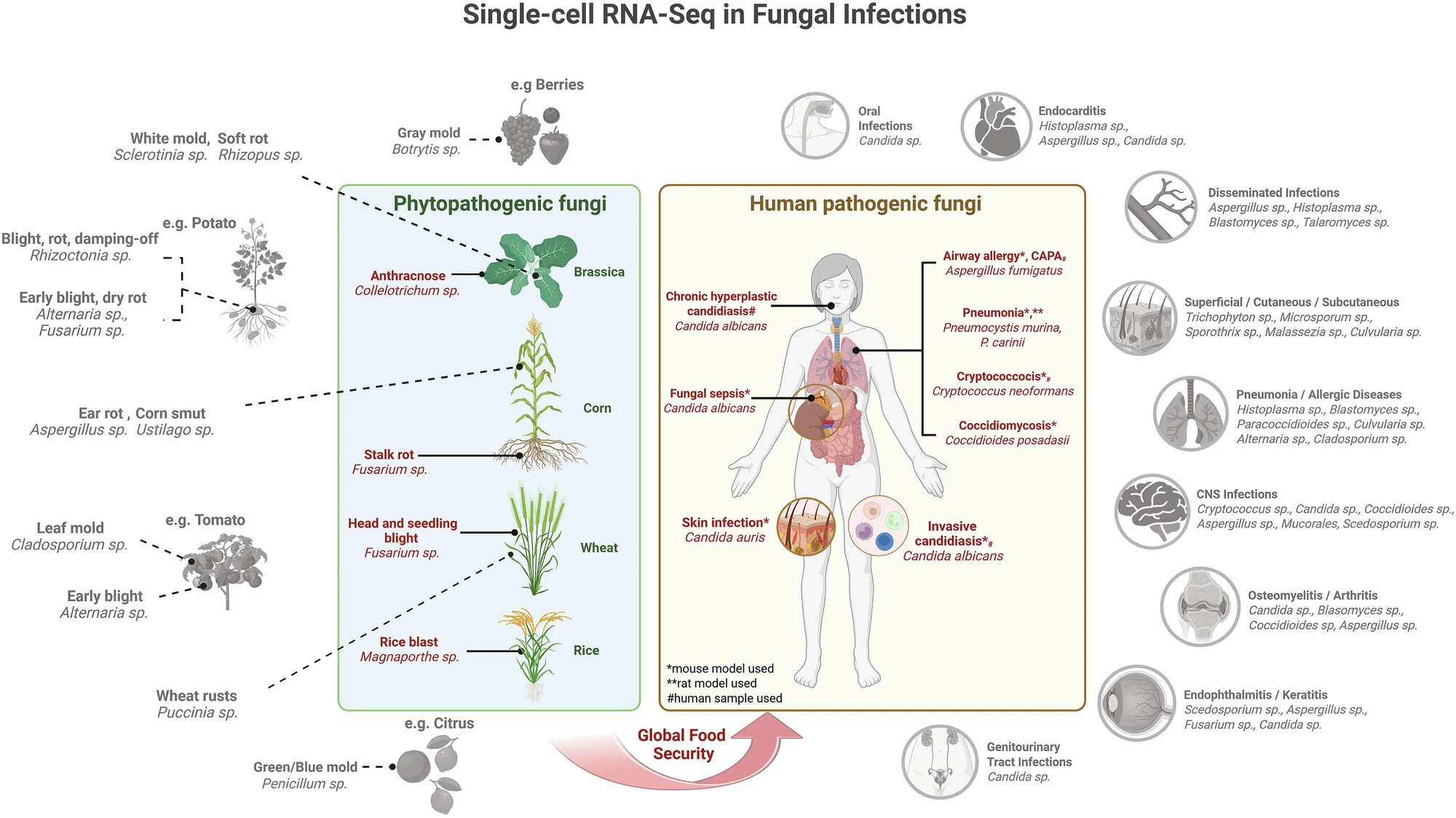
The figure summarizes scRNA-seq studies applied to unveil host-fungal pathogen dynamics during plant and human infections at the single-cell level. Gray areas with dashed lines indicate various fungal genera frequently associated with specific diseases that remain unexamined in the context of host–pathogen interactions.
Single-cell RNA sequencing, often called scRNA-seq, allows researchers to examine gene expression in individual cells rather than averaging signals across large populations of cells. This provides a much more detailed picture of how different cells respond during infection.
One of the major advantages of scRNA-seq is its ability to reveal cellular heterogeneity. During an infection, not all immune cells behave the same way. Some cells may actively fight the pathogen, while others may become suppressed or adopt specialized functions. Traditional methods often miss these differences because they analyze many cells together.
The technology has already been widely used to study viral and bacterial infections. Researchers have used it to identify disease-associated cell populations, uncover immune response pathways, and discover potential therapeutic targets. More recently, these same approaches have been applied to fungal pathogens.
Studies using single-cell RNA sequencing have begun to reveal how immune cells recognize fungal invaders and how fungal pathogens adapt to survive inside the host. These investigations provide valuable insights into the molecular processes that drive fungal pathogenesis and host defense.
The researchers highlight how scRNA-seq can help identify biomarkers that may improve diagnosis and monitoring of fungal infections. It can also uncover new therapeutic targets by pinpointing cellular pathways that contribute to disease progression or immune protection.
At the same time, the researchers note that challenges remain. Fungal infection studies often involve complex tissues, relatively low fungal cell numbers, and technical limitations that can make data collection and interpretation difficult. As sequencing technologies continue to improve, many of these obstacles are expected to become easier to overcome.
The researchers encourage broader adoption of single-cell technologies within fungal infection research. By providing a more detailed understanding of host-pathogen interactions, scRNA-seq may help accelerate the development of better diagnostics, treatments, and prevention strategies for fungal diseases that continue to pose a growing threat to human health and agriculture.
Toth R, Cabarrubias FR, Czimmerer Z, Vecsernyes-Nagy K, Gacser A. (2026) Empowering fungal infection research with single-cell RNA sequencing. Communications Biology 9(1):735. [article]
Related Posts


Fungal infections are becoming an increasingly important global health concern. They affect millions of people worldwide, threaten food production, and are responsible for significant illness and death. Despite their growing impact, fungal diseases have historically received less research attention than bacterial and viral infections, slowing progress in diagnosis and treatment.
Researchers at the University of Szeged in Hungary discuss how single-cell RNA sequencing is helping scientists better understand fungal infections and the complex interactions between fungal pathogens and their hosts.
The figure summarizes scRNA-seq studies applied to unveil host-fungal pathogen dynamics during plant and human infections at the single-cell level. Gray areas with dashed lines indicate various fungal genera frequently associated with specific diseases that remain unexamined in the context of host–pathogen interactions.
Single-cell RNA sequencing, often called scRNA-seq, allows researchers to examine gene expression in individual cells rather than averaging signals across large populations of cells. This provides a much more detailed picture of how different cells respond during infection.
One of the major advantages of scRNA-seq is its ability to reveal cellular heterogeneity. During an infection, not all immune cells behave the same way. Some cells may actively fight the pathogen, while others may become suppressed or adopt specialized functions. Traditional methods often miss these differences because they analyze many cells together.
The technology has already been widely used to study viral and bacterial infections. Researchers have used it to identify disease-associated cell populations, uncover immune response pathways, and discover potential therapeutic targets. More recently, these same approaches have been applied to fungal pathogens.
Studies using single-cell RNA sequencing have begun to reveal how immune cells recognize fungal invaders and how fungal pathogens adapt to survive inside the host. These investigations provide valuable insights into the molecular processes that drive fungal pathogenesis and host defense.
The researchers highlight how scRNA-seq can help identify biomarkers that may improve diagnosis and monitoring of fungal infections. It can also uncover new therapeutic targets by pinpointing cellular pathways that contribute to disease progression or immune protection.
At the same time, the researchers note that challenges remain. Fungal infection studies often involve complex tissues, relatively low fungal cell numbers, and technical limitations that can make data collection and interpretation difficult. As sequencing technologies continue to improve, many of these obstacles are expected to become easier to overcome.
The researchers encourage broader adoption of single-cell technologies within fungal infection research. By providing a more detailed understanding of host-pathogen interactions, scRNA-seq may help accelerate the development of better diagnostics, treatments, and prevention strategies for fungal diseases that continue to pose a growing threat to human health and agriculture.
Toth R, Cabarrubias FR, Czimmerer Z, Vecsernyes-Nagy K, Gacser A. (2026) Empowering fungal infection research with single-cell RNA sequencing. Communications Biology 9(1):735. [article]
Related Posts
Recent Posts
 Scientists identify the neuroblastoma cells that signal poor outcomes
 GARAGE improves rare cell detection in single-cell RNA sequencing analysis using AI
 Machine learning reveals how RNA splicing is regulated in individual cell types
 Illumina releases SpliceAI2 to help advance rare disease research
 Postdoctoral Fellow – Long-Read RNA Methods Development for Neurodegeneration
 Novel biosensor uses DNA ‘barcodes’ to uncover disease signals in cells
RNA-Seq Products & Services



Stay Connected