

Finding gene fusions and abnormal splice variants is an important part of diagnosing and treating many cancers. Traditionally, clinical labs rely on targeted RNA panels that look for a predefined list of fusions. Whole transcriptome sequencing offers a broader alternative because it captures all RNA in a sample, but its reliability in routine diagnostics has been an open question.
A team led by researchers at the University Hospital Heidelberg set out to evaluate how well whole transcriptome sequencing performs compared with commonly used fusion assays. They analyzed formalin-fixed tumor samples, which are typical of real-world clinical material and often present technical challenges due to RNA degradation.
Study design and overview of the three phases of implementation
of the WTS depletion assay in clinical practice
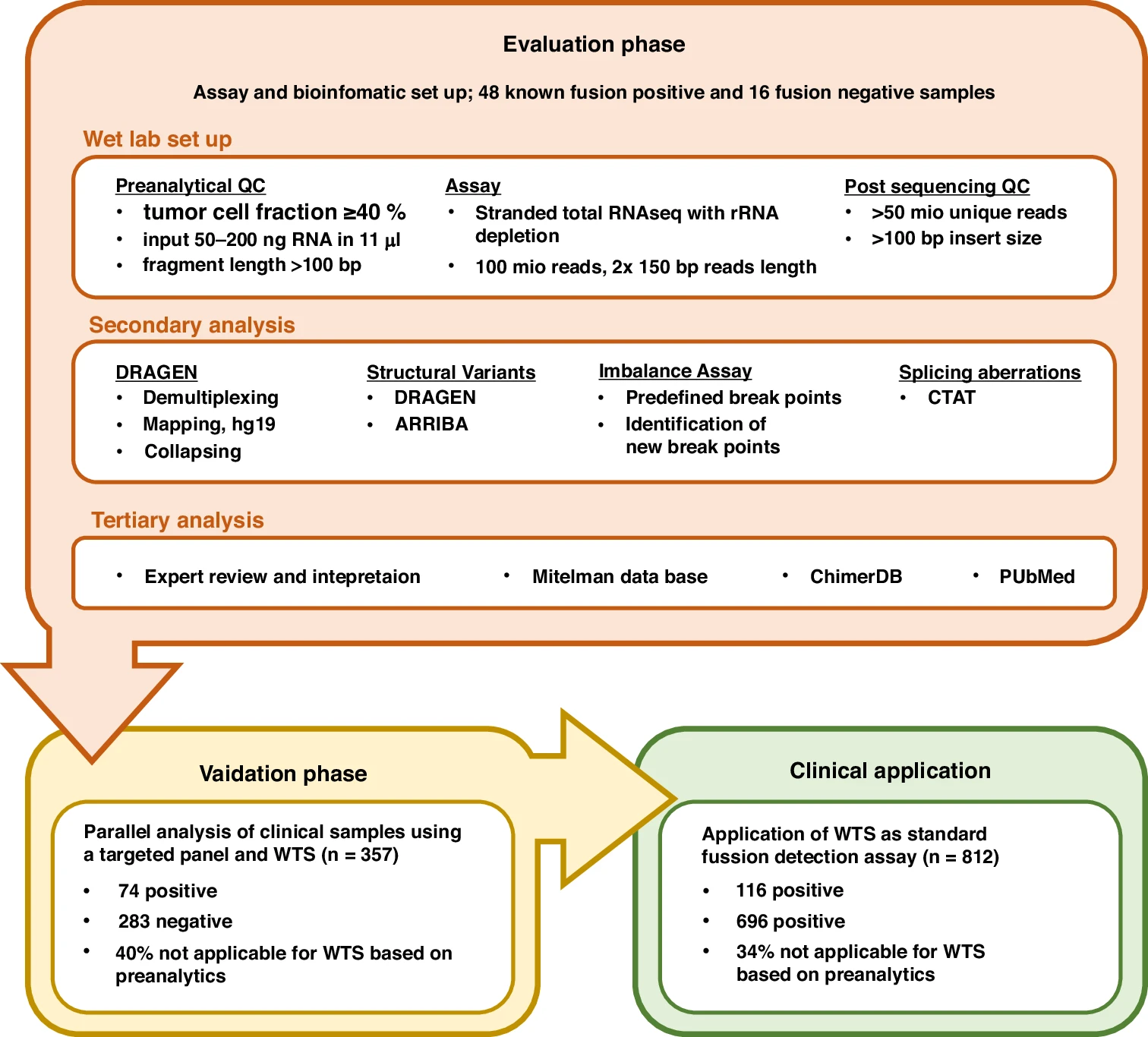
Evaluation phase shows QC parameters, methods and computational resources used for analysis. Validation phase and clinical application summarizes the experiments and application progress in this study.
The team first tested whole transcriptome sequencing on a smaller set of tumor samples to define strict quality thresholds. They found that tumor cell content and RNA quality were critical factors. When samples met these requirements, whole transcriptome sequencing detected the vast majority of known gene fusions. In a larger validation cohort, results from whole transcriptome sequencing fully matched those from targeted panel tests, provided quality criteria were satisfied.
After clinical rollout across more than 800 tumor cases, whole transcriptome sequencing successfully identified both known and novel fusions, as well as unexpected findings such as pathogen RNA and pathway-level information. However, samples with low tumor cell content often required follow-up testing with targeted panels. Overall, the work shows that RNA sequencing at the whole-transcriptome level can be a powerful diagnostic tool when paired with rigorous quality control, adding valuable biological insight beyond standard fusion testing.
Ball M, Beck S, Wlochowitz D, Fuchs T, Lorenz K, Zgorzelski C, Pallares Robles A, Allgäuer M, Volckmar A L, Goldschmid H, Ourailidis I, Brandt R, Christopoulos P, Thomas M, Seker-Cin H, Fink A, Schnecko F, Neuman O, Menzel M, Kirchner M, Fioretos T, Schirmacher P, Peters S, Budczies J, Stenzinger A, Kazdal D. (2026) Diagnostic whole transcriptome sequencing in a series of 1233 FFPE solid tumor samples. British Journal of Cancer [Epub ahead of print]. [article]
Related Posts






Finding gene fusions and abnormal splice variants is an important part of diagnosing and treating many cancers. Traditionally, clinical labs rely on targeted RNA panels that look for a predefined list of fusions. Whole transcriptome sequencing offers a broader alternative because it captures all RNA in a sample, but its reliability in routine diagnostics has been an open question.
A team led by researchers at the University Hospital Heidelberg set out to evaluate how well whole transcriptome sequencing performs compared with commonly used fusion assays. They analyzed formalin-fixed tumor samples, which are typical of real-world clinical material and often present technical challenges due to RNA degradation.
Study design and overview of the three phases of implementation
of the WTS depletion assay in clinical practice
Evaluation phase shows QC parameters, methods and computational resources used for analysis. Validation phase and clinical application summarizes the experiments and application progress in this study.
The team first tested whole transcriptome sequencing on a smaller set of tumor samples to define strict quality thresholds. They found that tumor cell content and RNA quality were critical factors. When samples met these requirements, whole transcriptome sequencing detected the vast majority of known gene fusions. In a larger validation cohort, results from whole transcriptome sequencing fully matched those from targeted panel tests, provided quality criteria were satisfied.
After clinical rollout across more than 800 tumor cases, whole transcriptome sequencing successfully identified both known and novel fusions, as well as unexpected findings such as pathogen RNA and pathway-level information. However, samples with low tumor cell content often required follow-up testing with targeted panels. Overall, the work shows that RNA sequencing at the whole-transcriptome level can be a powerful diagnostic tool when paired with rigorous quality control, adding valuable biological insight beyond standard fusion testing.
Ball M, Beck S, Wlochowitz D, Fuchs T, Lorenz K, Zgorzelski C, Pallares Robles A, Allgäuer M, Volckmar A L, Goldschmid H, Ourailidis I, Brandt R, Christopoulos P, Thomas M, Seker-Cin H, Fink A, Schnecko F, Neuman O, Menzel M, Kirchner M, Fioretos T, Schirmacher P, Peters S, Budczies J, Stenzinger A, Kazdal D. (2026) Diagnostic whole transcriptome sequencing in a series of 1233 FFPE solid tumor samples. British Journal of Cancer [Epub ahead of print]. [article]
Related Posts
Recent Posts
 Machine learning reveals how RNA splicing is regulated in individual cell types
 Illumina releases SpliceAI2 to help advance rare disease research
 Postdoctoral Fellow – Long-Read RNA Methods Development for Neurodegeneration
 Novel biosensor uses DNA ‘barcodes’ to uncover disease signals in cells
 GP-DHT uses single-cell RNA sequencing to map gene regulatory networks
 Boehringer taps Envisagenics’ AI to mine RNA splicing for cancer targets
RNA-Seq Products & Services



Stay Connected