

Single-cell RNA sequencing (scRNA-seq) has revolutionized our ability to study complex tissues, allowing researchers to explore gene expression at the level of individual cells. However, a major challenge in cancer research is obtaining high-quality samples that preserve the diverse cell populations within tumors. Formalin-fixed, paraffin-embedded (FFPE) tissue samples have long been used in pathology, but their suitability for advanced techniques like scRNA-seq was unclear. Researchers at the Fundación Contigo Contra el Cáncer de la Mujer aimed to evaluate whether FFPE samples could be used for single-cell RNA sequencing by comparing them to fresh frozen (FF) samples.
Comparing FFPE and FF Samples
In this study, the researchers analyzed two types of breast cancer: invasive ductal carcinoma (IDC) and invasive lobular carcinoma (ILC). They compared scRNA-seq results from FFPE samples to matched FF tissue samples. To assess the consistency of cell type distribution and molecular profiles, they used several validation methods, including immunohistochemistry (IHC), fluorescence in situ hybridization (FISH), and electron microscopy.
Process of single-cell analysis in fresh fixed and FFPE tissue samples
and cell heterogeneity and gene expression in both type of samples
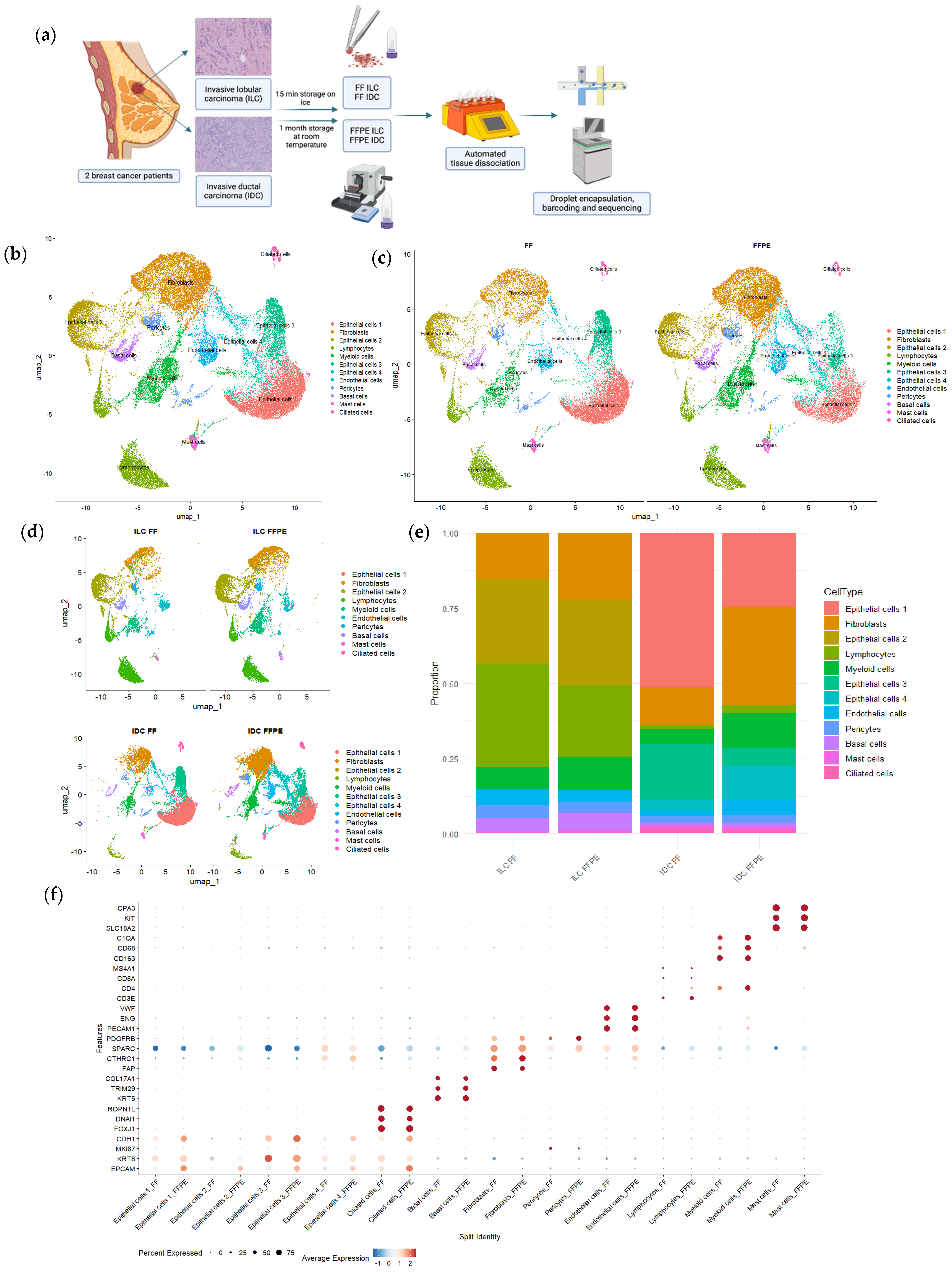
(a) Workflow of tissue specimens used for the study (created in BioRender.com). (b) UMAP plot manually annotated by cell type using canonical type-specific marker genes. (c) UMAP plot split by fresh and FFPE sample origins (d) UMAP plot split by sample ID. (e) Bar plot showing cellular proportions in each sample. (f) Dot plot representing the percentage of cells and the average gene expression of canonical markers for each cluster in fresh and FFPE samples.
The findings were promising. Both FFPE and FF-derived libraries showed high-quality sequencing metrics, and the analysis revealed similar patterns of cellular diversity in both sample types. Notably, no exclusive cell populations were found in either sample type, suggesting that FFPE samples can successfully capture the complexity of cancer tissue at the single-cell level.
Immune Cells and Tumor Microenvironment
One important aspect of the study was comparing the immune cell populations identified by scRNA-seq with those detected by IHC. The immune cell proportions obtained from FFPE sections matched the scRNA-seq results, demonstrating that FFPE samples can reliably be used for immune cell analysis in cancer research.
Discovery of a New Cell Subpopulation
The study also led to an exciting discovery. The researchers identified a previously under-recognized subpopulation of neoplastic multi-ciliated cells (MCCs) in breast cancer. These cells expressed the FOXJ1 and ROPN1L markers, which are typically associated with ciliated cells. By analyzing FOXJ1 expression in a larger set of 214 ER-positive invasive carcinomas, the team found that about one-third of the tumors expressed this marker, suggesting that MCC differentiation is a common but poorly understood feature in breast cancer.
Advancing Cancer Research with FFPE Samples
This research highlights the potential of FFPE tissue samples for scRNA-seq analysis, demonstrating that they can provide valuable insights into tumor biology, immune responses, and previously unknown cell populations. The ability to use archival FFPE samples for cutting-edge technologies like scRNA-seq could significantly impact cancer research, allowing scientists to better understand tumor heterogeneity and discover new therapeutic targets.
González-Martínez S, Palacios J, Carretero-Barrio I, Lanza VF, García-Cosío Piqueras M, Caniego-Casas T, Hardisson D, Esteban-Rodríguez I, Cortés J, Pérez-Mies B. (2025) Single-Cell RNA Sequencing on Formalin-Fixed and Paraffin-Embedded (FFPE) Tissue Identified Multi-Ciliary Cells in Breast Cancer. Cells 14(3):197.[article]
Related Posts






Single-cell RNA sequencing (scRNA-seq) has revolutionized our ability to study complex tissues, allowing researchers to explore gene expression at the level of individual cells. However, a major challenge in cancer research is obtaining high-quality samples that preserve the diverse cell populations within tumors. Formalin-fixed, paraffin-embedded (FFPE) tissue samples have long been used in pathology, but their suitability for advanced techniques like scRNA-seq was unclear. Researchers at the Fundación Contigo Contra el Cáncer de la Mujer aimed to evaluate whether FFPE samples could be used for single-cell RNA sequencing by comparing them to fresh frozen (FF) samples.
Comparing FFPE and FF Samples
In this study, the researchers analyzed two types of breast cancer: invasive ductal carcinoma (IDC) and invasive lobular carcinoma (ILC). They compared scRNA-seq results from FFPE samples to matched FF tissue samples. To assess the consistency of cell type distribution and molecular profiles, they used several validation methods, including immunohistochemistry (IHC), fluorescence in situ hybridization (FISH), and electron microscopy.
Process of single-cell analysis in fresh fixed and FFPE tissue samples
and cell heterogeneity and gene expression in both type of samples
(a) Workflow of tissue specimens used for the study (created in BioRender.com). (b) UMAP plot manually annotated by cell type using canonical type-specific marker genes. (c) UMAP plot split by fresh and FFPE sample origins (d) UMAP plot split by sample ID. (e) Bar plot showing cellular proportions in each sample. (f) Dot plot representing the percentage of cells and the average gene expression of canonical markers for each cluster in fresh and FFPE samples.
The findings were promising. Both FFPE and FF-derived libraries showed high-quality sequencing metrics, and the analysis revealed similar patterns of cellular diversity in both sample types. Notably, no exclusive cell populations were found in either sample type, suggesting that FFPE samples can successfully capture the complexity of cancer tissue at the single-cell level.
Immune Cells and Tumor Microenvironment
One important aspect of the study was comparing the immune cell populations identified by scRNA-seq with those detected by IHC. The immune cell proportions obtained from FFPE sections matched the scRNA-seq results, demonstrating that FFPE samples can reliably be used for immune cell analysis in cancer research.
Discovery of a New Cell Subpopulation
The study also led to an exciting discovery. The researchers identified a previously under-recognized subpopulation of neoplastic multi-ciliated cells (MCCs) in breast cancer. These cells expressed the FOXJ1 and ROPN1L markers, which are typically associated with ciliated cells. By analyzing FOXJ1 expression in a larger set of 214 ER-positive invasive carcinomas, the team found that about one-third of the tumors expressed this marker, suggesting that MCC differentiation is a common but poorly understood feature in breast cancer.
Advancing Cancer Research with FFPE Samples
This research highlights the potential of FFPE tissue samples for scRNA-seq analysis, demonstrating that they can provide valuable insights into tumor biology, immune responses, and previously unknown cell populations. The ability to use archival FFPE samples for cutting-edge technologies like scRNA-seq could significantly impact cancer research, allowing scientists to better understand tumor heterogeneity and discover new therapeutic targets.
González-Martínez S, Palacios J, Carretero-Barrio I, Lanza VF, García-Cosío Piqueras M, Caniego-Casas T, Hardisson D, Esteban-Rodríguez I, Cortés J, Pérez-Mies B. (2025) Single-Cell RNA Sequencing on Formalin-Fixed and Paraffin-Embedded (FFPE) Tissue Identified Multi-Ciliary Cells in Breast Cancer. Cells 14(3):197.[article]
Related Posts
Recent Posts
 Machine learning reveals how RNA splicing is regulated in individual cell types
 Illumina releases SpliceAI2 to help advance rare disease research
 Postdoctoral Fellow – Long-Read RNA Methods Development for Neurodegeneration
 Novel biosensor uses DNA ‘barcodes’ to uncover disease signals in cells
 GP-DHT uses single-cell RNA sequencing to map gene regulatory networks
 Boehringer taps Envisagenics’ AI to mine RNA splicing for cancer targets
RNA-Seq Products & Services



Stay Connected