

Scientists have long used gut microbiome sequencing to understand how microbes affect health. But feces contain more than bacteria. They also carry tiny amounts of human cells that have naturally shed from the lining of the digestive system. These cells can reveal important information about immunity and intestinal health, but their RNA breaks down quickly, making it very hard to analyze.
A research team led by researchers at the Columbia University Irving Medical Center has developed a method called Foli-seq, short for exfoliome sequencing, that finally allows scientists to study RNA from these shed human cells. Instead of relying only on microbial DNA, Foli-seq focuses on human messenger RNA found in feces. Surprisingly, the team discovered that many of these RNAs remain stable enough to provide accurate insights into both gut function and immune activity.
Overview of fecal exfoliome sequencing using Foli-seq
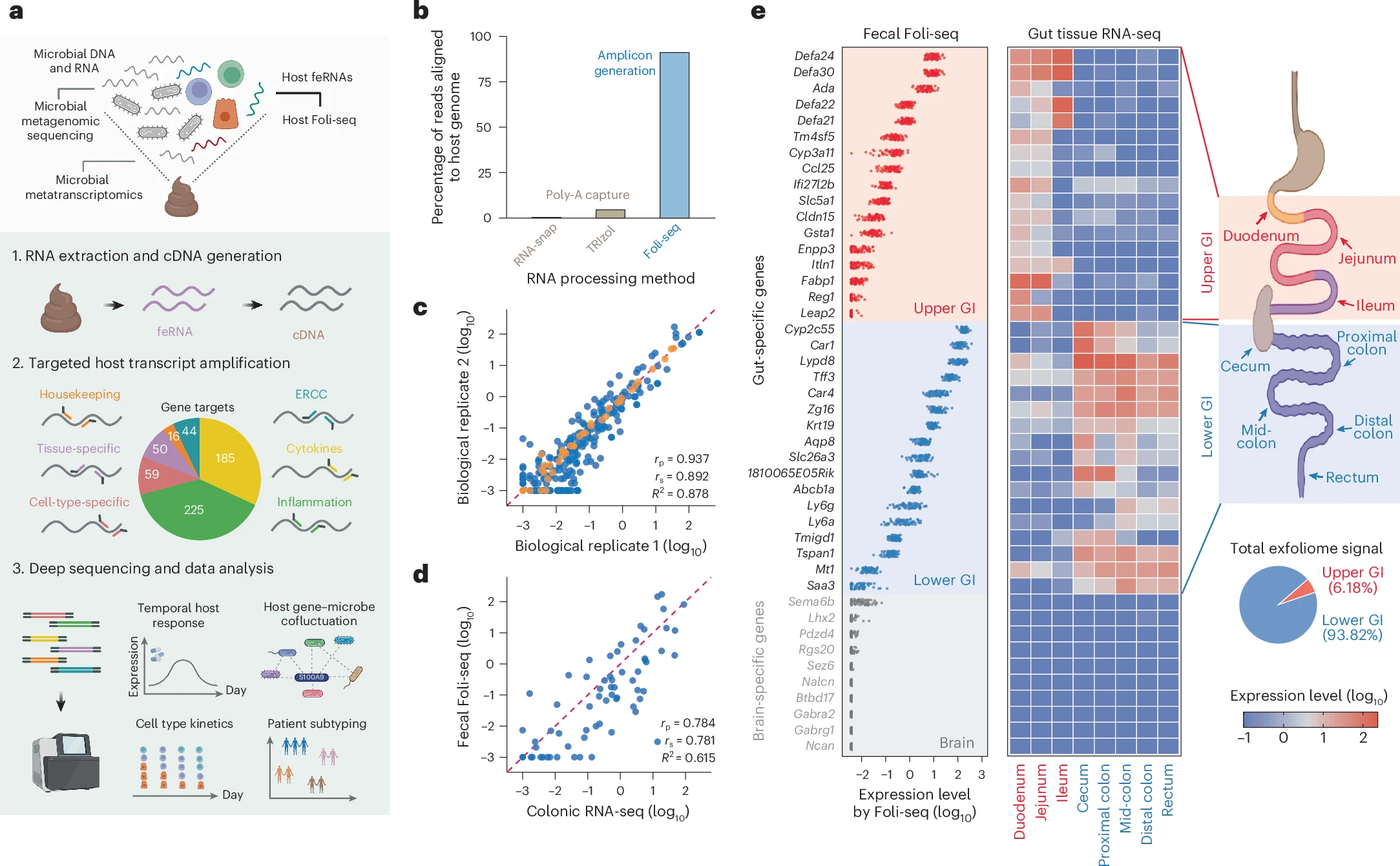
a, Schematic of the Foli-seq protocol is shown. Host RNAs are extracted and enriched from stool samples. Reverse transcription of the RNA generates cDNAs. Foli-seq amplicons are generated from cDNA using specially designed primer sets in a multiplex fashion and are subsequently sequenced and analyzed. b, Read alignment rate for stool RNA-seq using standard poly-A-capture-based methods (RNA-snap or TRIzol) versus Foli-seq in mouse fecal pellets. c, Correlation of RNA levels of 394 genes measured by Foli-seq between biological replicates, that is, different mice from the same cage. d, Correlation between murine transcript levels of housekeeping and tissue-specific genes as quantified by Foli-seq and colon RNA-seq. e, Correlation between RNA levels measured by Foli-seq and RNA-seq on different gut tissues. Left: expression levels of genes specific to different gut regions (upper GI, lower GI and brain as a control) measured by Foli-seq. Right: expression levels of the same genes measured by RNA-seq using murine tissues from duodenum, jejunum, ileum, cecum, proximal colon, mid-colon, distal colon and rectum. Inset: total Foli-seq signal derived from upper or lower GI. Primer set mPS1 targeting murine housekeeping genes, tissue-specific genes, cell-type-specific genes, genes related to GI function and immunity as well as ERCC targets was used for Foli-seq quantification (b–e).GI, gastrointestinal.
Foli-seq works by selectively amplifying important RNA transcripts. This improves sensitivity and reduces the problem of contamination. In mouse models of colitis, Foli-seq captured how the gut changes over time, including epithelial injury, immune activation, and healing. The patterns differed depending on the type of inflammation, showing how detailed the method can be.
The researchers also combined Foli-seq with traditional microbiome sequencing. This revealed a complex network of interactions between gut microbes and the human cells that line the intestine. When applied to human patients with inflammatory bowel disease, Foli-seq helped separate individuals into subgroups linked to disease severity. This suggests that the technique could one day assist doctors in monitoring gut health noninvasively.
Foli-seq represents a promising new tool for understanding the gut using a simple fecal sample. It opens the door to tracking intestinal health over time without the need for invasive procedures.
Huang Y, Sun Y, Ronda C, Mavros CF, Li J, Jacobse J, Huang LH, Resnick SJ, Giddins M, Freedberg DE, Chavez A, Goettel JA, Wang HH. (2025) Fecal exfoliome sequencing captures immune dynamics of the healthy and inflamed gut. Nature Biotechnology [Online ahead of print]. [article]
Related Posts






Scientists have long used gut microbiome sequencing to understand how microbes affect health. But feces contain more than bacteria. They also carry tiny amounts of human cells that have naturally shed from the lining of the digestive system. These cells can reveal important information about immunity and intestinal health, but their RNA breaks down quickly, making it very hard to analyze.
A research team led by researchers at the Columbia University Irving Medical Center has developed a method called Foli-seq, short for exfoliome sequencing, that finally allows scientists to study RNA from these shed human cells. Instead of relying only on microbial DNA, Foli-seq focuses on human messenger RNA found in feces. Surprisingly, the team discovered that many of these RNAs remain stable enough to provide accurate insights into both gut function and immune activity.
Overview of fecal exfoliome sequencing using Foli-seq
a, Schematic of the Foli-seq protocol is shown. Host RNAs are extracted and enriched from stool samples. Reverse transcription of the RNA generates cDNAs. Foli-seq amplicons are generated from cDNA using specially designed primer sets in a multiplex fashion and are subsequently sequenced and analyzed. b, Read alignment rate for stool RNA-seq using standard poly-A-capture-based methods (RNA-snap or TRIzol) versus Foli-seq in mouse fecal pellets. c, Correlation of RNA levels of 394 genes measured by Foli-seq between biological replicates, that is, different mice from the same cage. d, Correlation between murine transcript levels of housekeeping and tissue-specific genes as quantified by Foli-seq and colon RNA-seq. e, Correlation between RNA levels measured by Foli-seq and RNA-seq on different gut tissues. Left: expression levels of genes specific to different gut regions (upper GI, lower GI and brain as a control) measured by Foli-seq. Right: expression levels of the same genes measured by RNA-seq using murine tissues from duodenum, jejunum, ileum, cecum, proximal colon, mid-colon, distal colon and rectum. Inset: total Foli-seq signal derived from upper or lower GI. Primer set mPS1 targeting murine housekeeping genes, tissue-specific genes, cell-type-specific genes, genes related to GI function and immunity as well as ERCC targets was used for Foli-seq quantification (b–e).GI, gastrointestinal.
Foli-seq works by selectively amplifying important RNA transcripts. This improves sensitivity and reduces the problem of contamination. In mouse models of colitis, Foli-seq captured how the gut changes over time, including epithelial injury, immune activation, and healing. The patterns differed depending on the type of inflammation, showing how detailed the method can be.
The researchers also combined Foli-seq with traditional microbiome sequencing. This revealed a complex network of interactions between gut microbes and the human cells that line the intestine. When applied to human patients with inflammatory bowel disease, Foli-seq helped separate individuals into subgroups linked to disease severity. This suggests that the technique could one day assist doctors in monitoring gut health noninvasively.
Foli-seq represents a promising new tool for understanding the gut using a simple fecal sample. It opens the door to tracking intestinal health over time without the need for invasive procedures.
Huang Y, Sun Y, Ronda C, Mavros CF, Li J, Jacobse J, Huang LH, Resnick SJ, Giddins M, Freedberg DE, Chavez A, Goettel JA, Wang HH. (2025) Fecal exfoliome sequencing captures immune dynamics of the healthy and inflamed gut. Nature Biotechnology [Online ahead of print]. [article]
Related Posts
Recent Posts
 Scientists identify the neuroblastoma cells that signal poor outcomes
 GARAGE improves rare cell detection in single-cell RNA sequencing analysis using AI
 Machine learning reveals how RNA splicing is regulated in individual cell types
 Illumina releases SpliceAI2 to help advance rare disease research
 Postdoctoral Fellow – Long-Read RNA Methods Development for Neurodegeneration
 Novel biosensor uses DNA ‘barcodes’ to uncover disease signals in cells
RNA-Seq Products & Services


Stay Connected