

RNA does much more than simply carry genetic information from DNA to protein. Its ability to fold into complex three-dimensional shapes allows it to act as a regulator of gene expression. Among these structures, RNA G-quadruplexes, or rG4s, stand out for their stability and influence on how genes are turned on or off. These structures form when guanine-rich regions of RNA stack into tightly packed shapes, creating a kind of “molecular knot” that can slow or alter how cells interpret genetic information.
Despite their importance, one big question has remained: How do genetic variants impact the formation of rG4s, and what does this mean for human health?
A team led by researchers at the University of Pennsylvania set out to answer this by developing G4mer, a new computational model that treats RNA like a language. Similar to how language models learn patterns in text, G4mer learns patterns in RNA sequences to identify where rG4s form, distinguish between rG4 subtypes, and predict how genetic variants might alter these structures across the whole transcriptome.
G4mer model overview and performance across multiple benchmarks
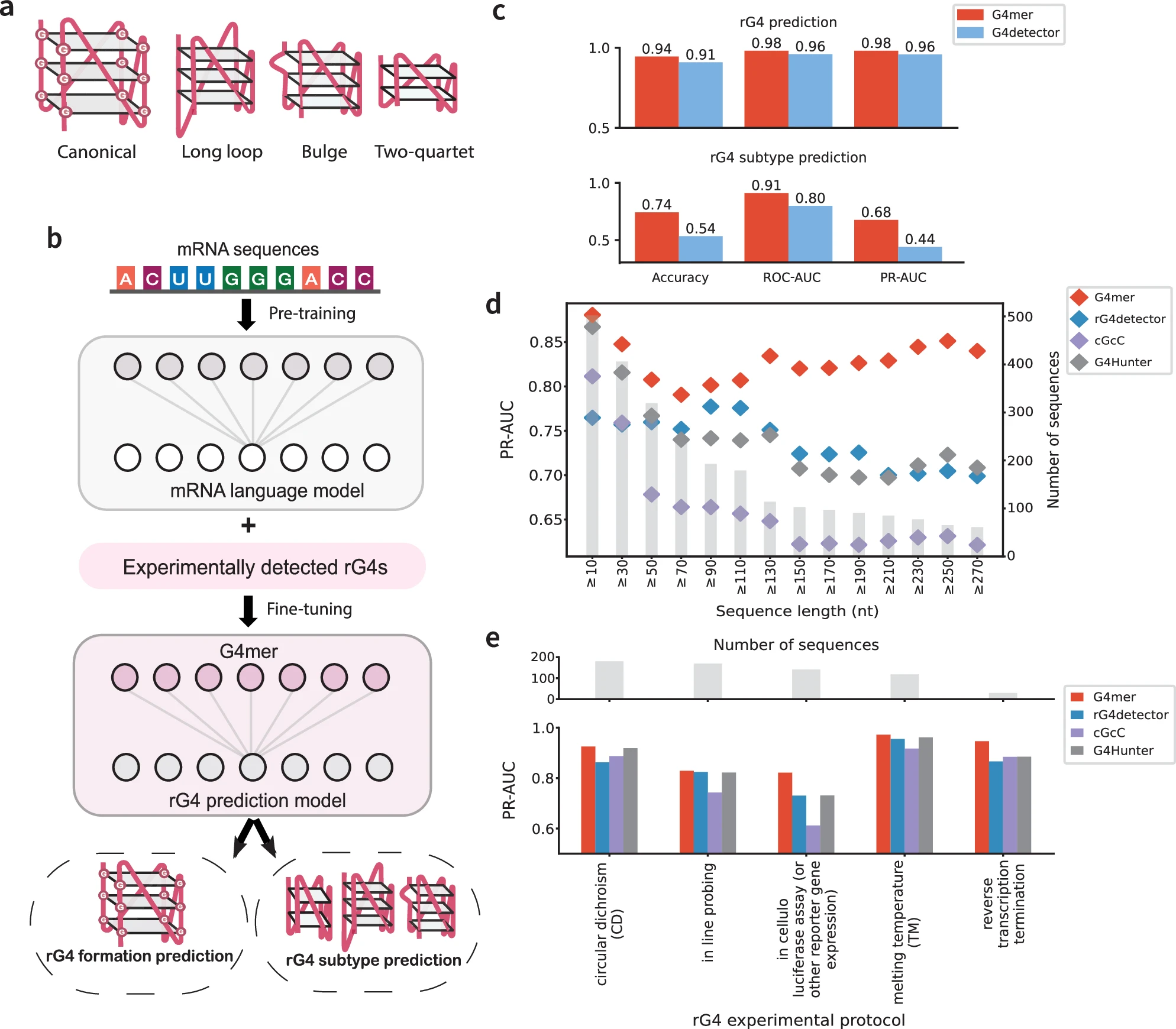
a rG4 structures can be categorized into canonical as well as noncanonical subtypes such as long loop, bulges, and two-quartet. b G4mer is developed based on an RNA language model that was pre-trained on the entire human transcriptome and fine-tuned with experimentally detected rG4 sequences. c Comparison of transformer-based G4mer (red) and CNN-based rG4detector (blue) for rG4 binary prediction (top) and rG4 subtype multiclass prediction (bottom), evaluated by accuracy, ROC-AUC, and PR-AUC. d PR-AUC performance of G4mer (red) compared to rG4detector (blue), cGcC (purple), and G4Hunter (gray) across sequence lengths from the G4RNA database. Gray bars indicate the number of sequences per length bin; colored points show PR-AUC. e PR-AUC comparison across the top 5 experimental rG4 detection protocols. The top bar plot shows the number of sequences; the bottom plot shows PR-AUC values across models.
One of G4mer’s strengths is its ability to outperform older prediction tools. It uncovers features that help determine whether an rG4 will form, including the length of the sequence and specific neighboring motifs that stabilize the structure. These discoveries deepen our understanding of how RNA architecture is encoded directly within genetic sequences.
G4mer also highlights how different rG4 subtypes vary in their sensitivity to mutations. Some rG4s tolerate sequence changes easily, while others are highly sensitive, offering insights into why certain RNA regions show strong evolutionary conservation. In other words, these findings help explain why specific parts of the RNA sequence remain unchanged across species: altering them could disrupt crucial rG4 structures and interfere with gene regulation.
To test G4mer in a real-world context, the team examined genetic variants in the 5′ untranslated regions (UTRs) of breast cancer-associated genes. These are regions that do not code for protein but still influence how genes are regulated. G4mer pinpointed variants likely to alter rG4 formation, and laboratory experiments confirmed that these variants affect both RNA structure and gene expression. These results reveal that changes in non-coding regions can have meaningful biological effects, especially in diseases like cancer where regulatory imbalances play a major role.
The broader message is clear: integrating computational models with experimental work can uncover important RNA structures that would otherwise be overlooked, particularly in regions where genetic variants are common but not well understood.
Availability – All scripts used in this analysis, including code for fine-tuning and evaluating the G4mer model, are available at the following Bitbucket repository: https://bitbucket.org/biociphers/g4mer/src/main/
A web application to run G4mer predictions is available at https://tools.biociphers.org/g4mer/index
Zhuang F, Gutman D, Islas N, Guzman B B, Jimenez A, Jewell S, Hand N J, Nathanson K, Dominguez D, Barash Y. (2025) G4mer: An RNA language model for transcriptome wide identification of G-quadruplexes and disease variants from population scale genetic data. Nat Commun 16(1):10221. [article]
Related Posts







RNA does much more than simply carry genetic information from DNA to protein. Its ability to fold into complex three-dimensional shapes allows it to act as a regulator of gene expression. Among these structures, RNA G-quadruplexes, or rG4s, stand out for their stability and influence on how genes are turned on or off. These structures form when guanine-rich regions of RNA stack into tightly packed shapes, creating a kind of “molecular knot” that can slow or alter how cells interpret genetic information.
Despite their importance, one big question has remained: How do genetic variants impact the formation of rG4s, and what does this mean for human health?
A team led by researchers at the University of Pennsylvania set out to answer this by developing G4mer, a new computational model that treats RNA like a language. Similar to how language models learn patterns in text, G4mer learns patterns in RNA sequences to identify where rG4s form, distinguish between rG4 subtypes, and predict how genetic variants might alter these structures across the whole transcriptome.
G4mer model overview and performance across multiple benchmarks
a rG4 structures can be categorized into canonical as well as noncanonical subtypes such as long loop, bulges, and two-quartet. b G4mer is developed based on an RNA language model that was pre-trained on the entire human transcriptome and fine-tuned with experimentally detected rG4 sequences. c Comparison of transformer-based G4mer (red) and CNN-based rG4detector (blue) for rG4 binary prediction (top) and rG4 subtype multiclass prediction (bottom), evaluated by accuracy, ROC-AUC, and PR-AUC. d PR-AUC performance of G4mer (red) compared to rG4detector (blue), cGcC (purple), and G4Hunter (gray) across sequence lengths from the G4RNA database. Gray bars indicate the number of sequences per length bin; colored points show PR-AUC. e PR-AUC comparison across the top 5 experimental rG4 detection protocols. The top bar plot shows the number of sequences; the bottom plot shows PR-AUC values across models.
One of G4mer’s strengths is its ability to outperform older prediction tools. It uncovers features that help determine whether an rG4 will form, including the length of the sequence and specific neighboring motifs that stabilize the structure. These discoveries deepen our understanding of how RNA architecture is encoded directly within genetic sequences.
G4mer also highlights how different rG4 subtypes vary in their sensitivity to mutations. Some rG4s tolerate sequence changes easily, while others are highly sensitive, offering insights into why certain RNA regions show strong evolutionary conservation. In other words, these findings help explain why specific parts of the RNA sequence remain unchanged across species: altering them could disrupt crucial rG4 structures and interfere with gene regulation.
To test G4mer in a real-world context, the team examined genetic variants in the 5′ untranslated regions (UTRs) of breast cancer-associated genes. These are regions that do not code for protein but still influence how genes are regulated. G4mer pinpointed variants likely to alter rG4 formation, and laboratory experiments confirmed that these variants affect both RNA structure and gene expression. These results reveal that changes in non-coding regions can have meaningful biological effects, especially in diseases like cancer where regulatory imbalances play a major role.
The broader message is clear: integrating computational models with experimental work can uncover important RNA structures that would otherwise be overlooked, particularly in regions where genetic variants are common but not well understood.
Availability – All scripts used in this analysis, including code for fine-tuning and evaluating the G4mer model, are available at the following Bitbucket repository: https://bitbucket.org/biociphers/g4mer/src/main/
A web application to run G4mer predictions is available at https://tools.biociphers.org/g4mer/index
Zhuang F, Gutman D, Islas N, Guzman B B, Jimenez A, Jewell S, Hand N J, Nathanson K, Dominguez D, Barash Y. (2025) G4mer: An RNA language model for transcriptome wide identification of G-quadruplexes and disease variants from population scale genetic data. Nat Commun 16(1):10221. [article]
Related Posts
Recent Posts
 Machine learning reveals how RNA splicing is regulated in individual cell types
 Illumina releases SpliceAI2 to help advance rare disease research
 Postdoctoral Fellow – Long-Read RNA Methods Development for Neurodegeneration
 Novel biosensor uses DNA ‘barcodes’ to uncover disease signals in cells
 GP-DHT uses single-cell RNA sequencing to map gene regulatory networks
 Boehringer taps Envisagenics’ AI to mine RNA splicing for cancer targets
RNA-Seq Products & Services


Stay Connected