

As RNA sequencing becomes faster, cheaper, and more widely used, scientists are increasingly asking more sophisticated questions about how cells work. Traditionally, RNA sequencing has been used to measure which genes are turned on or off, helping researchers compare cell types, track changes during development, or identify genes linked to disease. However, RNA molecules carry much more information than just gene expression levels. Chemical modifications to RNA, known collectively as the epitranscriptome, and long non-coding RNAs, which do not produce proteins but can regulate gene activity, add important layers of control that are often overlooked.
A team led by researchers from the University of Arizona and the University of Pennsylvania have developed HAMRLNC, a computational pipeline designed to make these hidden RNA features easier to study. One of the main challenges in analyzing RNA modifications and long non-coding RNAs is that they are often examined using separate tools and workflows. This can make results difficult to compare and harder to reproduce, especially when different preprocessing steps are used for each analysis. HAMRLNC addresses this problem by combining transcript abundance measurement, RNA modification inference, and long non-coding RNA annotation into a single, unified workflow that starts from the same RNA sequencing data and mapping steps.
HAMRLNC workflow: This high-level summary shows the pipeline workflow, from raw RNA-seq data to a dynamic epitranscriptomic summary.
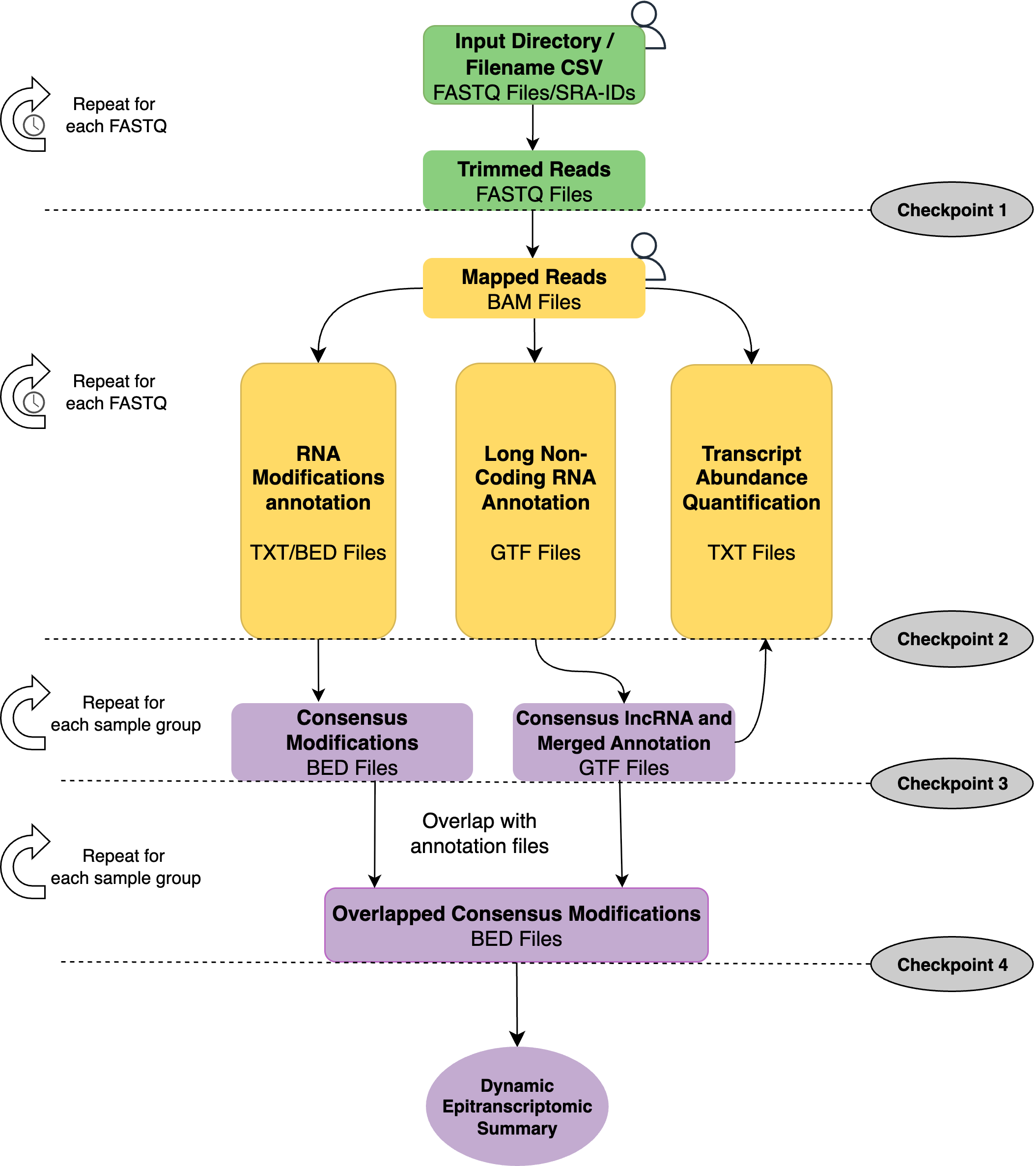
The input and quality control steps are in green; the pre-processing and core processing modules are in yellow, and the post-analyses steps are in purple. The checkpoints that enable restarting from the previous step in case of a failed run are in gray. Possible entry points of HAMRLNC are shown by the user icon. The clock icon indicates the time-consuming phases of the program. FASTQ: stores sequences with per-base quality scores. SRA: sequence read archive. TXT: plain text. BAM: binary alignment. BED: browser extensible data. GTF: general transfer format.
A key advantage of this approach is reproducibility. Because all analyses are performed within the same framework, researchers can be confident that differences they observe are biological rather than technical. The pipeline is also portable and scalable, meaning it can be run on large datasets and applied across many projects without extensive customization. This makes it especially useful for high-throughput studies and for groups that want a standardized way to analyze RNA sequencing data.
Another important feature of HAMRLNC is its ability to reanalyze existing datasets. Many laboratories already have large collections of archived RNA sequencing data generated for other purposes. With HAMRLNC, those datasets can be revisited to uncover RNA modifications and long non-coding RNAs that were not examined in the original analyses. This opens the door to new discoveries without the need for additional experiments.
To help researchers interpret complex results, HAMRLNC automatically generates a rich set of well-labeled visual outputs. These include gene ontology heatmaps that link RNA features to biological functions, landscapes showing where RNA modifications are enriched, and clustering analyses that reveal patterns across genes or conditions. By presenting results in a clear and consistent way, the pipeline lowers the barrier for scientists who may not be experts in computational biology but want to explore advanced regulatory layers of RNA.
Overall, HAMRLNC demonstrates how integrated analysis tools can expand the value of RNA sequencing beyond traditional gene expression profiling. By bringing together epitranscriptomic signals and long non-coding RNA annotation in a single, reproducible workflow, this approach helps researchers gain a more complete picture of how RNA regulation shapes cellular behavior.
Availability – HAMRLNC is open-source software, and the source code is available at https://github.com/bdgregory/HAMRLNC.
Obih C E, Li J, Melandri G, Pauli D, Lyons E, Nelson A D L, Gregory B D. (2025) HAMRLNC: a comprehensive and scalable pipeline for integrated epitranscriptomic analysis. Academia Molecular Biology and Genomics 2(4): 8059. [article]
Related Posts






As RNA sequencing becomes faster, cheaper, and more widely used, scientists are increasingly asking more sophisticated questions about how cells work. Traditionally, RNA sequencing has been used to measure which genes are turned on or off, helping researchers compare cell types, track changes during development, or identify genes linked to disease. However, RNA molecules carry much more information than just gene expression levels. Chemical modifications to RNA, known collectively as the epitranscriptome, and long non-coding RNAs, which do not produce proteins but can regulate gene activity, add important layers of control that are often overlooked.
A team led by researchers from the University of Arizona and the University of Pennsylvania have developed HAMRLNC, a computational pipeline designed to make these hidden RNA features easier to study. One of the main challenges in analyzing RNA modifications and long non-coding RNAs is that they are often examined using separate tools and workflows. This can make results difficult to compare and harder to reproduce, especially when different preprocessing steps are used for each analysis. HAMRLNC addresses this problem by combining transcript abundance measurement, RNA modification inference, and long non-coding RNA annotation into a single, unified workflow that starts from the same RNA sequencing data and mapping steps.
HAMRLNC workflow: This high-level summary shows the pipeline workflow, from raw RNA-seq data to a dynamic epitranscriptomic summary.
The input and quality control steps are in green; the pre-processing and core processing modules are in yellow, and the post-analyses steps are in purple. The checkpoints that enable restarting from the previous step in case of a failed run are in gray. Possible entry points of HAMRLNC are shown by the user icon. The clock icon indicates the time-consuming phases of the program. FASTQ: stores sequences with per-base quality scores. SRA: sequence read archive. TXT: plain text. BAM: binary alignment. BED: browser extensible data. GTF: general transfer format.
A key advantage of this approach is reproducibility. Because all analyses are performed within the same framework, researchers can be confident that differences they observe are biological rather than technical. The pipeline is also portable and scalable, meaning it can be run on large datasets and applied across many projects without extensive customization. This makes it especially useful for high-throughput studies and for groups that want a standardized way to analyze RNA sequencing data.
Another important feature of HAMRLNC is its ability to reanalyze existing datasets. Many laboratories already have large collections of archived RNA sequencing data generated for other purposes. With HAMRLNC, those datasets can be revisited to uncover RNA modifications and long non-coding RNAs that were not examined in the original analyses. This opens the door to new discoveries without the need for additional experiments.
To help researchers interpret complex results, HAMRLNC automatically generates a rich set of well-labeled visual outputs. These include gene ontology heatmaps that link RNA features to biological functions, landscapes showing where RNA modifications are enriched, and clustering analyses that reveal patterns across genes or conditions. By presenting results in a clear and consistent way, the pipeline lowers the barrier for scientists who may not be experts in computational biology but want to explore advanced regulatory layers of RNA.
Overall, HAMRLNC demonstrates how integrated analysis tools can expand the value of RNA sequencing beyond traditional gene expression profiling. By bringing together epitranscriptomic signals and long non-coding RNA annotation in a single, reproducible workflow, this approach helps researchers gain a more complete picture of how RNA regulation shapes cellular behavior.
Availability – HAMRLNC is open-source software, and the source code is available at https://github.com/bdgregory/HAMRLNC.
Obih C E, Li J, Melandri G, Pauli D, Lyons E, Nelson A D L, Gregory B D. (2025) HAMRLNC: a comprehensive and scalable pipeline for integrated epitranscriptomic analysis. Academia Molecular Biology and Genomics 2(4): 8059. [article]
Related Posts
Recent Posts
 Machine learning reveals how RNA splicing is regulated in individual cell types
 Illumina releases SpliceAI2 to help advance rare disease research
 Postdoctoral Fellow – Long-Read RNA Methods Development for Neurodegeneration
 Novel biosensor uses DNA ‘barcodes’ to uncover disease signals in cells
 GP-DHT uses single-cell RNA sequencing to map gene regulatory networks
 Boehringer taps Envisagenics’ AI to mine RNA splicing for cancer targets
RNA-Seq Products & Services


Stay Connected