

Understanding where genes are located within a genome is a critical part of biology, because genes act as the instruction manual for how organisms grow, function, and adapt. Yet as scientists sequence more species, especially those that have not been studied deeply, identifying genes accurately remains a major challenge. Many organisms have complex genomes, and traditional tools often struggle without additional experimental data to guide them.
A team led by researchers from Heinrich Heine University Düsseldorf has introduced a new tool that helps solve this problem in an efficient and accessible way. Their tool, called Helixer, uses artificial intelligence to predict genes directly from raw DNA sequences. This is known as ab initio prediction, meaning the tool makes decisions based solely on the sequence itself rather than relying on extra datasets or lab experiments.
Visual summary of Helixer’s predictive process
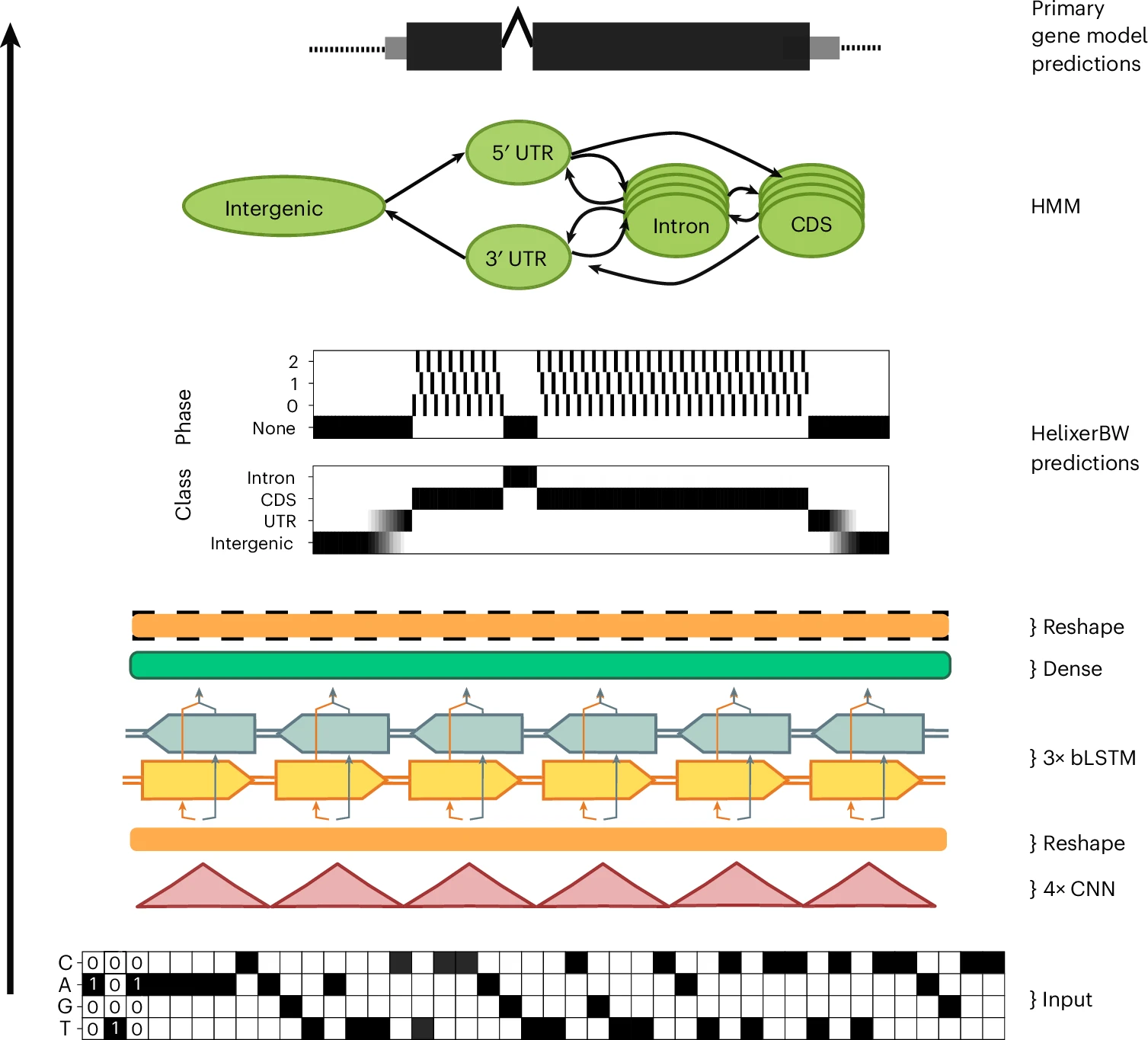
The depicted HMM state CDS is further broken down into 10 substates by phase and codon type (start, stop or regular), and the depicted intron state is further broken down into 60 substates by start or continuation of intron, splice motif and outer state. Not to scale. Hyperparameters are examples and can vary.
One of the biggest advantages of Helixer is that it does not require RNA sequencing, which is commonly used to confirm gene activity. Although RNA sequencing is powerful, it is not always available for newly sequenced species or for projects with limited budgets or resources. By eliminating this dependency, Helixer becomes an incredibly flexible option that can be used across a broad range of organisms.
The team evaluated Helixer across fungal, plant, vertebrate, and invertebrate genomes. They found that its accuracy matched or even exceeded well-established tools used in genome annotation. Helixer’s output closely aligned with expert curated gene references, showing that it can deliver high quality results even in difficult cases. These results demonstrate that artificial intelligence is becoming a central tool for interpreting complex biological information.
Another important strength of Helixer is its ease of use. The pretrained models are ready immediately, meaning researchers can apply Helixer to a new genome without spending time retraining or customizing anything. This makes the tool especially helpful for labs that work with a wide variety of species or need quick insights into genetic structure for ongoing projects.
Accessibility is also a major focus for the developers. Helixer is open source, so researchers can download and run the software locally. For those who prefer not to install it, Helixer is also available through a web interface and through the Galaxy ToolShed, a widely used platform for genomic analysis workflows. This ensures that scientists with different levels of computational experience can still benefit from the tool.
Overall, Helixer represents an important step forward in genome annotation. By combining deep learning with a hidden Markov model, the developers have created a system that is both accurate and versatile. As more species are sequenced and the demand for fast, reliable gene prediction grows, tools like Helixer will play a major role in expanding our understanding of biology, agriculture, and biodiversity.
Availability – Helixer’s source code is available via GitHub at https://github.com/usadellab/Helixer. Helixer’s online web interface is available at https://www.plabipd.de/helixer_main.html.
Holst F, Bolger A M, Kindel F, Günther C, Maß J, Triesch S, Kiel N, Saadat N, Ebenhöh O, Usadel B, Schwacke R, Weber A P M, Bolger M E, Denton A K. (2025) Helixer, ab initio prediction of primary eukaryotic gene models combining deep learning and a hidden Markov model. Nature Methods [Epub ahead of print]. [article]
Related Posts






Understanding where genes are located within a genome is a critical part of biology, because genes act as the instruction manual for how organisms grow, function, and adapt. Yet as scientists sequence more species, especially those that have not been studied deeply, identifying genes accurately remains a major challenge. Many organisms have complex genomes, and traditional tools often struggle without additional experimental data to guide them.
A team led by researchers from Heinrich Heine University Düsseldorf has introduced a new tool that helps solve this problem in an efficient and accessible way. Their tool, called Helixer, uses artificial intelligence to predict genes directly from raw DNA sequences. This is known as ab initio prediction, meaning the tool makes decisions based solely on the sequence itself rather than relying on extra datasets or lab experiments.
Visual summary of Helixer’s predictive process
The depicted HMM state CDS is further broken down into 10 substates by phase and codon type (start, stop or regular), and the depicted intron state is further broken down into 60 substates by start or continuation of intron, splice motif and outer state. Not to scale. Hyperparameters are examples and can vary.
One of the biggest advantages of Helixer is that it does not require RNA sequencing, which is commonly used to confirm gene activity. Although RNA sequencing is powerful, it is not always available for newly sequenced species or for projects with limited budgets or resources. By eliminating this dependency, Helixer becomes an incredibly flexible option that can be used across a broad range of organisms.
The team evaluated Helixer across fungal, plant, vertebrate, and invertebrate genomes. They found that its accuracy matched or even exceeded well-established tools used in genome annotation. Helixer’s output closely aligned with expert curated gene references, showing that it can deliver high quality results even in difficult cases. These results demonstrate that artificial intelligence is becoming a central tool for interpreting complex biological information.
Another important strength of Helixer is its ease of use. The pretrained models are ready immediately, meaning researchers can apply Helixer to a new genome without spending time retraining or customizing anything. This makes the tool especially helpful for labs that work with a wide variety of species or need quick insights into genetic structure for ongoing projects.
Accessibility is also a major focus for the developers. Helixer is open source, so researchers can download and run the software locally. For those who prefer not to install it, Helixer is also available through a web interface and through the Galaxy ToolShed, a widely used platform for genomic analysis workflows. This ensures that scientists with different levels of computational experience can still benefit from the tool.
Overall, Helixer represents an important step forward in genome annotation. By combining deep learning with a hidden Markov model, the developers have created a system that is both accurate and versatile. As more species are sequenced and the demand for fast, reliable gene prediction grows, tools like Helixer will play a major role in expanding our understanding of biology, agriculture, and biodiversity.
Availability – Helixer’s source code is available via GitHub at https://github.com/usadellab/Helixer. Helixer’s online web interface is available at https://www.plabipd.de/helixer_main.html.
Holst F, Bolger A M, Kindel F, Günther C, Maß J, Triesch S, Kiel N, Saadat N, Ebenhöh O, Usadel B, Schwacke R, Weber A P M, Bolger M E, Denton A K. (2025) Helixer, ab initio prediction of primary eukaryotic gene models combining deep learning and a hidden Markov model. Nature Methods [Epub ahead of print]. [article]
Related Posts
Recent Posts
 Scientists identify the neuroblastoma cells that signal poor outcomes
 GARAGE improves rare cell detection in single-cell RNA sequencing analysis using AI
 Machine learning reveals how RNA splicing is regulated in individual cell types
 Illumina releases SpliceAI2 to help advance rare disease research
 Postdoctoral Fellow – Long-Read RNA Methods Development for Neurodegeneration
 Novel biosensor uses DNA ‘barcodes’ to uncover disease signals in cells
RNA-Seq Products & Services



Stay Connected