

Understanding cancer at the cellular level is crucial for developing better treatments and therapies. One of the challenges in cancer research is identifying the genetic differences between cancer cells, especially when those differences are rare or subtle. Traditional methods of studying cancer cells often fall short, either by being too slow or not allowing researchers to study both DNA and RNA in the same cell. But a new technique developed at the German Cancer Research Center (DKFZ), called HIPSD&R-seq, is offering a way to overcome these challenges and study cancer cells more efficiently.
HIPSD&R-seq
HIPSD&R-seq stands for HIgh-throughPut Single-cell DNA and RNA sequencing, and it’s a new method that allows scientists to look at both the DNA and RNA of thousands of individual cells at the same time. This technique is a game-changer because it combines two important tools: DNA sequencing, which helps us understand genetic changes, and RNA sequencing, which shows how genes are being expressed (turned on or off) in the cells.
While traditional sequencing methods either focus on DNA or RNA, HIPSD&R-seq allows both to be studied in the same cell, which provides a much clearer and more complete picture of what’s happening inside cancer cells.
Schematic representation of the experimental approach for three connected protocols based on a modular modified 10 × Genomics workflow—HIPSD-seq, sci-HIPSD-seq, and HIPSD&R-seq
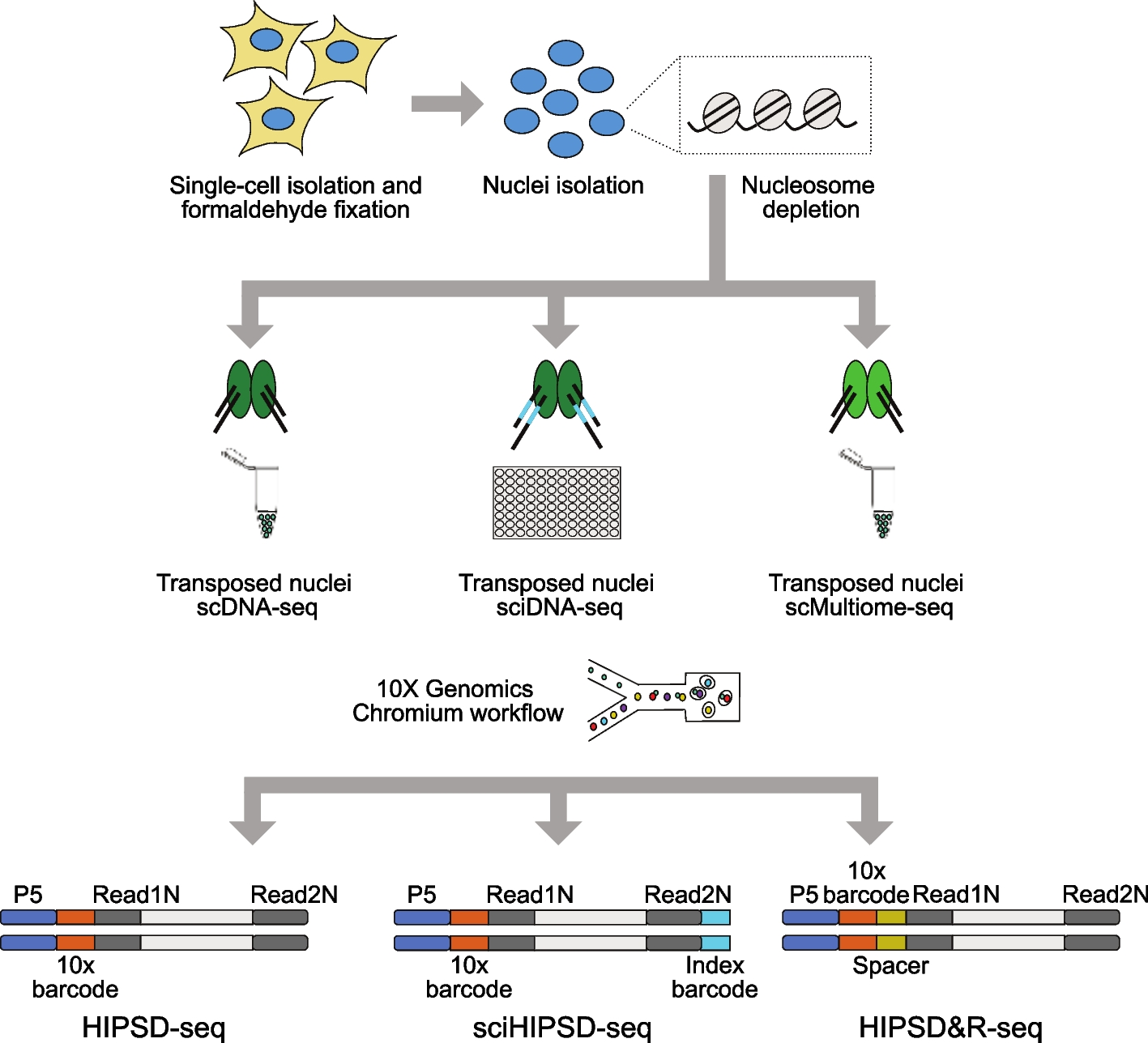
Formaldehyde fixed single-cell suspensions are used for nuclei isolation, followed by SDS-based nucleosome depletion. The nucleosome-depleted genomic regions are randomly tagmented using the transposase Tn5 (HIPSD-seq and HIPSD&R-seq) or barcoded Tn5 (sci-HIPSD-seq). Transposed nuclei are processed using the 10 × Genomics Chromium single cell ATAC workflow (HIPSD-seq and sci-HIPSD-seq) or the multiome workflow (HIPSD&R-seq) to generate single-cell DNA and gene expression (RNA) libraries for sequencing. Combining scDNA-seq with an additional combinatorial indexing step thanks to the barcoded Tn5 leads to an ultra-high throughput (sci-HIPSD-seq)
HIPSD&R-seq for Cancer Research
- Detecting Rare Cancer Clones
One of the biggest challenges in cancer research is identifying rare cancer cell clones. These clones can sometimes drive cancer progression or resistance to treatment. HIPSD&R-seq makes it easier to detect these rare clones by sequencing the DNA and RNA of thousands of individual cells simultaneously. This can help researchers pinpoint small, important changes that might otherwise be overlooked. - Studying DNA and RNA Together
Most current methods focus on either DNA or RNA, but not both. However, combining DNA and RNA data is essential for fully understanding how cancer develops. DNA changes can affect which genes are expressed, and studying both gives a more complete view of how cancer cells behave. HIPSD&R-seq provides this combined analysis, which could lead to better insights into cancer biology and more personalized treatments. - High Throughput and Scalability
HIPSD&R-seq is designed to be scalable, meaning it can analyze thousands of cells at once, making it much faster and more efficient than older methods. This high throughput also allows researchers to study a larger, more diverse set of cells, giving a broader picture of cancer’s complexity.
Study both DNA and RNA in Single Cells
The HIPSD&R-seq method builds on an existing platform developed by 10X Genomics, which is already used for studying DNA and RNA in single cells. This new version of the platform has been modified to work with a combination of both DNA and RNA sequencing in a way that can handle large numbers of cells in parallel.
Researchers have used this method in human cell models and primary tissue (like tissue samples from cancer patients) and have shown that it can detect rare clones of cancer cells. By profiling over 17,000 cells at once, HIPSD&R-seq can provide an incredible amount of data, helping to identify important genetic and molecular patterns that could be crucial for understanding cancer.
Identify More Targeted Treatments
Cancer is a complex disease that can look very different from one patient to another. By understanding the genetic and molecular differences between cancer cells, researchers can identify more targeted treatments that are specific to each patient’s cancer. HIPSD&R-seq offers a more efficient and effective way to study these differences, which could ultimately lead to better treatment options and improved outcomes for cancer patients.
The ability to study both DNA and RNA in the same cell, and the ability to analyze thousands of cells at once, gives researchers an unprecedented look at the inner workings of cancer cells. This could lead to the discovery of new biomarkers, potential drug targets, and a deeper understanding of how cancer develops and spreads.
Conclusion
HIPSD&R-seq is an exciting new technique that combines the power of DNA and RNA sequencing in single cells. By making it possible to study thousands of cells at once, including rare cancer clones, this method could revolutionize the way we study cancer and other diseases. As researchers continue to refine this technology, we can expect it to play a key role in the future of cancer research, leading to more personalized and effective treatments.
Otoničar J, Lazareva O, Mallm JP, Simovic-Lorenz M, Philippos G, Sant P, Parekh U, Hammann L, Li A, Yildiz U, Marttinen M, Zaugg J, Noh KM, Stegle O, Ernst A. (2024) HIPSD&R-seq enables scalable genomic copy number and transcriptome profiling. Genome Biol 25(1):316. [article]
Related Posts






Understanding cancer at the cellular level is crucial for developing better treatments and therapies. One of the challenges in cancer research is identifying the genetic differences between cancer cells, especially when those differences are rare or subtle. Traditional methods of studying cancer cells often fall short, either by being too slow or not allowing researchers to study both DNA and RNA in the same cell. But a new technique developed at the German Cancer Research Center (DKFZ), called HIPSD&R-seq, is offering a way to overcome these challenges and study cancer cells more efficiently.
HIPSD&R-seq
HIPSD&R-seq stands for HIgh-throughPut Single-cell DNA and RNA sequencing, and it’s a new method that allows scientists to look at both the DNA and RNA of thousands of individual cells at the same time. This technique is a game-changer because it combines two important tools: DNA sequencing, which helps us understand genetic changes, and RNA sequencing, which shows how genes are being expressed (turned on or off) in the cells.
While traditional sequencing methods either focus on DNA or RNA, HIPSD&R-seq allows both to be studied in the same cell, which provides a much clearer and more complete picture of what’s happening inside cancer cells.
Schematic representation of the experimental approach for three connected protocols based on a modular modified 10 × Genomics workflow—HIPSD-seq, sci-HIPSD-seq, and HIPSD&R-seq
Formaldehyde fixed single-cell suspensions are used for nuclei isolation, followed by SDS-based nucleosome depletion. The nucleosome-depleted genomic regions are randomly tagmented using the transposase Tn5 (HIPSD-seq and HIPSD&R-seq) or barcoded Tn5 (sci-HIPSD-seq). Transposed nuclei are processed using the 10 × Genomics Chromium single cell ATAC workflow (HIPSD-seq and sci-HIPSD-seq) or the multiome workflow (HIPSD&R-seq) to generate single-cell DNA and gene expression (RNA) libraries for sequencing. Combining scDNA-seq with an additional combinatorial indexing step thanks to the barcoded Tn5 leads to an ultra-high throughput (sci-HIPSD-seq)
HIPSD&R-seq for Cancer Research
- Detecting Rare Cancer Clones
One of the biggest challenges in cancer research is identifying rare cancer cell clones. These clones can sometimes drive cancer progression or resistance to treatment. HIPSD&R-seq makes it easier to detect these rare clones by sequencing the DNA and RNA of thousands of individual cells simultaneously. This can help researchers pinpoint small, important changes that might otherwise be overlooked. - Studying DNA and RNA Together
Most current methods focus on either DNA or RNA, but not both. However, combining DNA and RNA data is essential for fully understanding how cancer develops. DNA changes can affect which genes are expressed, and studying both gives a more complete view of how cancer cells behave. HIPSD&R-seq provides this combined analysis, which could lead to better insights into cancer biology and more personalized treatments. - High Throughput and Scalability
HIPSD&R-seq is designed to be scalable, meaning it can analyze thousands of cells at once, making it much faster and more efficient than older methods. This high throughput also allows researchers to study a larger, more diverse set of cells, giving a broader picture of cancer’s complexity.
Study both DNA and RNA in Single Cells
The HIPSD&R-seq method builds on an existing platform developed by 10X Genomics, which is already used for studying DNA and RNA in single cells. This new version of the platform has been modified to work with a combination of both DNA and RNA sequencing in a way that can handle large numbers of cells in parallel.
Researchers have used this method in human cell models and primary tissue (like tissue samples from cancer patients) and have shown that it can detect rare clones of cancer cells. By profiling over 17,000 cells at once, HIPSD&R-seq can provide an incredible amount of data, helping to identify important genetic and molecular patterns that could be crucial for understanding cancer.
Identify More Targeted Treatments
Cancer is a complex disease that can look very different from one patient to another. By understanding the genetic and molecular differences between cancer cells, researchers can identify more targeted treatments that are specific to each patient’s cancer. HIPSD&R-seq offers a more efficient and effective way to study these differences, which could ultimately lead to better treatment options and improved outcomes for cancer patients.
The ability to study both DNA and RNA in the same cell, and the ability to analyze thousands of cells at once, gives researchers an unprecedented look at the inner workings of cancer cells. This could lead to the discovery of new biomarkers, potential drug targets, and a deeper understanding of how cancer develops and spreads.
Conclusion
HIPSD&R-seq is an exciting new technique that combines the power of DNA and RNA sequencing in single cells. By making it possible to study thousands of cells at once, including rare cancer clones, this method could revolutionize the way we study cancer and other diseases. As researchers continue to refine this technology, we can expect it to play a key role in the future of cancer research, leading to more personalized and effective treatments.
Otoničar J, Lazareva O, Mallm JP, Simovic-Lorenz M, Philippos G, Sant P, Parekh U, Hammann L, Li A, Yildiz U, Marttinen M, Zaugg J, Noh KM, Stegle O, Ernst A. (2024) HIPSD&R-seq enables scalable genomic copy number and transcriptome profiling. Genome Biol 25(1):316. [article]
Related Posts
Recent Posts
 RNAmel simplifies RNA sequencing data analysis with a reproducible, integrated platform
 Heart failure reshapes bone marrow to create inflammation-related immune memory
 Overlooked DNA regions surrounding ‘microexons’ hold missing pieces of autism’s genetic puzzle
 RiboBA improves detection of hidden protein-coding regions using ribosome profiling
 An anti-senescence gene may fight spinal disc deterioration
 Bulk RNA-seq Analysis: A Complete Beginner’s Guide
RNA-Seq Products & Services



Stay Connected