

Microglia, the immune cells of the brain and spinal cord, play a critical role in neurodegenerative diseases such as Alzheimer’s and Parkinson’s. Scientists have long suspected that genetic variants associated with these diseases affect microglia-specific regulatory elements, but until now, identifying how these genetic variations impact gene splicing has been challenging due to the limitations of short-read sequencing technology.
Researchers from the Icahn School of Medicine at Mount Sinai introduce the isoform-centric microglia genomic atlas (isoMiGA), a groundbreaking resource that uses long-read RNA sequencing to uncover 35,879 previously unknown microglia isoforms. These alternative gene versions appear to be involved in microglial responses to stimulation and in region-specific functions within the brain.
The isoMiGA project
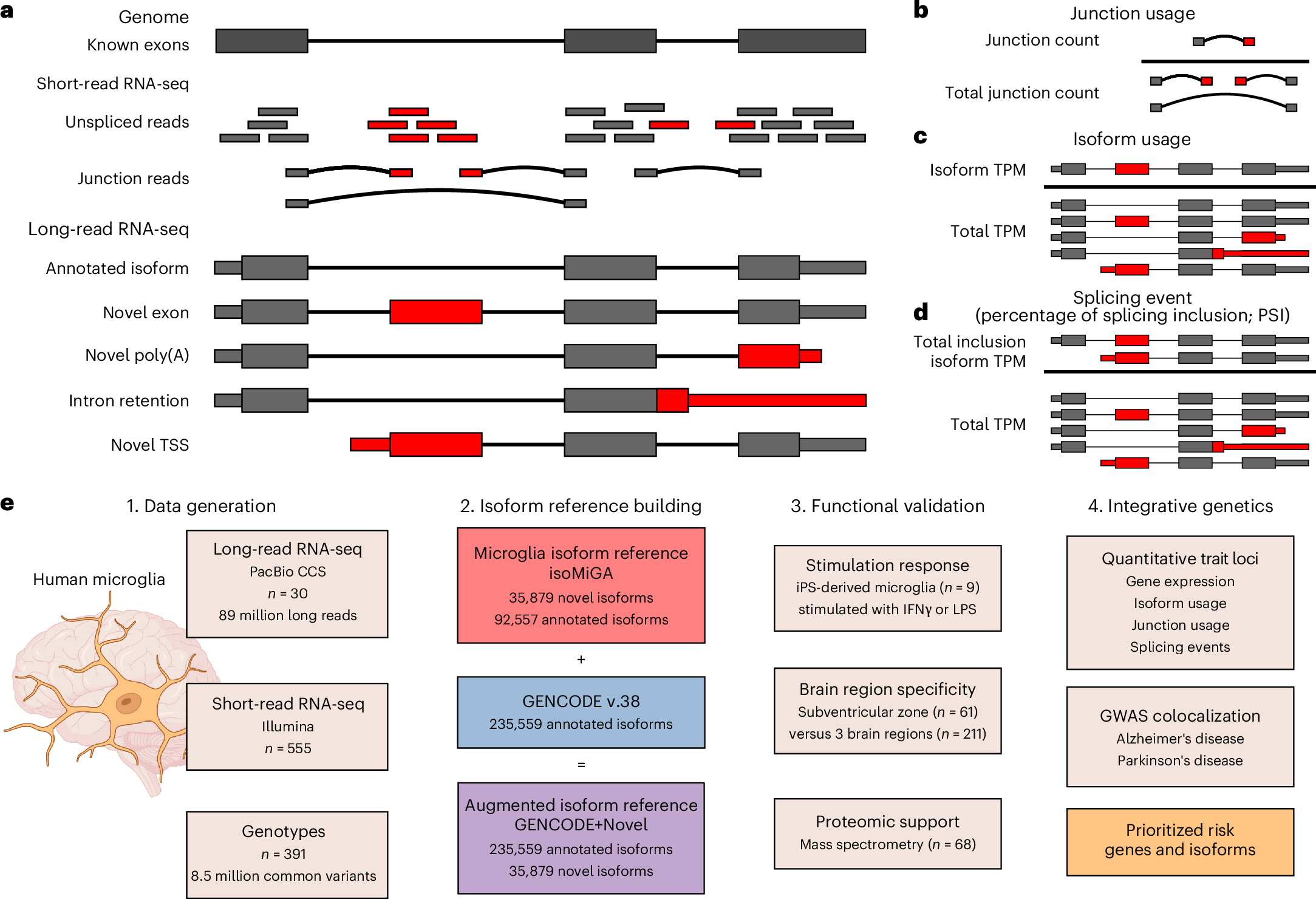
a, Comparison of short-read and long-read RNA-seq for novel isoform discovery. Short-read RNA-seq relies on spliced junction reads to define splice sites, whereas long-read RNA-seq can sequence an entire isoform in a single read, enabling the precise delineation of isoform structure, identifying novel sequences not present in the reference annotation (red boxes) as well as the potential amino acid coding sequence for each isoform, represented by the wide boxes. Narrow boxes represent 5′ and 3′ untranslated regions. b, Junction usage, as exemplified by Leafcutter, takes a ratio of each junction over the total set of overlapping junctions. c, Isoform usage calculates the ratio of each isoform over the total set of isoforms. d, In splicing events, as exemplified by SUPPA, the isoforms that contain the inclusion of a particular splicing event (in this case, inclusion of novel cassette exon), are summed and divided by the total isoforms for that gene. e, Schematic outline of data generation and analysis in this study. iPS, induced pluripotent stem cell; poly(A), polyadenylation site; PSI, percent-spliced-in.
To further explore the role of these newly identified isoforms, the researchers conducted a multi-ancestry meta-analysis of 555 human microglia RNA sequencing samples from 391 donors. They discovered associations between specific isoforms and genetic risk loci linked to Alzheimer’s and Parkinson’s disease. These findings suggest that certain genetic variants may influence disease progression by altering isoform usage and splice-site selection, potentially impacting microglial function.
This research provides valuable insight into the genetic regulation of splicing in microglia, opening new doors for targeted therapies in neurodegenerative diseases. The isoMiGA atlas serves as a key resource for future studies exploring the role of microglia in brain health and disease.
Availability – https://github.com/RajLabMSSM/isoMiGA/tree/publication
Humphrey J, Brophy E, Kosoy R, Zeng B, Coccia E, Mattei D, Ravi A, Naito T, Efthymiou AG, Navarro E, De Sanctis C, Flores-Almazan V, Muller BZ, Snijders GJLJ, Allan A, Münch A, Kitata RB, Kleopoulos SP, Argyriou S, Malakates P, Psychogyiou K, Shao Z, Francoeur N, Tsai CF, Gritsenko MA, Monroe ME, Paurus VL, Weitz KK, Shi T, Sebra R, Liu T, de Witte LD, Goate AM, Bennett DA, Haroutunian V, Hoffman GE, Fullard JF, Roussos P, Raj T. (2025) Long-read RNA sequencing atlas of human microglia isoforms elucidates disease-associated genetic regulation of splicing. Nat Genet [Epub ahead of print]. [article]
Related Posts






Microglia, the immune cells of the brain and spinal cord, play a critical role in neurodegenerative diseases such as Alzheimer’s and Parkinson’s. Scientists have long suspected that genetic variants associated with these diseases affect microglia-specific regulatory elements, but until now, identifying how these genetic variations impact gene splicing has been challenging due to the limitations of short-read sequencing technology.
Researchers from the Icahn School of Medicine at Mount Sinai introduce the isoform-centric microglia genomic atlas (isoMiGA), a groundbreaking resource that uses long-read RNA sequencing to uncover 35,879 previously unknown microglia isoforms. These alternative gene versions appear to be involved in microglial responses to stimulation and in region-specific functions within the brain.
The isoMiGA project
a, Comparison of short-read and long-read RNA-seq for novel isoform discovery. Short-read RNA-seq relies on spliced junction reads to define splice sites, whereas long-read RNA-seq can sequence an entire isoform in a single read, enabling the precise delineation of isoform structure, identifying novel sequences not present in the reference annotation (red boxes) as well as the potential amino acid coding sequence for each isoform, represented by the wide boxes. Narrow boxes represent 5′ and 3′ untranslated regions. b, Junction usage, as exemplified by Leafcutter, takes a ratio of each junction over the total set of overlapping junctions. c, Isoform usage calculates the ratio of each isoform over the total set of isoforms. d, In splicing events, as exemplified by SUPPA, the isoforms that contain the inclusion of a particular splicing event (in this case, inclusion of novel cassette exon), are summed and divided by the total isoforms for that gene. e, Schematic outline of data generation and analysis in this study. iPS, induced pluripotent stem cell; poly(A), polyadenylation site; PSI, percent-spliced-in.
To further explore the role of these newly identified isoforms, the researchers conducted a multi-ancestry meta-analysis of 555 human microglia RNA sequencing samples from 391 donors. They discovered associations between specific isoforms and genetic risk loci linked to Alzheimer’s and Parkinson’s disease. These findings suggest that certain genetic variants may influence disease progression by altering isoform usage and splice-site selection, potentially impacting microglial function.
This research provides valuable insight into the genetic regulation of splicing in microglia, opening new doors for targeted therapies in neurodegenerative diseases. The isoMiGA atlas serves as a key resource for future studies exploring the role of microglia in brain health and disease.
Availability – https://github.com/RajLabMSSM/isoMiGA/tree/publication
Humphrey J, Brophy E, Kosoy R, Zeng B, Coccia E, Mattei D, Ravi A, Naito T, Efthymiou AG, Navarro E, De Sanctis C, Flores-Almazan V, Muller BZ, Snijders GJLJ, Allan A, Münch A, Kitata RB, Kleopoulos SP, Argyriou S, Malakates P, Psychogyiou K, Shao Z, Francoeur N, Tsai CF, Gritsenko MA, Monroe ME, Paurus VL, Weitz KK, Shi T, Sebra R, Liu T, de Witte LD, Goate AM, Bennett DA, Haroutunian V, Hoffman GE, Fullard JF, Roussos P, Raj T. (2025) Long-read RNA sequencing atlas of human microglia isoforms elucidates disease-associated genetic regulation of splicing. Nat Genet [Epub ahead of print]. [article]
Related Posts
Recent Posts
 RNAmel simplifies RNA sequencing data analysis with a reproducible, integrated platform
 Heart failure reshapes bone marrow to create inflammation-related immune memory
 Overlooked DNA regions surrounding ‘microexons’ hold missing pieces of autism’s genetic puzzle
 RiboBA improves detection of hidden protein-coding regions using ribosome profiling
 An anti-senescence gene may fight spinal disc deterioration
 Bulk RNA-seq Analysis: A Complete Beginner’s Guide
RNA-Seq Products & Services



Stay Connected