

Researchers from Cold Spring Harbor Laboratory have developed a powerful new technique called hybrid BAG-seq that can analyze DNA and RNA from the same single cell. This breakthrough allows scientists to look at both the genetic code and how it is being expressed, giving a more complete picture of what is happening inside tumors.
Overview of hybrid BAG-seq protocol and performance on cell-mixture experiment
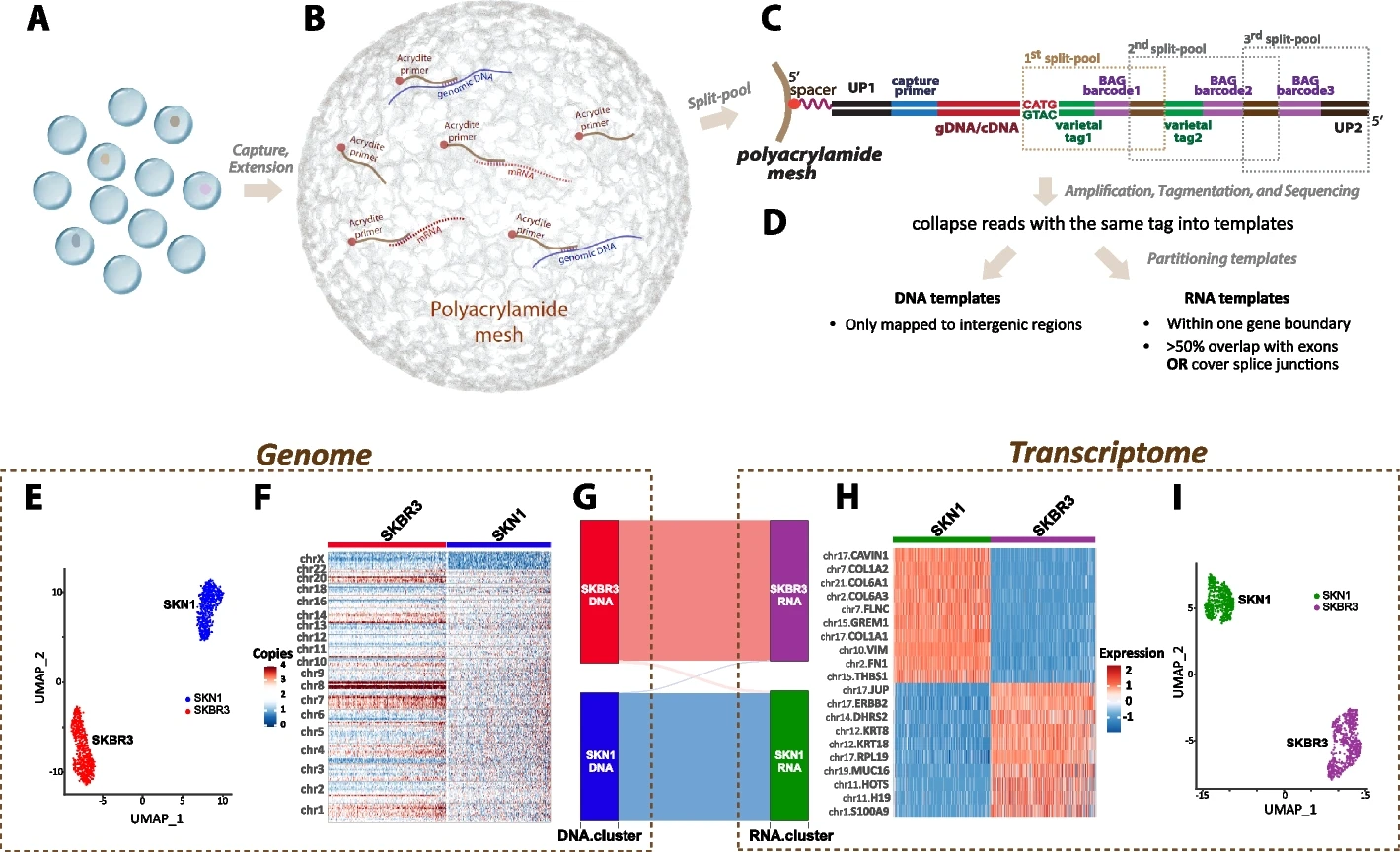
A–D Key steps for hybrid BAG-seq pipeline. A Encapsulation: Individual cells or nuclei are encapsulated within droplets containing acrylamide and Acrydite-modified primers that are designed to capture both mRNA and genomic DNA. B Polymerization and primer extension: Gel polymerization is followed by primer hybridization. Acrydite primers are extended by reverse transcriptase and DNA polymerase. C Split-and-pool barcoding: The double-stranded cDNA and genomic DNA are cleaved with a restriction enzyme. During successive rounds of pool-and-split, BAG-specific barcodes (purple) and template-specific varietal tags (green) are added. This process uniquely tags each molecule while assigning a distinct BAG barcode to templates in the same droplet. D Sequencing and layer assignment: Post-amplification, the molecules undergo tagmentation and subsequent sequencing. The sequencing reads are analyzed for expected structure, tags are extracted, and reads with identical varietal tags are collapsed into single templates. Templates are then partitioned into either the DNA or RNA layers based on their mapping characteristics. E–I Performance and genome-transcriptome correlation from a SKN1-SBKR3 mixture single-cell hybrid sequencing experiment: E clustering based on DNA copy number; F heatmap of DNA copy number variations across chromosomes for SKN1 and SBKR3 cells; G correlation between genomic clusters and expression clusters; H heatmap of marker genes of expression clusters; and I clustering result based on gene-count matrix
The team applied hybrid BAG-seq to more than 65,000 single cells from uterine cancer patients. They discovered that even within one patient, multiple tumor cell populations can exist, each with unique genetic changes and gene expression patterns. These tumor clones sometimes overlap in how they express genes, while in other cases they look completely different.
Interestingly, the researchers also found that the supporting tissue around tumors, called stroma, can carry mutations of its own. Some stromal cells had lost parts of the X chromosome, while others showed unusual activity that varied between patients. This suggests that the tumor environment itself may play a more complex role in cancer development than previously thought.
By combining DNA and RNA sequencing in one experiment, hybrid BAG-seq provides scientists with a new way to study how genetic changes and gene activity interact in cancer. This insight could one day help guide more personalized treatment strategies for patients.
Li S, Alexander J, Kendall J, Andrews P, Rose E, Orjuela H, Park S, Podszus C, Shanley L, Ranade N, Morris P, Stauder D, Bradford D, Laster Z, Ronemus M, Rishi A, Frimer M, Ma R, Donoho DL, Goldberg GL, Wigler M, Levy D. (2025) Hybrid BAG-seq: DNA and RNA from the same single nucleus reveals interactions between genomic and transcriptomic landscapes in human tumor samples. Genome Biol 26(1):314. [article]
Related Posts




Researchers from Cold Spring Harbor Laboratory have developed a powerful new technique called hybrid BAG-seq that can analyze DNA and RNA from the same single cell. This breakthrough allows scientists to look at both the genetic code and how it is being expressed, giving a more complete picture of what is happening inside tumors.
Overview of hybrid BAG-seq protocol and performance on cell-mixture experiment
A–D Key steps for hybrid BAG-seq pipeline. A Encapsulation: Individual cells or nuclei are encapsulated within droplets containing acrylamide and Acrydite-modified primers that are designed to capture both mRNA and genomic DNA. B Polymerization and primer extension: Gel polymerization is followed by primer hybridization. Acrydite primers are extended by reverse transcriptase and DNA polymerase. C Split-and-pool barcoding: The double-stranded cDNA and genomic DNA are cleaved with a restriction enzyme. During successive rounds of pool-and-split, BAG-specific barcodes (purple) and template-specific varietal tags (green) are added. This process uniquely tags each molecule while assigning a distinct BAG barcode to templates in the same droplet. D Sequencing and layer assignment: Post-amplification, the molecules undergo tagmentation and subsequent sequencing. The sequencing reads are analyzed for expected structure, tags are extracted, and reads with identical varietal tags are collapsed into single templates. Templates are then partitioned into either the DNA or RNA layers based on their mapping characteristics. E–I Performance and genome-transcriptome correlation from a SKN1-SBKR3 mixture single-cell hybrid sequencing experiment: E clustering based on DNA copy number; F heatmap of DNA copy number variations across chromosomes for SKN1 and SBKR3 cells; G correlation between genomic clusters and expression clusters; H heatmap of marker genes of expression clusters; and I clustering result based on gene-count matrix
The team applied hybrid BAG-seq to more than 65,000 single cells from uterine cancer patients. They discovered that even within one patient, multiple tumor cell populations can exist, each with unique genetic changes and gene expression patterns. These tumor clones sometimes overlap in how they express genes, while in other cases they look completely different.
Interestingly, the researchers also found that the supporting tissue around tumors, called stroma, can carry mutations of its own. Some stromal cells had lost parts of the X chromosome, while others showed unusual activity that varied between patients. This suggests that the tumor environment itself may play a more complex role in cancer development than previously thought.
By combining DNA and RNA sequencing in one experiment, hybrid BAG-seq provides scientists with a new way to study how genetic changes and gene activity interact in cancer. This insight could one day help guide more personalized treatment strategies for patients.
Li S, Alexander J, Kendall J, Andrews P, Rose E, Orjuela H, Park S, Podszus C, Shanley L, Ranade N, Morris P, Stauder D, Bradford D, Laster Z, Ronemus M, Rishi A, Frimer M, Ma R, Donoho DL, Goldberg GL, Wigler M, Levy D. (2025) Hybrid BAG-seq: DNA and RNA from the same single nucleus reveals interactions between genomic and transcriptomic landscapes in human tumor samples. Genome Biol 26(1):314. [article]
Related Posts
Recent Posts
 Scientists identify the neuroblastoma cells that signal poor outcomes
 GARAGE improves rare cell detection in single-cell RNA sequencing analysis using AI
 Machine learning reveals how RNA splicing is regulated in individual cell types
 Illumina releases SpliceAI2 to help advance rare disease research
 Postdoctoral Fellow – Long-Read RNA Methods Development for Neurodegeneration
 Novel biosensor uses DNA ‘barcodes’ to uncover disease signals in cells
RNA-Seq Products & Services



Stay Connected