

Researchers from the Southern University of Science and Technology, Shenzhen have developed an innovative artificial intelligence model called HydraRNA that can interpret the complex biological “language” of RNA. RNA, a key molecule that helps convert genetic information from DNA into proteins, is central to almost every cellular process. Understanding how RNA functions and regulates itself is essential for studying diseases and designing RNA-based therapeutics, such as vaccines and gene therapies.
Until now, most RNA large language models (LLMs) have used Transformer-based architectures trained on short RNA sequences. These models struggled to understand full-length RNA molecules, especially messenger RNA (mRNA), which can be thousands of nucleotides long and folded into complex structures. HydraRNA overcomes these limitations through a hybrid architecture that combines a bidirectional state space model with a multi-head attention mechanism. This approach allows the model to process entire RNA molecules more efficiently and accurately.
Overview of HydraRNA
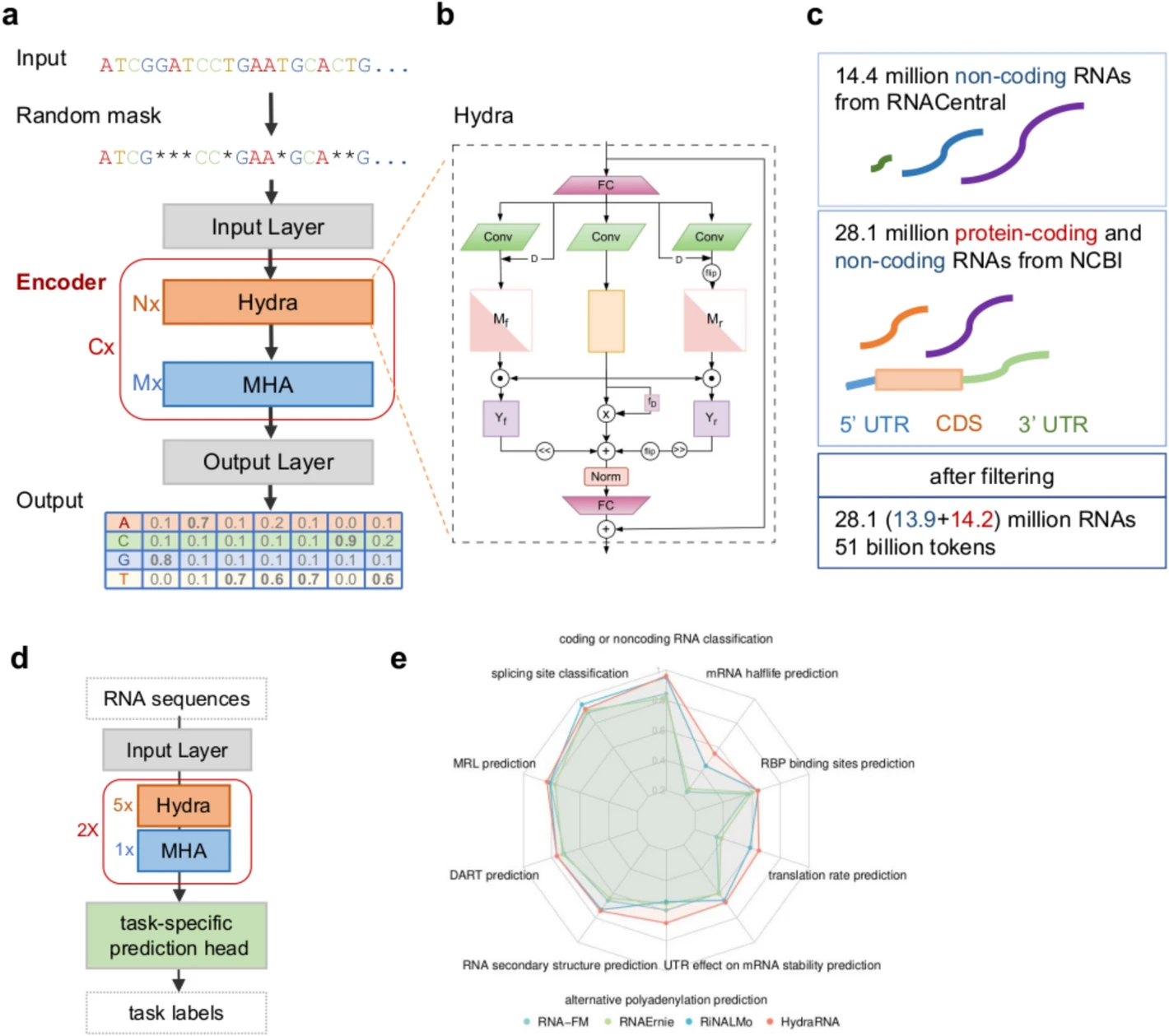
a HydraRNA employs a hybrid architecture with 12 layers. Each layer contains a Hydra module except the 6th and 12th layer, which contains a MHA module, i.e. C = 2,N = 5,M = 1 in this case. b Illustration of Hydra module. c HydraRNA was pretrained on 28.1 million RNAs including both non-coding and protein-coding RNAs using masked language modeling. d Task-specific prediction head was added to the HydraRNA encoder. e Radar plot for overview of prediction performance comparison
HydraRNA was trained on massive datasets that include both protein-coding mRNAs and non-coding RNAs, giving it a broader understanding of RNA biology. Despite using fewer computational resources than previous models, HydraRNA produced better results across a range of RNA-related tasks. These tasks included distinguishing between coding and non-coding RNAs, predicting RNA secondary structure, identifying RNA-binding protein (RBP) sites, detecting splicing and polyadenylation sites, and estimating RNA stability and translation efficiency.
One of the most impressive features of HydraRNA is its ability to predict how mutations affect RNA. By modeling how different parts of an RNA molecule contribute to its stability and translation, the model provides valuable insights into how genetic variations may influence protein production and disease outcomes.
The results suggest that HydraRNA’s hybrid design outperforms previous models built purely on Transformer technology. The researchers believe that this new model will not only help decode the hidden regulatory mechanisms of RNA but also accelerate the design of mRNA-based drugs and vaccines, including those used in infectious disease and cancer therapy.
Availability – HydraRNA can be accessed under the MIT License at HydraRNA Github repository (https://github.com/GuipengLi/HydraRNA)
Li G, Jiang F, Zhu J, Cui H, Wang Z, Chen W. (2025) HydraRNA a hybrid architecture based full-length RNA language model. Genome Biology 26(1): 383. [article]
Related Posts




Researchers from the Southern University of Science and Technology, Shenzhen have developed an innovative artificial intelligence model called HydraRNA that can interpret the complex biological “language” of RNA. RNA, a key molecule that helps convert genetic information from DNA into proteins, is central to almost every cellular process. Understanding how RNA functions and regulates itself is essential for studying diseases and designing RNA-based therapeutics, such as vaccines and gene therapies.
Until now, most RNA large language models (LLMs) have used Transformer-based architectures trained on short RNA sequences. These models struggled to understand full-length RNA molecules, especially messenger RNA (mRNA), which can be thousands of nucleotides long and folded into complex structures. HydraRNA overcomes these limitations through a hybrid architecture that combines a bidirectional state space model with a multi-head attention mechanism. This approach allows the model to process entire RNA molecules more efficiently and accurately.
Overview of HydraRNA
a HydraRNA employs a hybrid architecture with 12 layers. Each layer contains a Hydra module except the 6th and 12th layer, which contains a MHA module, i.e. C = 2,N = 5,M = 1 in this case. b Illustration of Hydra module. c HydraRNA was pretrained on 28.1 million RNAs including both non-coding and protein-coding RNAs using masked language modeling. d Task-specific prediction head was added to the HydraRNA encoder. e Radar plot for overview of prediction performance comparison
HydraRNA was trained on massive datasets that include both protein-coding mRNAs and non-coding RNAs, giving it a broader understanding of RNA biology. Despite using fewer computational resources than previous models, HydraRNA produced better results across a range of RNA-related tasks. These tasks included distinguishing between coding and non-coding RNAs, predicting RNA secondary structure, identifying RNA-binding protein (RBP) sites, detecting splicing and polyadenylation sites, and estimating RNA stability and translation efficiency.
One of the most impressive features of HydraRNA is its ability to predict how mutations affect RNA. By modeling how different parts of an RNA molecule contribute to its stability and translation, the model provides valuable insights into how genetic variations may influence protein production and disease outcomes.
The results suggest that HydraRNA’s hybrid design outperforms previous models built purely on Transformer technology. The researchers believe that this new model will not only help decode the hidden regulatory mechanisms of RNA but also accelerate the design of mRNA-based drugs and vaccines, including those used in infectious disease and cancer therapy.
Availability – HydraRNA can be accessed under the MIT License at HydraRNA Github repository (https://github.com/GuipengLi/HydraRNA)
Li G, Jiang F, Zhu J, Cui H, Wang Z, Chen W. (2025) HydraRNA a hybrid architecture based full-length RNA language model. Genome Biology 26(1): 383. [article]
Related Posts
Recent Posts
 Scientists identify the neuroblastoma cells that signal poor outcomes
 GARAGE improves rare cell detection in single-cell RNA sequencing analysis using AI
 Machine learning reveals how RNA splicing is regulated in individual cell types
 Illumina releases SpliceAI2 to help advance rare disease research
 Postdoctoral Fellow – Long-Read RNA Methods Development for Neurodegeneration
 Novel biosensor uses DNA ‘barcodes’ to uncover disease signals in cells
RNA-Seq Products & Services



Stay Connected