Why It Matters
There is an urgent need for precision immunotherapy strategies that simultaneously target both tumor cells and immune cells to enhance treatment efficacy. Identifying genes with dual functions in both cancer and immune cells opens new possibilities for overcoming tumor resistance and improving patient survival.
ICRAFT: A New Approach to Immunotherapy Target Discovery
The research team developed ICRAFT, a CRISPR-based tumor immunotherapy target identification platform.
ICRAFT integrates:
- 558 CRISPR screening datasets
- 2 million single-cell RNA sequencing datasets
- 943 RNA-Seq datasets from clinical immunotherapy samples
By analyzing this large-scale data, ICRAFT systematically identifies genes that regulate both tumor behavior and immune responses, addressing a major gap in immunotherapy research.
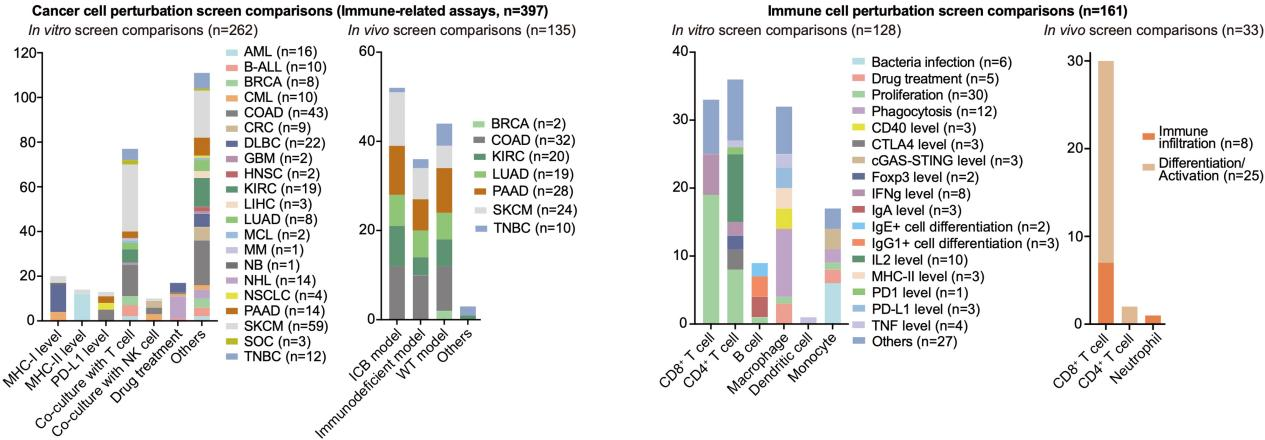
CRISPR Screening Data Integration in ICRAFT
Key Findings: The Dual Role of TNFAIP3 (A20)
ICRAFT pinpointed TNFAIP3 (A20) as a crucial gene with dual immunoregulatory effects:
In tumor cells:
- Loss of TNFAIP3 activates TNF-induced apoptosis, upregulates NF-κB signaling, and enhances chemokine expression, promoting T cell infiltration.
- This makes tumor cells more vulnerable to immune destruction.
In CD8+ T cells:
- TNFAIP3 inactivation enhances T cell cytotoxicity, improving their ability to attack and eliminate tumors in the microenvironment.
Additionally, PTPN2 and SOCS1 were identified as genes with similar dual functions, making them potential targets for combination immunotherapy.
Future Implications
ICRAFT is an open-source platform, allowing scientists worldwide to explore new immunotherapy targets, accelerating cancer research. The study paves the way for combination therapies that enhance both immune responses and tumor susceptibility. By integrating multi-source CRISPR and RNA-Seq data, ICRAFT provides a powerful tool for discovering novel immunotherapy targets, potentially transforming personalized cancer treatment.
Availability – An interactive web server is publicly available at https://icraft.pku-genomics.org/
Source – Peking University


Researchers from the Center for Quantitative Biology at the Peking University Academy for Advanced Interdisciplinary Studies, in collaboration with the Peking University-Tsinghua University Joint Center for Life Sciences, have developed ICRAFT, an innovative computational platform for identifying cancer immunotherapy targets. Their study has been published in Immunity, an immunology research journal.
Why It Matters
There is an urgent need for precision immunotherapy strategies that simultaneously target both tumor cells and immune cells to enhance treatment efficacy. Identifying genes with dual functions in both cancer and immune cells opens new possibilities for overcoming tumor resistance and improving patient survival.
ICRAFT: A New Approach to Immunotherapy Target Discovery
The research team developed ICRAFT, a CRISPR-based tumor immunotherapy target identification platform.
ICRAFT integrates:
By analyzing this large-scale data, ICRAFT systematically identifies genes that regulate both tumor behavior and immune responses, addressing a major gap in immunotherapy research.
CRISPR Screening Data Integration in ICRAFT
Key Findings: The Dual Role of TNFAIP3 (A20)
ICRAFT pinpointed TNFAIP3 (A20) as a crucial gene with dual immunoregulatory effects:
In tumor cells:
In CD8+ T cells:
Additionally, PTPN2 and SOCS1 were identified as genes with similar dual functions, making them potential targets for combination immunotherapy.
Future Implications
ICRAFT is an open-source platform, allowing scientists worldwide to explore new immunotherapy targets, accelerating cancer research. The study paves the way for combination therapies that enhance both immune responses and tumor susceptibility. By integrating multi-source CRISPR and RNA-Seq data, ICRAFT provides a powerful tool for discovering novel immunotherapy targets, potentially transforming personalized cancer treatment.
Availability – An interactive web server is publicly available at https://icraft.pku-genomics.org/
Source – Peking University
Luo C, Zhang R, Guo R, Wu L, Xue T, He Y, Jin Y, Zhao Y, Zhang Z, Zhang P, Ye S, Li X, Li D, Zhang W, Wang C, Lai L, Pan-Hammarström Q, Wucherpfennig KW, Gao Z, Pan D, Zeng Z. (2025) Integrated computational analysis identifies therapeutic targets with dual action in cancer cells and T cells. Immunity 58(3):745-765.e9. [article]
Related Posts
RNAmel simplifies RNA sequencing data analysis with a reproducible, integrated platform
Heart failure reshapes bone marrow to create inflammation-related immune memory
Overlooked DNA regions surrounding ‘microexons’ hold missing pieces of autism’s genetic puzzle
RiboBA improves detection of hidden protein-coding regions using ribosome profiling
An anti-senescence gene may fight spinal disc deterioration
Scientists identify the neuroblastoma cells that signal poor outcomes
Novel biosensor uses DNA ‘barcodes’ to uncover disease signals in cells
CellART extracts single-cell information from high-resolution spatial transcriptomics
Cell2space restores spatial context to single-cell RNA sequencing data
Urine test may improve bladder cancer diagnosis and guide treatment decisions
DeCoRE – a computational method to resolve RNA structural heterogeneity from RNA structure probing data by direct RNA sequencing
Tracing 700 million years of cell evolution
How should biological replicates be handled in long-read RNA sequencing?
RNA-Seq reveals a new way the developing heart controls its growth
The Human RNome Project Consortium seeks to publish first-ever complete sequence of the body’s RNA
scFlowReport brings multiple single-cell RNA sequencing analyses into one workflow
Long-read RNA sequencing reveals how neurons choose alternative RNA endings
DeOPUS improves cell-type estimates from bulk RNA sequencing
ResolVI improves accuracy in spatial transcriptomics analysis
RNA sequencing reveals transcriptional allele differences in prostate cancer stem cells
Stay Connected
Submit a Post to the Blog
Recent Posts
Subscribe to the RNA-Seq Blog
RNA-Seq Products & Services