Insights into a novel diagnostic and therapeutic target in bipolar disorder
Bipolar disorder is a significant global health issue, affecting millions worldwide. To address the urgent need for novel therapeutic approaches, it is important to deepen the understanding of its pathology. A group of researchers from the Juntendo University has demonstrated how alterations and abnormalities in the neurons of the paraventricular thalamic nucleus region of the brain are associated with bipolar disorder, offering a novel therapeutic and diagnostic approach.
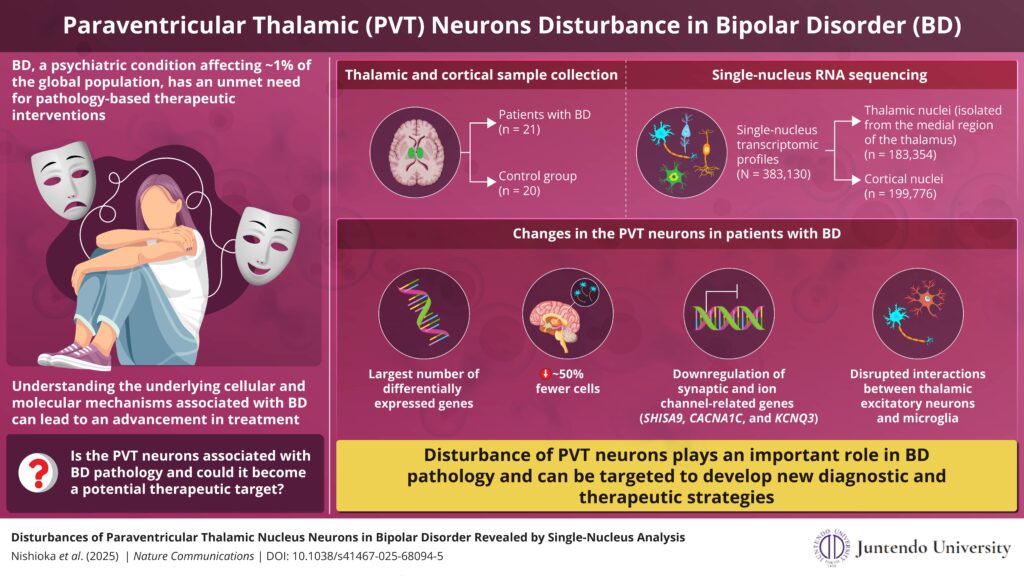
Researchers have demonstrated how paraventricular thalamic nucleus neurons play a role in bipolar disorder pathology and highlighted their potential as a promising diagnostic and therapeutic target.
Bipolar disorder (BD) is a major mental disorder, affecting 1% of the global population. Patients suffering from BD frequently experience manic and depressive episodes, which disrupt interpersonal relationships and social confidence. While conventional therapies can mitigate the symptoms for some patients, they are also associated with adverse effects and treatment resistance in many, highlighting the urgent need for pathology-driven diagnosis and therapeutic intervention.
The thalamus, especially the paraventricular thalamic nucleus (PVT), has been previously associated with emotional processing and mood regulation. Magnetic resonance imaging (MRI) studies have shown volume reduction in certain regions of the brain, including the thalamus and cortex, in patients with BD. Current research utilizes single-nucleus ribonucleic acid (RNA) sequencing technology to elucidate the cellular pathology for different mental disorders. The changes in cellular and molecular mechanisms in the subcortical region, particularly the PVT, in patients with BD also warrant further investigation.
In an innovative study published online in the journal Nature Communications on January 07, 2026, a team of researchers led by Associate Professor Masaki Nishioka from the Department of Psychiatry and Behavioral Science, Juntendo University Graduate School of Medicine, Japan, along with Dr. Mie Sakashita-Kubota and Professor Tadafumi Kato, also from Juntendo University Graduate School of Medicine, used single-nucleus RNA sequencing to explore gene expression changes in the PVT of patients with BD.
“While mood stabilizers like lithium and lamotrigine, as well as atypical antipsychotics such as quetiapine, are commonly used for treatment, many patients continue to experience manic or depressive episodes due to low medication response or medication discontinuation caused by side effects. Developing diagnostic tests to determine the necessity of prophylactic medication, as well as creating more effective drugs with fewer side effects, could significantly improve the lives of those with BD and alter societal perceptions of the illness,” explains Dr. Nishioka.
The researchers used postmortem brain samples for single-nucleus RNA sequencing. The comparative analysis of transcriptional changes was conducted between normal brain samples and those obtained from patients with BD. Neurons from the cortical and thalamic regions were utilized for the study.
The PVT region in patients with BD showed notable alteration, with around 50% reduction in the number of cells. There was also downregulation of genes associated with synaptic function and ion channels, which may be associated with altered neural communication, excitability, and synaptic plasticity. Disrupted interactions were also noted between thalamic excitatory neurons and microglia. Interestingly, even though a reduction in cortical volume is observed by brain MRI of patients with BD, alterations in this region were modest compared to those in the PVT.
The dopamine signaling and monoamine receptor enrichment in PVT underscore the relevance of using antipsychotic drugs in the treatment. Focusing on these neurons as a therapeutic target might also restore the regulation of calcium and ion channel functions, leading to the alleviation of symptoms.
“This study highlights the need to extend research to the subcortical regions of the brain, which may harbor critical yet underexplored components of BD pathophysiology. There is also an increasing need for integrating multi-modal methodologies to advance BD pathology-related research. Various cellular, molecular, neuroimaging techniques can help to bridge research gaps and lead up advanced diagnostic and therapeutic strategies, aimed at improving patient outcomes,” said Dr. Nishioka.
“We have been studying the mitochondrial dysfunction of BD, and finally came to be aware that the fact that mitochondrial dysfunction is related to this disorder means that some specific brain region should be affected. We finally identified that PVT is the brain region causative for BD. This discovery will lead to the paradigm shift of BD research,” said Professor Kato.
Despite some limitations, the findings of this study highlight the relevance of PVT neurons in BD pathology, prioritizing them as a diagnostic and therapeutic target.
Source – Juntendo University


Insights into a novel diagnostic and therapeutic target in bipolar disorder
Bipolar disorder is a significant global health issue, affecting millions worldwide. To address the urgent need for novel therapeutic approaches, it is important to deepen the understanding of its pathology. A group of researchers from the Juntendo University has demonstrated how alterations and abnormalities in the neurons of the paraventricular thalamic nucleus region of the brain are associated with bipolar disorder, offering a novel therapeutic and diagnostic approach.
Researchers have demonstrated how paraventricular thalamic nucleus neurons play a role in bipolar disorder pathology and highlighted their potential as a promising diagnostic and therapeutic target.
Bipolar disorder (BD) is a major mental disorder, affecting 1% of the global population. Patients suffering from BD frequently experience manic and depressive episodes, which disrupt interpersonal relationships and social confidence. While conventional therapies can mitigate the symptoms for some patients, they are also associated with adverse effects and treatment resistance in many, highlighting the urgent need for pathology-driven diagnosis and therapeutic intervention.
The thalamus, especially the paraventricular thalamic nucleus (PVT), has been previously associated with emotional processing and mood regulation. Magnetic resonance imaging (MRI) studies have shown volume reduction in certain regions of the brain, including the thalamus and cortex, in patients with BD. Current research utilizes single-nucleus ribonucleic acid (RNA) sequencing technology to elucidate the cellular pathology for different mental disorders. The changes in cellular and molecular mechanisms in the subcortical region, particularly the PVT, in patients with BD also warrant further investigation.
In an innovative study published online in the journal Nature Communications on January 07, 2026, a team of researchers led by Associate Professor Masaki Nishioka from the Department of Psychiatry and Behavioral Science, Juntendo University Graduate School of Medicine, Japan, along with Dr. Mie Sakashita-Kubota and Professor Tadafumi Kato, also from Juntendo University Graduate School of Medicine, used single-nucleus RNA sequencing to explore gene expression changes in the PVT of patients with BD.
The researchers used postmortem brain samples for single-nucleus RNA sequencing. The comparative analysis of transcriptional changes was conducted between normal brain samples and those obtained from patients with BD. Neurons from the cortical and thalamic regions were utilized for the study.
The PVT region in patients with BD showed notable alteration, with around 50% reduction in the number of cells. There was also downregulation of genes associated with synaptic function and ion channels, which may be associated with altered neural communication, excitability, and synaptic plasticity. Disrupted interactions were also noted between thalamic excitatory neurons and microglia. Interestingly, even though a reduction in cortical volume is observed by brain MRI of patients with BD, alterations in this region were modest compared to those in the PVT.
The dopamine signaling and monoamine receptor enrichment in PVT underscore the relevance of using antipsychotic drugs in the treatment. Focusing on these neurons as a therapeutic target might also restore the regulation of calcium and ion channel functions, leading to the alleviation of symptoms.
Despite some limitations, the findings of this study highlight the relevance of PVT neurons in BD pathology, prioritizing them as a diagnostic and therapeutic target.
Source – Juntendo University
Nishioka M, Sakashita-Kubota M, Iijima K, Hasegawa Y, Ishiwata M, Takase K, Ichikawa R, Mechawar N, Turecki G, Kato T. (2026) Disturbances of paraventricular thalamic nucleus neurons in bipolar disorder revealed by single-nucleus analysis. Nature Communications 17(1):1338. [article]
Related Posts
Novel biosensor uses DNA ‘barcodes’ to uncover disease signals in cells
CellART extracts single-cell information from high-resolution spatial transcriptomics
Cell2space restores spatial context to single-cell RNA sequencing data
Urine test may improve bladder cancer diagnosis and guide treatment decisions
DeCoRE – a computational method to resolve RNA structural heterogeneity from RNA structure probing data by direct RNA sequencing
Tracing 700 million years of cell evolution
How should biological replicates be handled in long-read RNA sequencing?
RNA-Seq reveals a new way the developing heart controls its growth
The Human RNome Project Consortium seeks to publish first-ever complete sequence of the body’s RNA
scFlowReport brings multiple single-cell RNA sequencing analyses into one workflow
Long-read RNA sequencing reveals how neurons choose alternative RNA endings
DeOPUS improves cell-type estimates from bulk RNA sequencing
ResolVI improves accuracy in spatial transcriptomics analysis
RNA sequencing reveals transcriptional allele differences in prostate cancer stem cells
Unmasking “zombie cells” in aging tissue with an AI-powered barcode
RNA variant imaging for cancer diagnosis
Autism-risk mutations reveal two opposing patterns of brain gene activity
A real-data approach to evaluating RNA transcript analysis methods
Detection and sequencing of Ap2N-capped RNAs in human cells
Single-cell RNA sequencing provides a closer look at the Aedes aegypti midgut
Stay Connected
Submit a Post to the Blog
Recent Posts
Subscribe to the RNA-Seq Blog
RNA-Seq Products & Services