

Understanding the human immune system at a cellular level has become increasingly important in fields like cancer research, infectious disease, and autoimmune disorders. Thanks to advancements in single-cell technologies, scientists can now analyze individual immune cells to see which genes are turned on and what receptors are present on their surfaces. Two powerful methods for doing this are single-cell RNA sequencing (scRNA-seq), which reveals gene expression profiles, and single-cell T-cell receptor sequencing (scTCR-seq), which identifies the unique receptors that T cells use to recognize pathogens or cancer cells.
Combining these two data types provides a more complete picture of how T cells behave, but integrating them can be technically challenging. To address this, researchers from the Mayo Clinic have developed a new tool called immunopipe. This computational pipeline makes it easier for scientists to analyze scRNA-seq and scTCR-seq data side by side, unlocking deeper insights into T-cell heterogeneity and immune responses.
Illustration of analysis by immunopipe
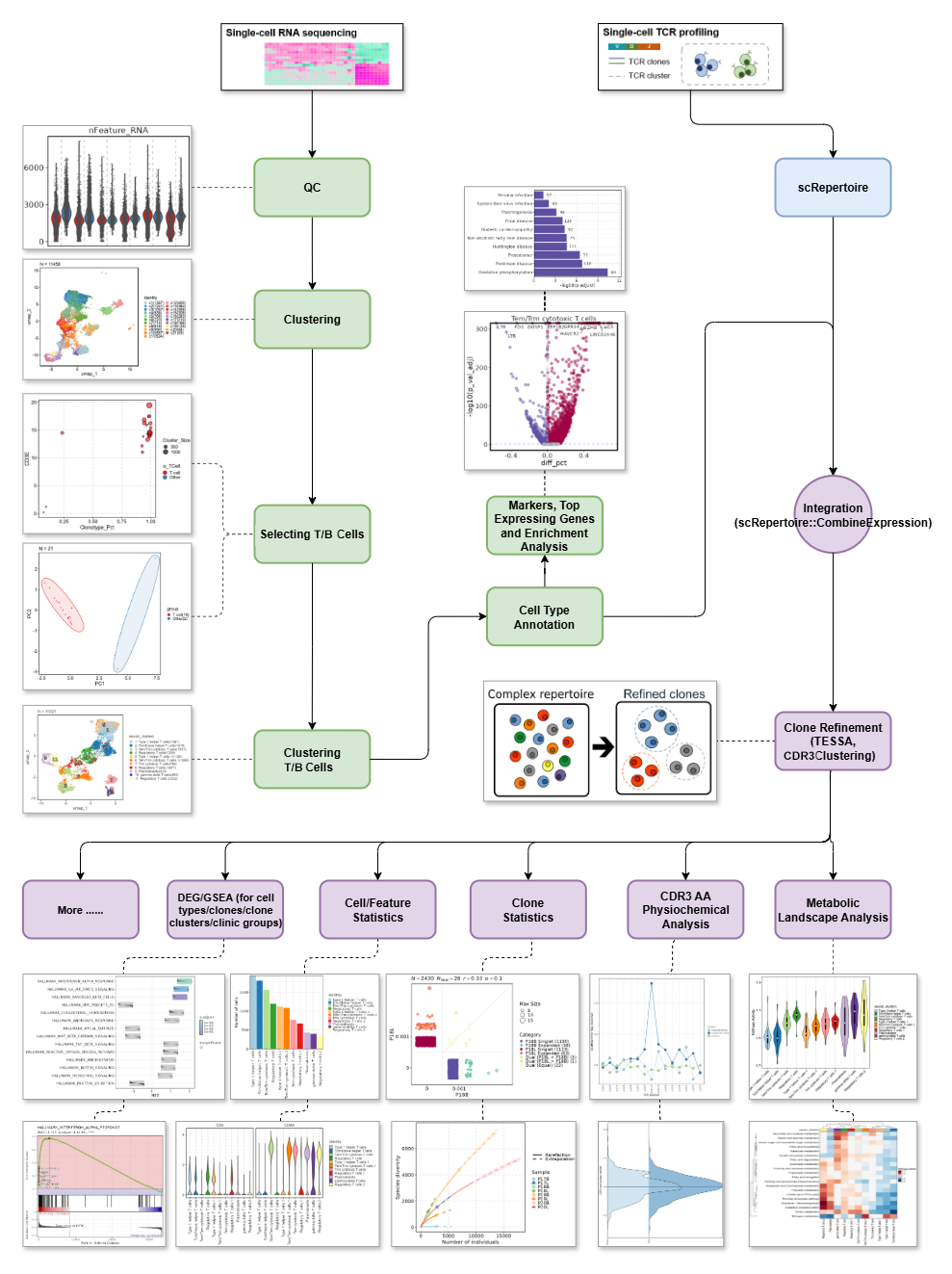
The analysis initiates with quality control (QC) of scRNA-seq data, followed by comprehensive data integration. Dimensionality reduction techniques are subsequently applied, facilitating clustering and annotation or supervised clustering of the data. Concurrently, single-cell TCR profiling encompasses clonality analysis and diversity assessment. The tracking of TCR clones over time, VJ gene usage, and clustering of TCR repertoires further refine the analysis. The integration of T-cell selection data from both scRNA-seq and TCR profiling is centrally depicted, highlighting an innovative approach for comprehensive analysis. The outputs, illustrated in the bottom panel, include cell composition, clone residency, differential gene expression (DGE), gene set enrichment analysis (GSEA), and other analyses. This integrated methodology delivers an in-depth understanding of immune cell heterogeneity and dynamics.
What makes immunopipe especially valuable is its accessibility. While many bioinformatics tools require users to have coding skills and command-line experience, immunopipe includes a web-based interface that allows researchers to set up their analyses and monitor progress without writing a single line of code. This lowers the barrier to entry for biologists, immunologists, and clinicians who may not have a computational background but want to leverage single-cell technologies in their work.
The pipeline is also flexible and comprehensive, supporting a wide range of analysis tasks, from clustering cells based on gene expression to tracking clonal expansion of specific T-cell populations. By streamlining these processes, immunopipe enables researchers to focus on biological interpretation rather than data wrangling.
This kind of integrated analysis is particularly relevant for advancing immunotherapy. By better understanding which T cells are active and how they respond to specific threats, scientists can develop more targeted and effective treatments. For example, in cancer immunotherapy, identifying the most responsive T-cell clones can help in designing personalized therapies that harness the body’s own immune system to fight tumors.
Immunopipe represents a significant step forward in computational immunology. By combining the power of single-cell RNA sequencing and TCR profiling in a user-friendly platform, it opens up new possibilities for researchers to explore the immune system in greater detail than ever before.
Availability – The most recent source code for immunopipe is publicly available on GitHub (https://github.com/pwwang/immunopipe)
Wang P, Yu Y, Dong H, Zhang S, Sun Z, Zeng H, Mondello P, Kocher JA, Wang J, Asmann YW, Lin Y, Li Y. (2025) Immunopipe: a comprehensive and flexible scRNA-seq and scTCR-seq data analysis pipeline. NAR Genomics and Bioinformatics 7(2): lqaf063. https://doi.org/10.1093/nargab/lqaf063
Related Posts






Understanding the human immune system at a cellular level has become increasingly important in fields like cancer research, infectious disease, and autoimmune disorders. Thanks to advancements in single-cell technologies, scientists can now analyze individual immune cells to see which genes are turned on and what receptors are present on their surfaces. Two powerful methods for doing this are single-cell RNA sequencing (scRNA-seq), which reveals gene expression profiles, and single-cell T-cell receptor sequencing (scTCR-seq), which identifies the unique receptors that T cells use to recognize pathogens or cancer cells.
Combining these two data types provides a more complete picture of how T cells behave, but integrating them can be technically challenging. To address this, researchers from the Mayo Clinic have developed a new tool called immunopipe. This computational pipeline makes it easier for scientists to analyze scRNA-seq and scTCR-seq data side by side, unlocking deeper insights into T-cell heterogeneity and immune responses.
Illustration of analysis by immunopipe
The analysis initiates with quality control (QC) of scRNA-seq data, followed by comprehensive data integration. Dimensionality reduction techniques are subsequently applied, facilitating clustering and annotation or supervised clustering of the data. Concurrently, single-cell TCR profiling encompasses clonality analysis and diversity assessment. The tracking of TCR clones over time, VJ gene usage, and clustering of TCR repertoires further refine the analysis. The integration of T-cell selection data from both scRNA-seq and TCR profiling is centrally depicted, highlighting an innovative approach for comprehensive analysis. The outputs, illustrated in the bottom panel, include cell composition, clone residency, differential gene expression (DGE), gene set enrichment analysis (GSEA), and other analyses. This integrated methodology delivers an in-depth understanding of immune cell heterogeneity and dynamics.
What makes immunopipe especially valuable is its accessibility. While many bioinformatics tools require users to have coding skills and command-line experience, immunopipe includes a web-based interface that allows researchers to set up their analyses and monitor progress without writing a single line of code. This lowers the barrier to entry for biologists, immunologists, and clinicians who may not have a computational background but want to leverage single-cell technologies in their work.
The pipeline is also flexible and comprehensive, supporting a wide range of analysis tasks, from clustering cells based on gene expression to tracking clonal expansion of specific T-cell populations. By streamlining these processes, immunopipe enables researchers to focus on biological interpretation rather than data wrangling.
This kind of integrated analysis is particularly relevant for advancing immunotherapy. By better understanding which T cells are active and how they respond to specific threats, scientists can develop more targeted and effective treatments. For example, in cancer immunotherapy, identifying the most responsive T-cell clones can help in designing personalized therapies that harness the body’s own immune system to fight tumors.
Immunopipe represents a significant step forward in computational immunology. By combining the power of single-cell RNA sequencing and TCR profiling in a user-friendly platform, it opens up new possibilities for researchers to explore the immune system in greater detail than ever before.
Availability – The most recent source code for immunopipe is publicly available on GitHub (https://github.com/pwwang/immunopipe)
Wang P, Yu Y, Dong H, Zhang S, Sun Z, Zeng H, Mondello P, Kocher JA, Wang J, Asmann YW, Lin Y, Li Y. (2025) Immunopipe: a comprehensive and flexible scRNA-seq and scTCR-seq data analysis pipeline. NAR Genomics and Bioinformatics 7(2): lqaf063. https://doi.org/10.1093/nargab/lqaf063
Related Posts
Recent Posts
 Scientists identify the neuroblastoma cells that signal poor outcomes
 GARAGE improves rare cell detection in single-cell RNA sequencing analysis using AI
 Machine learning reveals how RNA splicing is regulated in individual cell types
 Illumina releases SpliceAI2 to help advance rare disease research
 Postdoctoral Fellow – Long-Read RNA Methods Development for Neurodegeneration
 Novel biosensor uses DNA ‘barcodes’ to uncover disease signals in cells
RNA-Seq Products & Services


Stay Connected