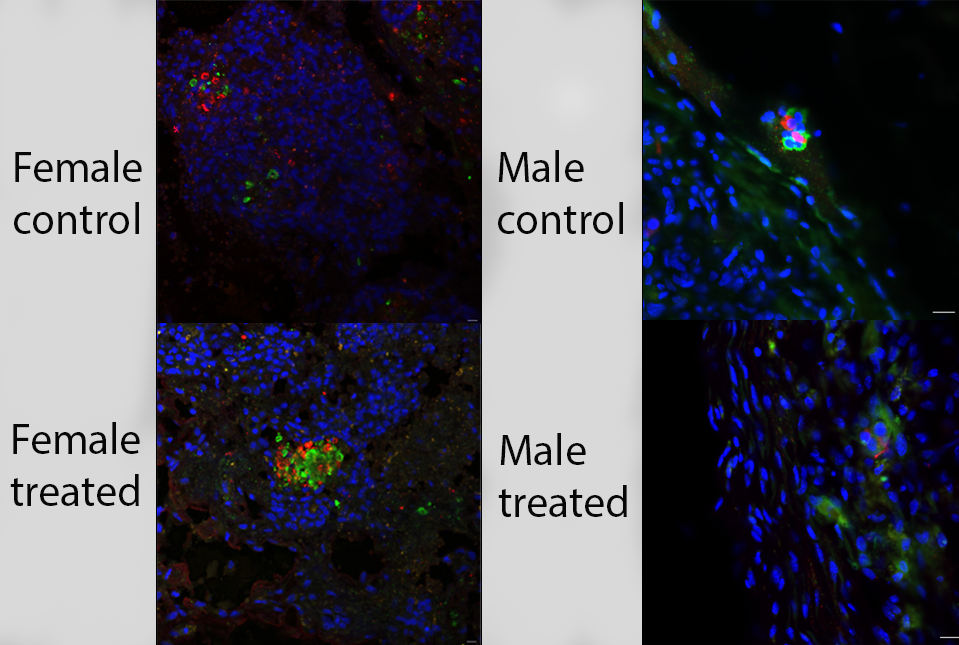
A pretreatment step could help transplanted pancreatic islets survive longer in patients with type 1 diabetes, according to a new preclinical study from Weill Cornell Medicine investigators. One combination of small molecules extended the cells’ lives in female mice, and adding two molecules to the mixture boosted cell survival in male mice.
The findings, published on June 24 in Cell Stem Cell, could allow physicians to treat more patients with fewer cells.
In type 1 diabetes, autoimmune cells attack the pancreatic islets, destroying the insulin-producing beta cells and leaving patients dependent on insulin injections. The current FDA-approved transplant procedure replaces these cells with pancreatic islet cells from one or more deceased organ donors. It typically takes up to 48 hours to isolate islets from the donor for injection into a vein that carries them to the recipient’s liver. Once in the liver, the islet cells begin producing insulin, just as they would in a healthy pancreas.
However, many transplanted cells die soon after the procedure, and complications can arise from targeting the liver. Transplanting the cells under the skin, an option with some potential advantages, also has challenges with dying cells. Dr. Shuibing Chen, the Kilts Family Professor of Surgery and director of the Center for Genomic Health at Weill Cornell Medicine, noted research by others showing that pretreating a type of cell used to replenish blood cell populations during a six-hour period improves their survival after a transplant, so she explored a similar approach for islet cells.
“With our new strategy, we should only need one donor per patient, or maybe one donor could contribute cells to two patients, lessening the waiting time for patients to receive the therapy,” said Dr. Chen, who is also a member of the Hartman Institute for Therapeutic Organ Regeneration at Weill Cornell Medicine.
Small Molecule Cocktails
Determining the best pretreatment approach typically requires several expensive and labor-intensive drug screens, but J. Jeya Vandana, graduate student in the Tri-Institutional PhD Program in Chemical Biology and first author of the paper, had an idea.
“Jeya combined chemical screens with single cell RNA-sequencing technology so that we could check multiple readouts in one experiment,” said Dr. Chen.
With their system, which they call ChemPerturb-Seq, each cell in an experiment receives a unique barcode and is treated for 48 hours with a unique small molecule drug. After the treatment, the team pools the cells and sequences the RNA. The barcode tells the researchers which cells responded well to a certain molecule. All the data are made publicly available through a website called ChemPerturbDB, which is powered by an artificial intelligence assistant that is similar to ChatGPT.

Sex Differences
Performing ChemPerturb-Seq with a human beta cell line led to discovery of a pretreatment they called LIP. This combination of beta-lipotropin, insulin growth factor-1 and prostaglandin E2 boosted the survival of beta cells and human islets from donors when transplanted subcutaneously in a type-1 diabetes mouse model compared to controls. But there was a catch.
“Jeya first transplanted everything into female mice, and the approach worked very well, but when she transplanted the pretreated cells into male mice, it failed,” said Dr. Chen.
Going back to the drawing board, the team used ChemPerturb-Seq to predict other small molecules that could help the cells live longer in males. The result was a cocktail called LIPHS, which included the three LIP molecules plus histamine and serotonin, that was successful in males.
Armed with their new technique, Dr. Chen’s group will conduct more studies to see whether the results hold for additional preclinical models. The team is also adding even more small-molecule data to the website.
Source – Weill Cornell Medicine


A pretreatment step could help transplanted pancreatic islets survive longer in patients with type 1 diabetes, according to a new preclinical study from Weill Cornell Medicine investigators. One combination of small molecules extended the cells’ lives in female mice, and adding two molecules to the mixture boosted cell survival in male mice.
The findings, published on June 24 in Cell Stem Cell, could allow physicians to treat more patients with fewer cells.
In type 1 diabetes, autoimmune cells attack the pancreatic islets, destroying the insulin-producing beta cells and leaving patients dependent on insulin injections. The current FDA-approved transplant procedure replaces these cells with pancreatic islet cells from one or more deceased organ donors. It typically takes up to 48 hours to isolate islets from the donor for injection into a vein that carries them to the recipient’s liver. Once in the liver, the islet cells begin producing insulin, just as they would in a healthy pancreas.
However, many transplanted cells die soon after the procedure, and complications can arise from targeting the liver. Transplanting the cells under the skin, an option with some potential advantages, also has challenges with dying cells. Dr. Shuibing Chen, the Kilts Family Professor of Surgery and director of the Center for Genomic Health at Weill Cornell Medicine, noted research by others showing that pretreating a type of cell used to replenish blood cell populations during a six-hour period improves their survival after a transplant, so she explored a similar approach for islet cells.
Small Molecule Cocktails
Determining the best pretreatment approach typically requires several expensive and labor-intensive drug screens, but J. Jeya Vandana, graduate student in the Tri-Institutional PhD Program in Chemical Biology and first author of the paper, had an idea.
With their system, which they call ChemPerturb-Seq, each cell in an experiment receives a unique barcode and is treated for 48 hours with a unique small molecule drug. After the treatment, the team pools the cells and sequences the RNA. The barcode tells the researchers which cells responded well to a certain molecule. All the data are made publicly available through a website called ChemPerturbDB, which is powered by an artificial intelligence assistant that is similar to ChatGPT.
Sex Differences
Performing ChemPerturb-Seq with a human beta cell line led to discovery of a pretreatment they called LIP. This combination of beta-lipotropin, insulin growth factor-1 and prostaglandin E2 boosted the survival of beta cells and human islets from donors when transplanted subcutaneously in a type-1 diabetes mouse model compared to controls. But there was a catch.
Going back to the drawing board, the team used ChemPerturb-Seq to predict other small molecules that could help the cells live longer in males. The result was a cocktail called LIPHS, which included the three LIP molecules plus histamine and serotonin, that was successful in males.
Armed with their new technique, Dr. Chen’s group will conduct more studies to see whether the results hold for additional preclinical models. The team is also adding even more small-molecule data to the website.
Source – Weill Cornell Medicine
Vandana J, Zhu J, Giani A M, Zhang T, Lacko L A, Leng D, Taylor D L, Lee B N, Han Z, Jiao T, Huang Y, Zhao M, Liu X, Chong A C N, Xue D, Meng Z, Xiang J Z, Pan C, Wang W, Naji A, Evans T, Liu J, Collins F S, Liu C, Chen S. (2025) ChemPerturb-seq screen identifies a small molecule cocktail enhancing human beta cell survival after subcutaneous transplantation. Cell Stem Cell S1934-5909(25)00224-3. [article]
Related Posts
Scientists identify the neuroblastoma cells that signal poor outcomes
Novel biosensor uses DNA ‘barcodes’ to uncover disease signals in cells
CellART extracts single-cell information from high-resolution spatial transcriptomics
Cell2space restores spatial context to single-cell RNA sequencing data
Urine test may improve bladder cancer diagnosis and guide treatment decisions
DeCoRE – a computational method to resolve RNA structural heterogeneity from RNA structure probing data by direct RNA sequencing
Tracing 700 million years of cell evolution
How should biological replicates be handled in long-read RNA sequencing?
RNA-Seq reveals a new way the developing heart controls its growth
The Human RNome Project Consortium seeks to publish first-ever complete sequence of the body’s RNA
scFlowReport brings multiple single-cell RNA sequencing analyses into one workflow
Long-read RNA sequencing reveals how neurons choose alternative RNA endings
DeOPUS improves cell-type estimates from bulk RNA sequencing
ResolVI improves accuracy in spatial transcriptomics analysis
RNA sequencing reveals transcriptional allele differences in prostate cancer stem cells
Unmasking “zombie cells” in aging tissue with an AI-powered barcode
Single-cell TimeLapse-seq reveals MTA is an essential retrotransposon
RNA variant imaging for cancer diagnosis
Autism-risk mutations reveal two opposing patterns of brain gene activity
A real-data approach to evaluating RNA transcript analysis methods
Stay Connected
Submit a Post to the Blog
Recent Posts
Subscribe to the RNA-Seq Blog
RNA-Seq Products & Services