Since the COVID-19 pandemic, mRNA vaccines have been attracting attention as a next-generation pharmaceutical technology. mRNA medicines deliver genetic information that directs cells to produce specific proteins, resulting in therapeutic effects. However, limitations have been raised, such as reduced efficacy in the elderly or obese. To address this issue, a team of Korean researchers has redesigned a key mRNA region that enhances therapeutic protein production efficiency, developing a next-generation mRNA platform that maintains efficacy even in aging and obesity settings.
A joint research team led by Professor Young-Seok Lee of the Department of Bio at the Korea Advanced Institute of Science and Technology and Brain Engineering and Professor Jae-Hwan Nam of The Catholic University of Korea (President Jun-Kyu Choi) developed a new mRNA platform that precisely designed the sequence of the ‘5’ untranslated region (5’UTR)*’, a key regulatory region of mRNA.
*5′ untranslated region (5’UTR): This is the section of mRNA that initiates protein production and controls efficiency, and the amount and speed of protein production can vary depending on the design of this section.
By analyzing vast bioinformatics data, the research team identified 5′UTR sequences that enhance protein production in diverse cellular environments. Applying these sequences, they confirmed significant improvements in protein production and immune response in preclinical models of aging and obesity.
mRNA is a long, single-stranded RNA molecule, the blueprint for creating the proteins our bodies need. mRNA consists of a 5′ untranslated region (UTR), which initiates and regulates protein production; a coding sequence (CDS), which contains the information for a specific protein; a 3′ untranslated region (3′UTR), which helps maintain mRNA stability within the cell; and a poly(A) tail, which enhances stability and aids protein production.
Among these, the 5’UTR and 3’UTR do not determine the type of protein, but they are crucial regions that regulate the efficiency of protein production. Because of these characteristics, these two regions are attracting attention as key bioengineering platform technologies for enhancing the performance of various mRNA pharmaceuticals, including vaccines and therapeutics.
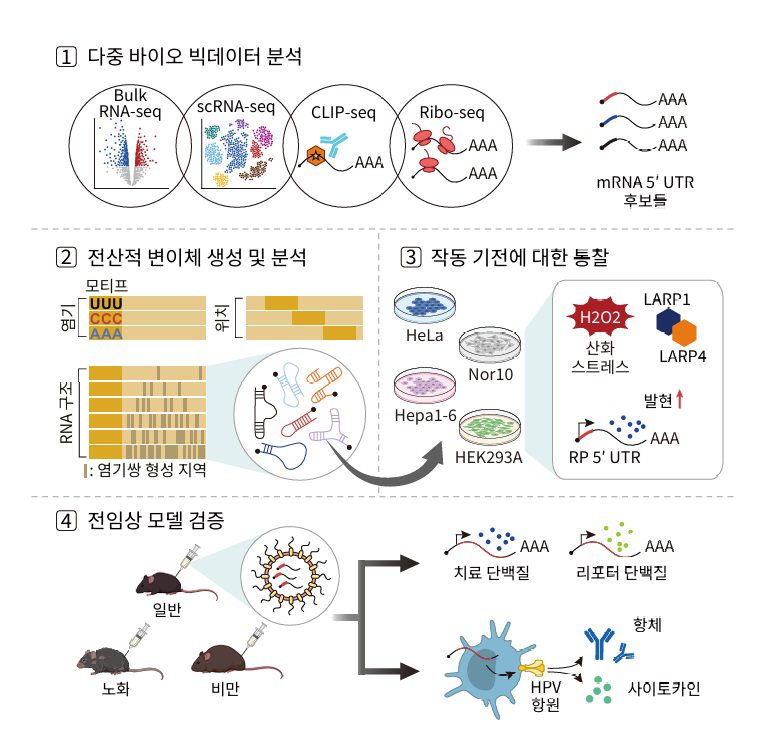
Schematic diagram of mRNA drug design and validation using bioinformatics
The research team integrated and analyzed large-scale biodata to identify 5′UTR sequences with high protein production capacity across various tissues and cellular environments. This process utilized a variety of analytical techniques, including large-scale tissue transcriptome analysis (RNA-seq), which analyzes gene activity; single-cell transcriptome analysis (scRNA-seq), which determines gene expression at the individual cell level; and ribosome profiling (Ribo-seq), which measures actual protein production efficiency.
The research team noted that aging and obesity can lead to increased cell stress (oxidative stress), which can impair the ability to produce proteins. Applying the newly designed mRNA therapeutic to preclinical models of aging and obesity, they confirmed a significant increase in the production of proteins produced by cells and immune responses. This research is expected to be applied not only to mRNA vaccines but also to the development of various biopharmaceutical technologies, including gene therapies and immunotherapies.

mRNA Drug Design Based on Multi-Bio Big Data Analysis (AI-Generated Images)
Professor Young-Seok Lee of KAIST’s Department of Bio and Brain Engineering said, “This study analyzed a large amount of biological data and discovered a design method to make mRNA better at making proteins.” He added, “This technology will serve as an important foundation for ensuring that mRNA vaccines and therapeutics work well even in environments where the drug’s effectiveness may be reduced, such as the elderly or obese patients.”
Source – Kaist


Since the COVID-19 pandemic, mRNA vaccines have been attracting attention as a next-generation pharmaceutical technology. mRNA medicines deliver genetic information that directs cells to produce specific proteins, resulting in therapeutic effects. However, limitations have been raised, such as reduced efficacy in the elderly or obese. To address this issue, a team of Korean researchers has redesigned a key mRNA region that enhances therapeutic protein production efficiency, developing a next-generation mRNA platform that maintains efficacy even in aging and obesity settings.
A joint research team led by Professor Young-Seok Lee of the Department of Bio at the Korea Advanced Institute of Science and Technology and Brain Engineering and Professor Jae-Hwan Nam of The Catholic University of Korea (President Jun-Kyu Choi) developed a new mRNA platform that precisely designed the sequence of the ‘5’ untranslated region (5’UTR)*’, a key regulatory region of mRNA.
*5′ untranslated region (5’UTR): This is the section of mRNA that initiates protein production and controls efficiency, and the amount and speed of protein production can vary depending on the design of this section.
By analyzing vast bioinformatics data, the research team identified 5′UTR sequences that enhance protein production in diverse cellular environments. Applying these sequences, they confirmed significant improvements in protein production and immune response in preclinical models of aging and obesity.
mRNA is a long, single-stranded RNA molecule, the blueprint for creating the proteins our bodies need. mRNA consists of a 5′ untranslated region (UTR), which initiates and regulates protein production; a coding sequence (CDS), which contains the information for a specific protein; a 3′ untranslated region (3′UTR), which helps maintain mRNA stability within the cell; and a poly(A) tail, which enhances stability and aids protein production.
Among these, the 5’UTR and 3’UTR do not determine the type of protein, but they are crucial regions that regulate the efficiency of protein production. Because of these characteristics, these two regions are attracting attention as key bioengineering platform technologies for enhancing the performance of various mRNA pharmaceuticals, including vaccines and therapeutics.
Schematic diagram of mRNA drug design and validation using bioinformatics
The research team integrated and analyzed large-scale biodata to identify 5′UTR sequences with high protein production capacity across various tissues and cellular environments. This process utilized a variety of analytical techniques, including large-scale tissue transcriptome analysis (RNA-seq), which analyzes gene activity; single-cell transcriptome analysis (scRNA-seq), which determines gene expression at the individual cell level; and ribosome profiling (Ribo-seq), which measures actual protein production efficiency.
The research team noted that aging and obesity can lead to increased cell stress (oxidative stress), which can impair the ability to produce proteins. Applying the newly designed mRNA therapeutic to preclinical models of aging and obesity, they confirmed a significant increase in the production of proteins produced by cells and immune responses. This research is expected to be applied not only to mRNA vaccines but also to the development of various biopharmaceutical technologies, including gene therapies and immunotherapies.
mRNA Drug Design Based on Multi-Bio Big Data Analysis (AI-Generated Images)
Source – Kaist
Yoon S, Cho H, Lee J, Ha S, Lee S, Lee YS, Cho Y, Ha D, Oh A, Lee S, Jeong D, Cho J, Park SI, Nam JH, Lee YS. (2026) Designing 5′ UTR sequences improves the capacity of mRNA therapeutics in preclinical models of aging and obesity. Molecular Therapy [Epub ahead of print]. [article]
Related Posts
RNAmel simplifies RNA sequencing data analysis with a reproducible, integrated platform
Heart failure reshapes bone marrow to create inflammation-related immune memory
Overlooked DNA regions surrounding ‘microexons’ hold missing pieces of autism’s genetic puzzle
RiboBA improves detection of hidden protein-coding regions using ribosome profiling
An anti-senescence gene may fight spinal disc deterioration
Scientists identify the neuroblastoma cells that signal poor outcomes
Novel biosensor uses DNA ‘barcodes’ to uncover disease signals in cells
CellART extracts single-cell information from high-resolution spatial transcriptomics
Cell2space restores spatial context to single-cell RNA sequencing data
Urine test may improve bladder cancer diagnosis and guide treatment decisions
DeCoRE – a computational method to resolve RNA structural heterogeneity from RNA structure probing data by direct RNA sequencing
Tracing 700 million years of cell evolution
How should biological replicates be handled in long-read RNA sequencing?
RNA-Seq reveals a new way the developing heart controls its growth
The Human RNome Project Consortium seeks to publish first-ever complete sequence of the body’s RNA
scFlowReport brings multiple single-cell RNA sequencing analyses into one workflow
Long-read RNA sequencing reveals how neurons choose alternative RNA endings
DeOPUS improves cell-type estimates from bulk RNA sequencing
ResolVI improves accuracy in spatial transcriptomics analysis
RNA sequencing reveals transcriptional allele differences in prostate cancer stem cells
Stay Connected
Submit a Post to the Blog
Recent Posts
Subscribe to the RNA-Seq Blog
RNA-Seq Products & Services